
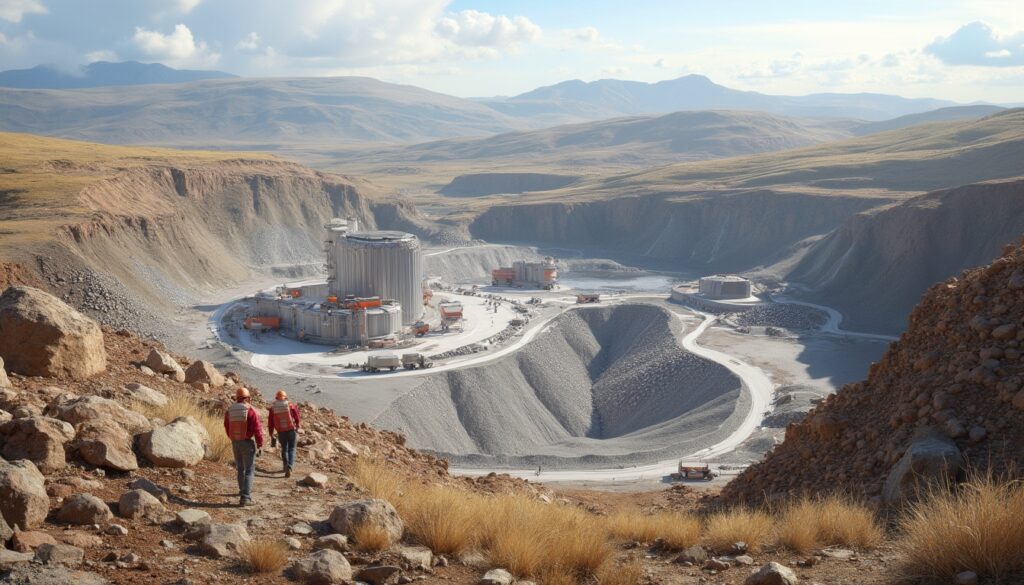
WASHINGTON, July 14 — The strategic calculus behind America’s rare earth supply chain runs through a single mine in the California desert, and the man who bet his career on reviving it is now pressing Washington for the next move. James Litinsky, founder, chairman, and CEO of MP Materials, owns and operates the Mountain Pass rare earth mine. That facility, once left for dead after its previous owner Molycorp filed for bankruptcy in 2015, now stands as the only operating rare earth mine on U.S. soil.
Litinsky led the acquisition of Mountain Pass in 2017, raising $500 million in equity and debt to restart operations. The mine reopened in 2018.
From hedge fund to hardrock mining
Litinsky is not a career miner. He co-founded JHL Capital Group, a Chicago-based hedge fund, in 2007. He holds a B.A. in political science from the University of Michigan and a J.D. from Harvard Law School.
That legal and financial background shaped his approach to what he saw as a national security vulnerability: America’s near-total dependence on China for processed rare earth materials used in everything from F-35 fighter jets to electric vehicle motors. Under Litinsky’s leadership, MP Materials went public in November 2020 through a merger with Fortress Value Acquisition Corp., a special purpose acquisition company.
The deal valued the company at $1.47 billion. The stock trades on the New York Stock Exchange under the ticker MP. By 2022, MP Materials reported revenue of $523 million and net income of $340 million.
Those numbers reflect the early-stage economics of a company that mines rare earth concentrate but still ships most of it overseas for processing — a gap Litinsky has been working to close.
The processing bottleneck
Mining is only the first step. Rare earth elements must be separated into individual oxides and then turned into metals and magnets. That downstream capacity barely exists in the United States today.
Litinsky has made building it the central mission of his tenure. He testified before the U.S. Senate Committee on Energy and Natural Resources in 2021, urging passage of the Energy Act of 2020 and the Critical Minerals Independence Act.
The broader stakes, as he framed them for lawmakers, are straightforward: without domestic processing and magnet manufacturing, the United States remains vulnerable to supply disruptions from China, which dominates global rare earth refining. In 2022, MP Materials received a $35 million grant from the U.S. Department of Defense for a separation facility. That grant signals the Pentagon’s recognition that rare earth supply chains are a national security issue, not merely a commercial one.
What this signals for critical minerals policy
Litinsky also sits on the board of directors of the National Mining Association, giving him a direct line to the broader mining industry’s policy priorities. His advocacy blends corporate interest with a geopolitical argument: that the United States cannot afford to remain dependent on adversarial nations for materials essential to defense and advanced manufacturing. The calculus for Washington is whether to invest further in domestic processing capacity or continue relying on allies and market forces.
MP Materials has demonstrated that a U.S. rare earth mine can operate profitably. The next question — whether the full supply chain from mine to magnet can be rebuilt on American soil — remains open.
What to watch: whether the current administration pursues additional grants or loan guarantees for downstream rare earth facilities, and whether MP Materials can scale its separation and magnet production fast enough to meet both commercial and defense demand.




