
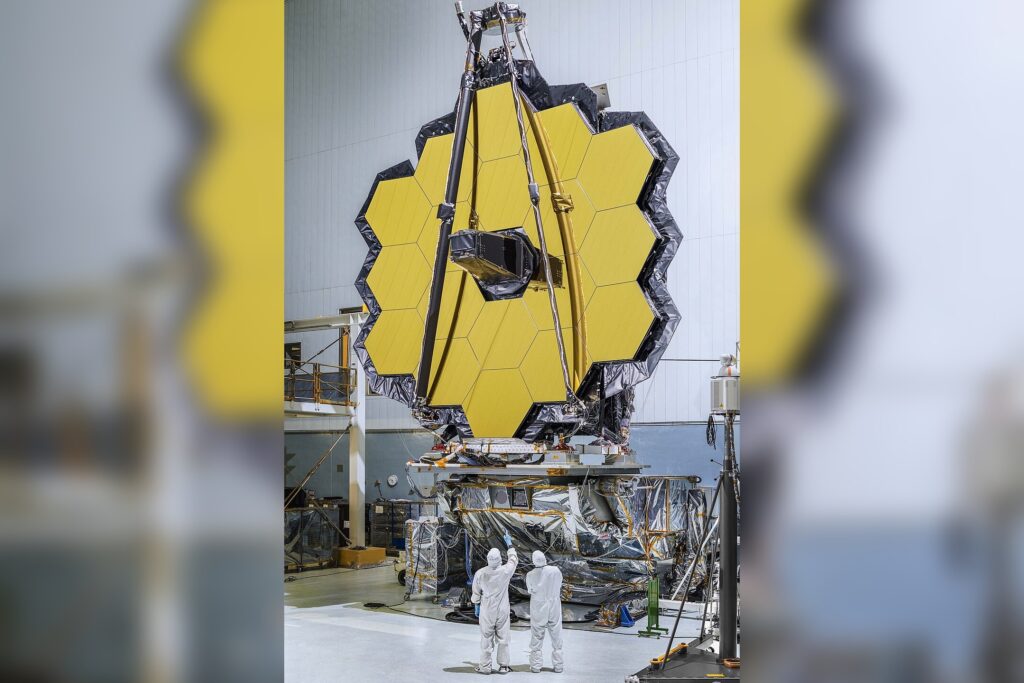
GUIANA SPACE CENTRE, August 3 — The sheer ambition of space exploration often hinges on the reliability of the hardware that gets it off the ground. Nearly five years ago, on December 25, 2021, the venerable Ariane 5 heavy-lift launch vehicle executed what was arguably one of its most critical missions: delivering the James Webb Space Telescope (JWST) to its precise trajectory.
This launch, from the European Space Agency’s (ESA) Guiana Space Centre in French Guiana, underscored the Ariane 5’s enduring legacy, a vehicle that has been in service since 1996.
The Precision of Launch
The selection of the Ariane 5 for the JWST mission was a testament to its established reliability and its capacity to place payloads with exceptional accuracy. The technical reality of this mission demanded nothing less, as the telescope was destined for the Sun-Earth L2 Lagrange point, a location 1.5 million kilometers from Earth. This specific orbital sweet spot, one of five such points in the Earth-Sun system, allows the JWST to maintain a stable position relative to Earth, drastically minimising the fuel required for station-keeping.
It’s the kind of detail that matters when planning for a scientific platform designed for decades of operation. The journey to L2 itself was approximately 30 days, a period during which the telescope underwent a complex and nail-biting deployment sequence.
This wasn’t merely a case of reaching an orbit; it was about orchestrating a ballet of unfolding components millions of kilometres away. Under the hood, the engineering marvels continued to reveal themselves.
Unfolding a Celestial Eye
The deployment sequence involved the unfurling of the telescope’s 6.5-meter primary mirror, a marvel of materials science composed of 18 hexagonal beryllium segments, each meticulously coated in gold. Equally critical was the unfurling of its five-layer sunshield, an assembly the size of a tennis court. This sunshield is not merely a shade; it is indispensable for cooling the telescope’s instruments to near absolute zero, specifically -273.15°C.
Without this extreme thermal regulation, the infrared observations, the very purpose of JWST, would be rendered impossible due to interference from the Sun, Earth, and Moon. As ever, the physics dictates the engineering.
This entire endeavour, from initial concept to operational deployment, was the culmination of over two decades of development, with construction commencing in 2004. The project’s total cost, exceeding $10 billion, positions JWST as one of the most expensive scientific platforms ever constructed. It stands as a powerful demonstration of what can be achieved through sustained international collaboration.
A Global Engineering Feat
The scale of this undertaking also highlights the deep international cooperation that underpins modern space exploration. The mission was a tripartite effort involving NASA, the European Space Agency (ESA), and the Canadian Space Agency (CSA). ESA’s contribution of the Ariane 5 launch vehicle was, of course, pivotal in getting the telescope off Earth.
The CSA, for its part, provided key instruments, including the Fine Guidance Sensor (FGS) and the Near Infrared Imager and Slitless Spectrograph (NIRISS), both essential for the telescope’s operational capabilities. The successful launch and intricate deployment of the JWST via the Ariane 5 rocket represent a high-water mark in precision engineering and international scientific partnership.
The capabilities unlocked by such a feat continue to reshape our understanding of the cosmos, hinting at further breakthroughs as this remarkable instrument continues its work at L2.




