
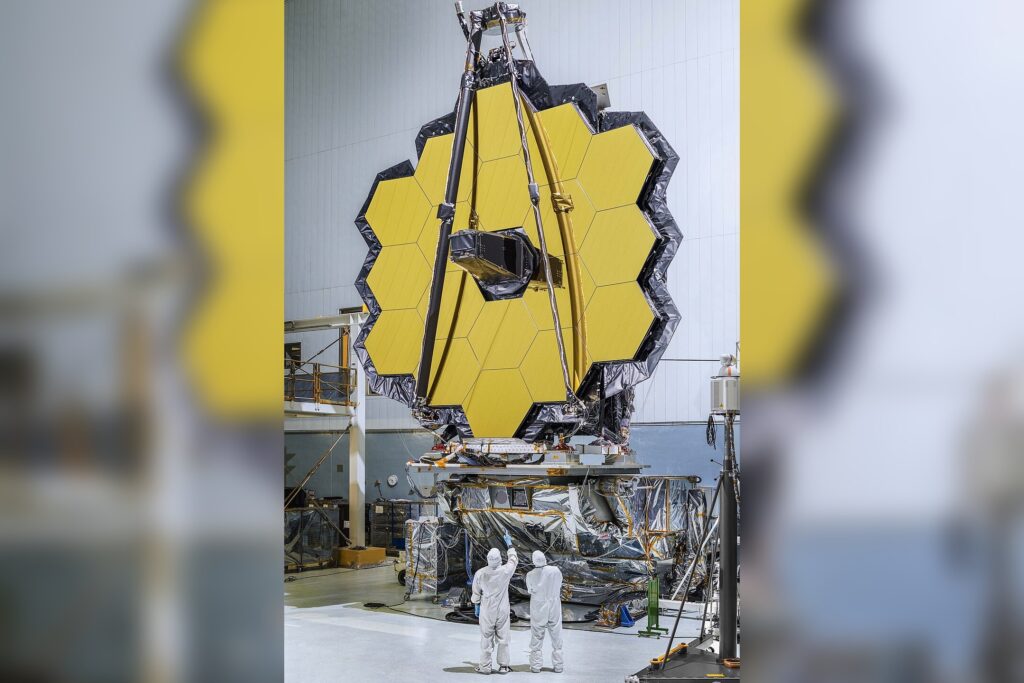
Spectroscopy of 200 galaxies at once: that is what the Near Infrared Spectrograph, or NIRSpec, on the James Webb Space Telescope can do in its multi-object mode. It is the instrument now doing the most to settle how early galaxies grew.
The Hubble Space Telescope could not do this work at high redshift. At those distances it sees rest-frame ultraviolet light and only has the sensitivity to map the brightest galaxies. A large population was missed, either because its ultraviolet glow is faint or because dust blocks it. Webb’s near- and mid-infrared coverage picks up the same galaxies at rest-frame optical wavelengths.
Two surprises from the first months
In its first months of science observations, Webb’s Near-Infrared Camera detected several thousand objects that Hubble and ground-based telescopes had missed. Two findings stood out.
The first was maturity. Several groups reported that galaxies at redshift 2 to 4, when the universe was 1.5 to 3.0 billion years old, already show the orderly structures seen today. Hubble had suggested early galaxies were clumpier and less disky. Some objects that looked clumpy in Hubble images appear as smooth disks with spiral arms in Webb’s.
Imaging cannot settle whether those disks truly rotate, because a galaxy’s tilt on the sky is random. Spectroscopy can. Using NIRSpec, de Graaff and colleagues studied the motion of six galaxies at redshifts of about 6 to 7, all low in mass and compact. Some showed clear rotation. Others were highly turbulent. A separate team, led by Nelson, found a very massive galaxy whose motions resembled those of galaxies much closer to us in time.
The second surprise was brightness. Many of the new sources looked extraordinarily bright for their estimated redshift, or unusually red. Some were thought to be very massive already at an early epoch, and a subset appeared to be in tension with established models of cosmology or galaxy formation, because their estimated masses exceeded what the models allow.
A test case
Imaging alone could not say what these sources are. Kocevski and colleagues pointed NIRSpec at one of the candidates flagged by Labbe and colleagues, as part of the CEERS program. The spectrum put it at a redshift of 5.6, not the 8.3 estimated from imaging. It also showed a broad emission line, evidence of a luminous active galactic nucleus.
That meant the earlier mass estimate was too high. It had assumed all the light came from stars.
Many massive candidates remain, and it is not yet clear whether all of them will turn out to host actively feeding black holes or whether some really are too massive for current theory. Follow-up NIRSpec observations targeting them are planned for Cycle 2, in programs 4106 and 4233. Large spectroscopic surveys are expected to cover more than 15,000 sources at redshifts above 1 by the end of 2024.




