
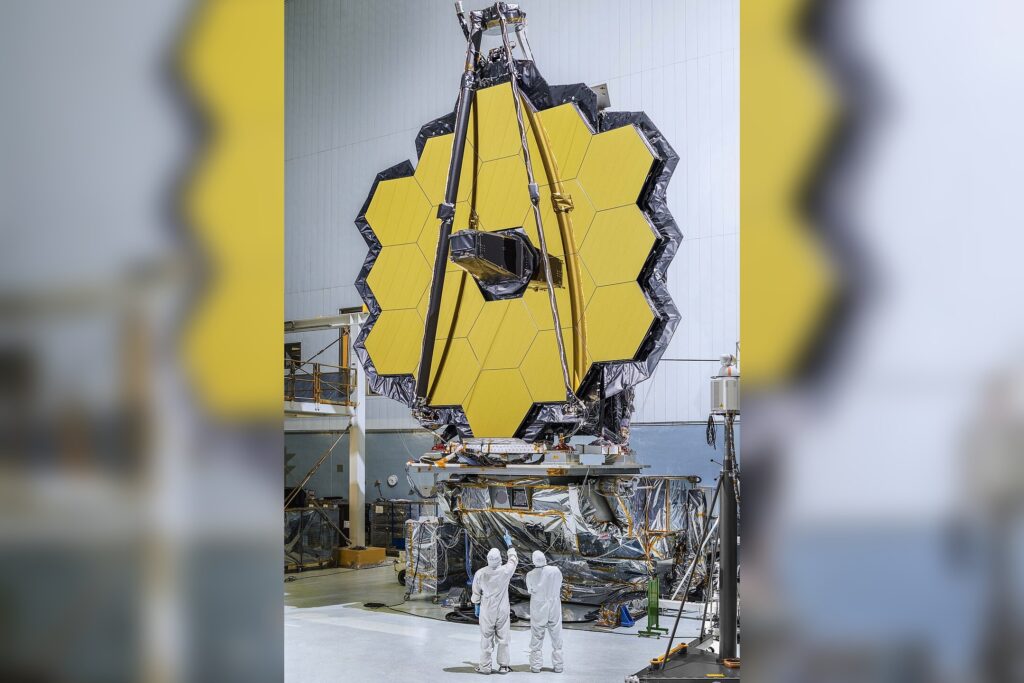
KOUROU, August 3 — From its silent perch, millions of kilometers from our pale blue dot, the James Webb Space Telescope continues to rewrite the story of the cosmos. Launched on December 25, 2021, from the Guiana Space Centre aboard an Ariane 5 rocket, this collaborative marvel, a joint endeavor by NASA, the European Space Agency, and the Canadian Space Agency, stands today as the largest and most powerful space telescope ever built, offering humanity an unprecedented window into the universe’s earliest moments.
Positioned at the Sun-Earth L2 Lagrange point, approximately 1.5 million kilometers from Earth, JWST’s sheer scale dwarfs its predecessors. Its primary mirror, a vast 6.5 meters in diameter, allows it to gather light with a potency far exceeding the Hubble Space Telescope’s 2.4-meter mirror.
Designed specifically to observe in infrared wavelengths, this remarkable instrument can pierce through the obscuring dust clouds that have long hidden the universe’s infancy, detecting light from stars and galaxies that formed a mere 200-300 million years after the Big Bang itself. The immediate impact of this new vision was felt in July 2022, when NASA released JWST’s first full-color images. Among them was “Webb’s First Deep Field,” a breathtaking, deepest and sharpest infrared image of the distant universe ever captured.
It revealed the galaxy cluster SMACS 0723 as it appeared a staggering 4.6 billion years ago, a cosmic snapshot that instantly expanded our understanding of ancient celestial structures.
Unveiling the Early Universe
These initial glimpses were just the beginning. Subsequent observations have since pushed the boundaries even further, revealing galaxies with redshifts greater than 10. This corresponds to a time when the universe was less than 500 million years old, offering direct evidence of celestial bodies far earlier than previously observed.
What these findings bring into sharp focus are fundamental challenges to existing models of galaxy formation, suggesting that these early galaxies were not only more massive but also more mature and numerous than scientists had long theorized. The sheer capability of JWST lies in its suite of advanced instruments.
The Near Infrared Camera (NIRCam), Near Infrared Spectrograph (NIRSpec), and Mid-Infrared Instrument (MIRI) work in concert, providing the tools necessary for groundbreaking scientific inquiry. These instruments allow researchers to meticulously analyze the atmospheric compositions of exoplanets, offering clues to their habitability. They also enable detailed studies of how stars and planetary systems form from nebulae, tracing the very genesis of worlds.
The Tools of Discovery
Beyond these immediate insights, the telescope is actively investigating the profound question of the origins of life itself, seeking the chemical signatures in distant worlds that could hint at biological processes. With an estimated mission lifetime of 5-10 years, and a potential extension to 20 years depending on factors like fuel efficiency and instrument performance, the James Webb Space Telescope continues its relentless journey, promising a steady stream of discoveries that will redefine our place in the universe for years to come.
Sources
{“@context”: “https://schema.org”, “@type”: “NewsArticle”, “headline”: “James Webb Telescope Alters Early Universe Timeline”, “description”: “KOUROU, August 3 — From its silent perch, millions of kilometers from our pale blue dot, the James Webb Space Telescope continues to rewrite the…”, “datePublished”: “2026-08-03T09:30:00+00:00”, “author”: {“@type”: “Person”, “name”: “Isabella Moore”}, “publisher”: {“@type”: “Organization”, “name”: “InfoPulse Today”, “url”: “https://newsfeed.2bme.xyz/”}, “citation”: [{“@type”: “CreativeWork”, “url”: “https://en.wikipedia.org/wiki/James_Webb_Space_Telescope”}]}




