
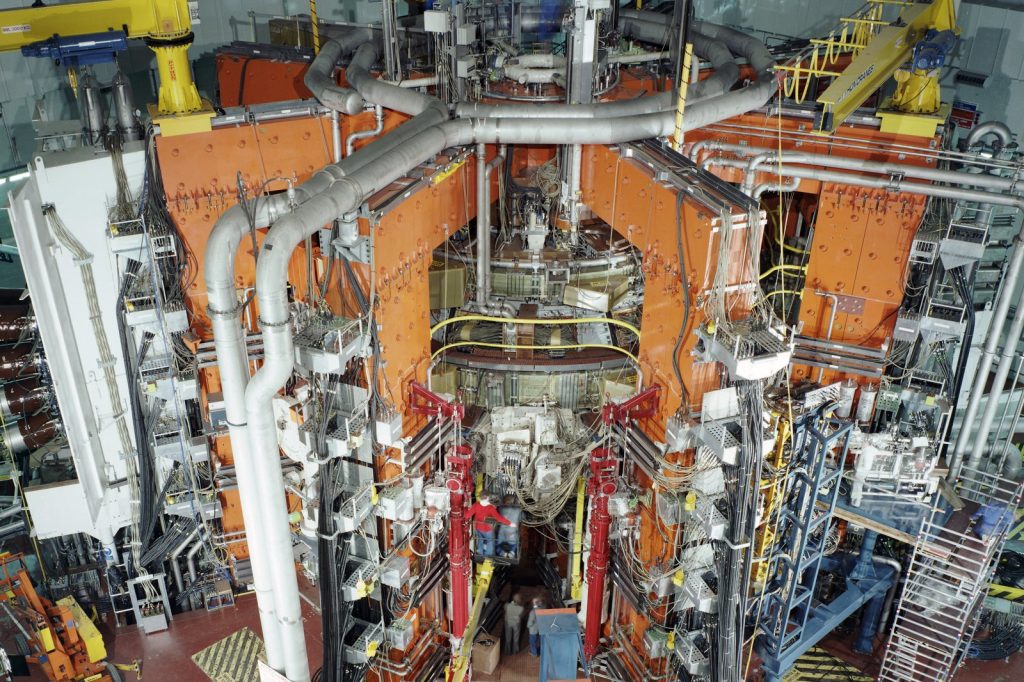
The Joint European Torus sits cold in the Oxfordshire countryside. Its last pulse ran in December 2023, and the job of taking it apart is expected to run until 2040.
JET was a tokamak, a magnetically confined plasma experiment, built at the Culham Centre for Fusion Energy as a joint European project. When it was designed, nothing comparable was bigger. It started up in 1983 and spent most of the following decade pushing its performance higher through experiment after experiment and upgrade after upgrade.
In 1991 it ran its first tritium experiments, which made it the first reactor anywhere to burn the 50-50 tritium and deuterium mix a power plant would use. A divertor went in between 1991 and 1993, and performance improved sharply. In 1997 JET came closer to scientific breakeven than any machine before it, reaching Q = 0.67. It produced 16 megawatts of fusion power while 24 megawatts of thermal power went in to heat the fuel.
Not breakeven, then. But close.
Preparing the ground for ITER
From 2009 to 2011 the machine was shut down and rebuilt to adopt concepts from ITER, the larger reactor taking shape at Saint-Paul-lès-Durance in Provence. A tritium upgrade began in December 2020, again as part of JET’s contribution to ITER.
The experiment’s stated aims were always about scaling up. Researchers wanted to know how plasma behaves as conditions approach those of a reactor, how it interacts with the wall around it, and how extra heating methods such as neutral beam injection and ion cyclotron resonance perform. They also wanted to see how alpha particles from fusion reactions are produced and confined, and how they heat the plasma in turn.
A gap before ITER
The closure was announced at the IAEA Fusion Energy Conference in London in October 2023. Almost at once a group calling itself Scientists for JET launched a petition asking for the decision to be reviewed.
Their worry is a stretch of years with no fusion experiments. JET’s end date, they argue, was set on the assumption that ITER would be running by then. ITER’s start-up has since slipped, and its deuterium-tritium reactions are scheduled only for 2039. Along the way, they fear, research time and trained staff will be lost.




