
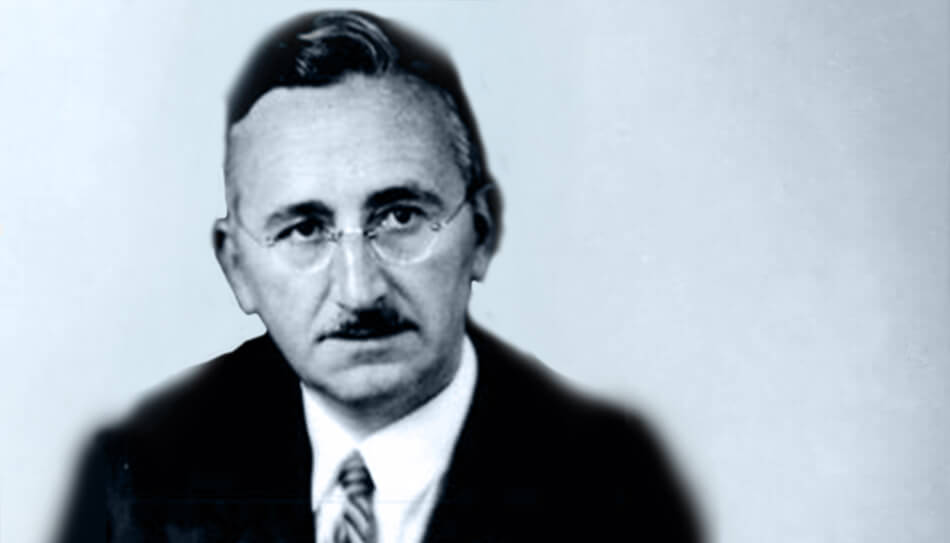
Winston Churchill went on the radio in 1945 and told voters that a socialist government would “have to fall back on some form of Gestapo.” Harold Macmillan later said Churchill had been “fortified in his apprehensions” by a book he had just read: Friedrich Hayek’s The Road to Serfdom.
Labour leader Clement Attlee answered in his own broadcast. Churchill’s speech, he said, was the “second-hand version of the academic views of an Austrian professor, Friedrich August von Hayek.” The Conservative Central Office gave up 1.5 tons of its scarce paper ration for the campaign so more copies could be printed. Labour won in a landslide anyway.
A wartime bestseller
Routledge first published the book in Britain in March 1944, with the war still on. Paper was rationed, copies were hard to find, and Hayek took to calling it “that unobtainable book.”
The American road to print was rougher. Three US publishers turned it down. Only after the economist Aaron Director talked to friends at the University of Chicago did the university’s press agree, and it released the book on September 18, 1944. The press expected to sell somewhere between 900 and 3,000 copies. The first printing of 2,000 sold out quickly, and 30,000 copies were gone within six months.
A 20-page version ran in Reader’s Digest in April 1945, with a press run of several million. Look magazine published a picture-book edition that February, and General Motors later handed out a pamphlet version.
What Hayek argued
Hayek had started thinking about the subject at the London School of Economics in the early 1930s. He wrote a memo to William Beveridge, then the school’s director, disputing the popular claim that fascism was the dying gasp of a failed capitalism. The memo became a magazine article, and the article grew into this book.
His case was blunt. Western democracies, including Britain and the United States, had “progressively abandoned that freedom in economic affairs without which personal and political freedom has never existed in the past.” Planning, he held, needs the will of a small minority imposed on everyone else, and that destroys the rule of law. He drew a line between the two systems: “While the last resort of a competitive economy is the bailiff, the ultimate sanction of a planned economy is the hangman.” He also argued that fascism, Nazism and state socialism shared roots in central economic planning, and he wrote that the admiration of power and the enthusiasm for “organization” of everything were “scarcely less marked in England now than they were in Germany.”
The book was dedicated “To the socialists of all parties.”
Hayek was no anarchist, though. He accepted rules that limit poisonous substances or working hours, as long as they apply to everyone and the benefits outweigh the costs. He allowed that the market cannot contain every harm, such as smoke and noise from factories, and he called fraud prevention “a great and by no means fully accomplished object of legislative activity.” He also backed a floor under the poorest: “some minimum of food, shelter, and clothing, sufficient to preserve health.” His own summary: “In no system that could be rationally defended would the state just do nothing.”
After publication he also pushed back on how people read his terms. By “socialism” he meant state control of the economy, not a welfare state.
Afterlife
The University of Chicago Press issued a “Definitive Edition” in 2007. In June 2010 the book hit the top of the Amazon.com bestseller list after extended coverage on The Glenn Beck Program, and it has sold another 250,000 copies since. It has been translated into around 20 languages and had sold over two million copies by 2010.




