
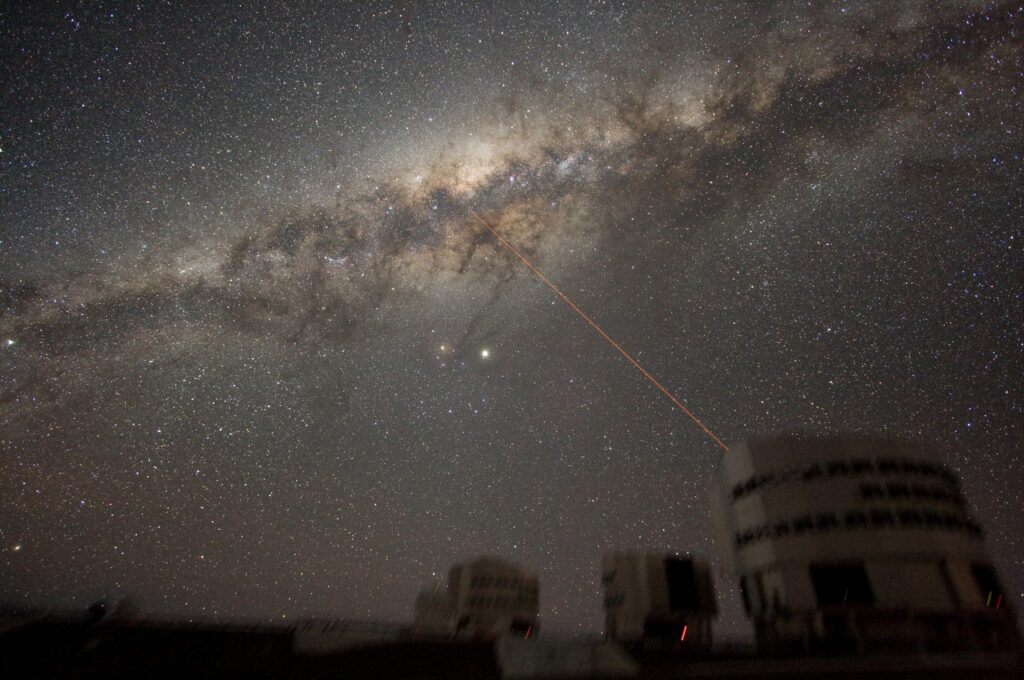
“It’s a big part of our connection to the cosmos, and it’s been lost,” said Christopher Elvidge, a scientist with the US National Oceanic and Atmospheric Administration. He was talking about the Milky Way, which whole generations of North Americans have never seen.
Elvidge is a co-author of a global atlas of light pollution published in the journal Science Advances. Its findings were stark. More than four-fifths of people live under skies polluted by artificial light, and for more than a third of humanity the Milky Way is blotted out. Nearly 80 percent of North Americans and 60 percent of Europeans can no longer see it.
“I hope that this atlas will finally open the eyes of people to light pollution,” lead author Fabio Falchi said. He works at the Light Pollution Science and Technology Institute in northern Italy. The atlas rests on new satellite data and special software.
Who has it worst
Singapore tops the list. Its entire population lives where the true night sky is gone. Kuwait and Qatar are close behind. At the other end, Chad, the Central African Republic and Madagascar have the least light pollution.
A separate estimate puts 83 percent of the world’s people, including 99 percent of Europeans and Americans, beneath skies more than 10 percent brighter than natural darkness. About 23 percent of the world’s land area is affected by skyglow. The lit area keeps growing: globally, light pollution rose by at least 49 percent from 1992 to 2017, and by 16 percent between 2014 and 2022.
The trend is not the same everywhere. France cut its light pollution by 33 percent over that later period, through policy.
The harm
Skyglow is the bright haze over cities, made when artificial light bounces off particles in the atmosphere. It washes out the stars and the Milky Way. Light pollution is also blamed for damaging health and disrupting ecosystems. Falchi and his colleagues say the damage goes past astronomy. Artificial light can confuse insects, birds and sea turtles, sometimes with deadly results, and it wastes energy and money.
Even protected land is not safe. Dan Duriscoe of the US National Park Service, another co-author, noted that parks in the West such as Yellowstone are among the last refuges of darkness in the country. City light from a few hundred miles away can still spoil the view in a place like Death Valley National Park in Southern California.
The fixes sound simple: adjust fixtures, use more suitable bulbs, and educate the public to push for new laws. Because people make the problem, though, the cleanup involves political, social and economic choices. Satellite constellations such as Starlink add a new worry, and astronomers have petitioned over them.
Sources
- Light pollution – Wikipedia
- Losing a 'connection to the cosmos': Lights drown out Milky Way for third of world's population | CBC News




