
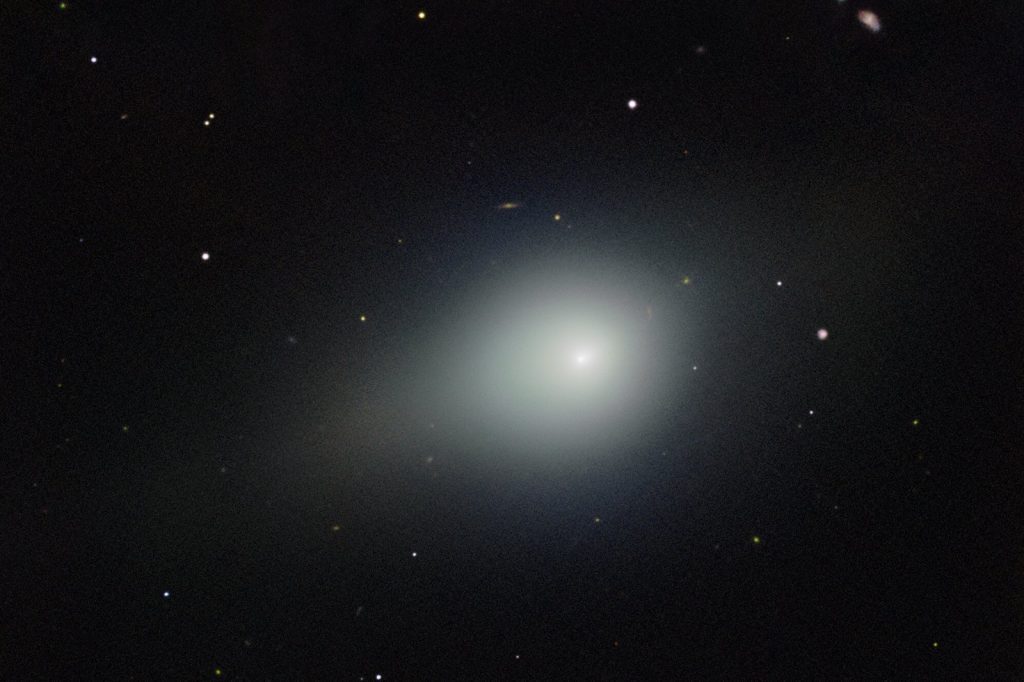
The European Space Agency’s JUICE spacecraft, launched in 2023 with a primary mission to study Jupiter’s icy moons, has captured the best images yet of an interstellar object. In July 2025, astronomers detected a small, fast-moving object in telescope surveys.
Its unusual speed and steep trajectory indicated it was not from our solar system. That object, designated Comet 3I/ATLAS, had completed a journey beginning billions of years ago near the center of the Milky Way. JUICE was approximately 66 million kilometers away when it received instructions to observe the intruder.
The spacecraft’s instruments captured over 120 images at multiple wavelengths, revealing a glowing coma and a sweeping tail of gas and dust. While the comet’s appearance was unremarkable, its origin made it historic.
It is only the third interstellar object ever photographed inside our solar system. Data reached Earth in early 2026, with analysis still ongoing. The comet is traveling at roughly 137,000 miles per hour.
This speed, combined with its trajectory, traces back to the galactic center. The object spent billions of years in interstellar space before passing through our neighborhood.
For planetary scientists, Comet 3I/ATLAS represents a rare opportunity. Unlike comets that formed around our Sun, this one formed around another star in a distant part of the galaxy. The ice and dust in its tail are not local materials but samples from another planetary system. Studying them offers a direct comparison of how comets and planets form elsewhere versus in our own system.
JUICE was not designed for comet observation. It is a Jovian orbiter built to study Europa and Ganymede.
However, it happened to be in the right position with the right instruments. The comet was photographed from a distance that allowed the entire coma and tail to fit in the frame. While closer observation would have been ideal, 66 million kilometers was close enough to obtain high-quality spectral data.
The spacecraft can detect outgassing elements and molecules and measure dust particle sizes. It can perform nearly all functions of a dedicated comet mission, except it cannot get closer.
The comet has already departed, heading back into interstellar space. This is the frustrating aspect of interstellar visitors. ‘Oumuamua in 2017 appeared as a blurry dot. Comet 2I/Borisov in 2019 was better observed but remained a fleeting target.
Comet 3I/ATLAS is the best-observed so far, thanks to JUICE’s timing, but it remains a one-time opportunity. The existing data is all that will ever be collected.
The implications extend beyond astronomy. If comets carry organic material between stars and can seed planets with life’s building blocks, then every interstellar visitor is a messenger. Comet 3I/ATLAS may contain clues about the potential for life beyond Earth through the actual chemistry of another star’s leftovers.
Scientists analyzing JUICE data are treating the information with appropriate gravity. The European Space Agency has not released final results, with work ongoing.
Every new spectrum from the JUICE archive could rewrite a chapter of planetary science. The comet is now a ghost, already far beyond Neptune’s orbit, carrying its secrets back toward the galactic center. Humanity obtained 120 images and a few months of data.




