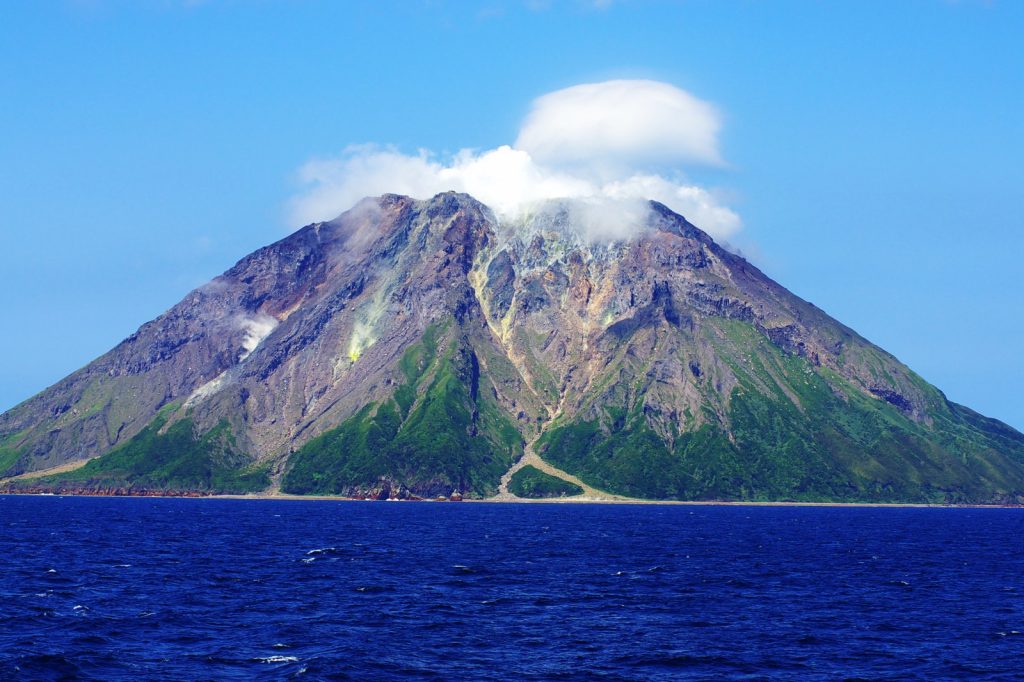
Seven thousand three hundred years ago, Kikai caldera, most of it under the sea off Japan, produced the largest known volcanic eruption of the Holocene. Now it appears to be filling up again. Researchers at Kobe University have found evidence that fresh magma is collecting beneath it.
Listening to the seabed
Why do giant calderas matter? When huge volumes of magma leave a reservoir, the rock above can collapse and leave a broad, shallow depression. Yellowstone and Toba are famous examples, and so is Kikai. The amount of magma in an eruption like Kikai’s could bury New York’s Central Park under a layer roughly 12 kilometers, or 7.5 miles, thick. Scientists know these volcanoes can erupt more than once, but how the enormous stores of magma build up is still poorly understood, which makes the timing of another big eruption very hard to judge.
Kikai’s position under water turns out to help. Geophysicist Nobukazu Seama said the setting allows “systematic, large-scale surveys” across the whole structure. Working with the Japan Agency for Marine-Earth Science and Technology, the team fired powerful airgun arrays to send seismic pulses down through the crust below the sea floor. Ocean bottom seismometers recorded how the waves travelled. Those waves move differently through solid rock than through rock with molten material in it, so their behavior shows structures nobody can see directly.
The results, published in Communications Earth & Environment, show a large zone with a high proportion of magma directly under the site of the ancient eruption. From the seismic data the team estimated the reservoir’s size and shape. “Due to its extent and location it is clear that this is in fact the same magma reservoir as in the previous eruption,” Seama said.
Newly injected, not left over
Intriguingly, the magma does not look like a leftover from the catastrophe. Earlier work found a lava dome that has been growing near the center of the caldera for about 3,900 years. Chemical analyses show that material from the dome and other recent activity differs in composition from what the giant eruption threw out. That points to fresh injections of molten rock from deeper in the crust or mantle. In Seama’s words, the magma under the dome “is likely newly injected magma.”
None of this means another catastrophic eruption is close. It shows how a reservoir can be recharged over thousands of years, which scientists need to understand before they can judge how supervolcanoes behave over the long term.
Lessons for Yellowstone and Toba
The researchers suggest the same process could explain why Yellowstone and Toba also hold large reservoirs relatively near the surface. “This magma re-injection model is consistent with the existence of large shallow magma reservoirs beneath other giant calderas like Yellowstone and Toba,” Seama said.
The team now wants to sharpen the seismic methods used at Kikai. “Our ultimate goal is to become better able to monitor the crucial indicators of future giant eruptions,” Seama said.
Sources
- One of Earthâs most powerful supervolcanoes is refilling with fresh magma
- Supervolcano
- One of Earthâs most powerful supervolcanoes is refilling with fresh magma
Photo: 名古屋太郎 (CC BY-SA 3.0)