
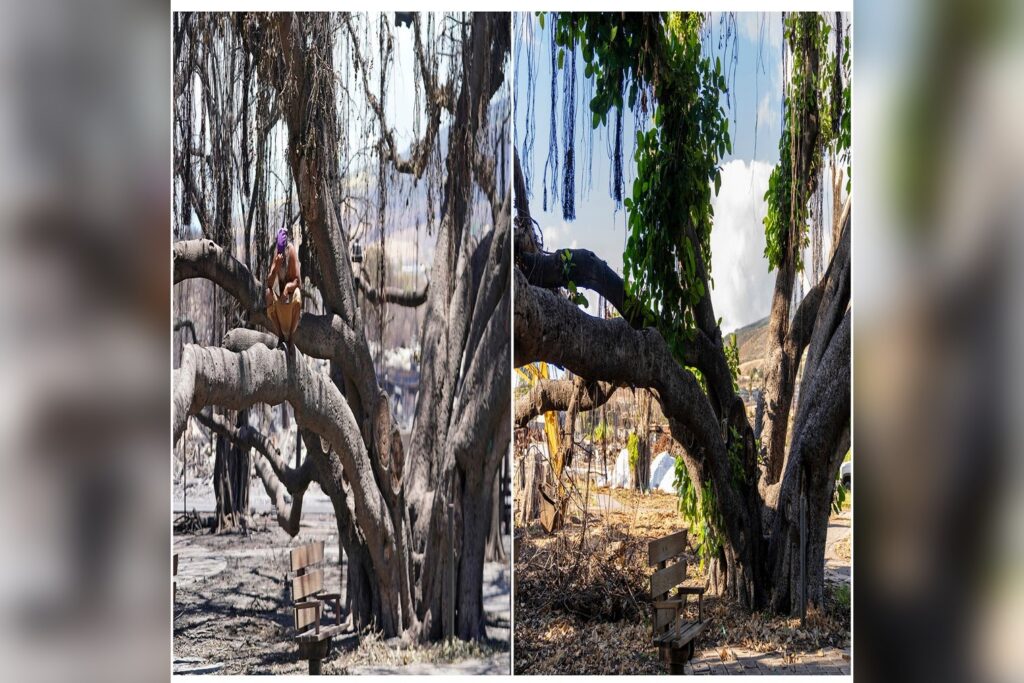
Historic Banyan Tree in Lahaina Endures Wildfire
The massive banyan that has shaded Lahaina for 150 years stood amid the devastation after the recent wildfire swept through the town. Though its canopy shows scorch marks and several limbs are blackened, the underground root system remained intact, keeping the tree alive. Hawaii Governor Josh Green confirmed the survival, noting that the tree withstood the inferno even as flames consumed homes, businesses, and historic structures across the area.
Planted in 1873, the banyan grew to cover nearly an entire city block, becoming more than just a botanical specimen. For generations it functioned as the town’s living room: children played under its shade, tourists posed for pictures beside its aerial roots, and residents gathered beneath its limbs for conversations, celebrations, and quiet moments.
The tree was the physical and emotional center of Lahaina, a fixed point where art fairs, markets, and everyday life intersected. The fire that struck last week did not discriminate. It reduced whole blocks to ash, destroyed dwellings and commercial buildings, and the death toll is still being tallied.
Against this backdrop of loss, the banyan’s continued existence is not merely sentimental; it represents a tangible anchor in a landscape that has suddenly become unrecognizable. Governor Green’s announcement brought a sense of relief, but also a clear-eyed acknowledgment of the challenges that lie ahead.
Officials have begun assessing the extent of the damage to the tree. While it is alive, it is wounded—burned in places and stressed by the heat. The central question now is whether the banyan can recover fully and what measures will be required to support its healing.
The stakes are significant because a dead tree could be removed and replaced, but a 150‑year‑old banyan is irreplaceable. Its root network spreads far beneath the soil, its canopy stretches wide, and its presence is woven into the identity of the community.
Losing it would mean losing a landmark that no new planting could replicate within a human lifetime. Governor Green emphasized that he was not declaring victory; he was stating a factual observation: the tree endured the fire. In a crisis, communities need genuine points of hope rather than unfounded optimism, and the confirmation that the banyan survived provides exactly that—a real piece of good news that residents can hold onto. The tree has quickly become a symbol of resilience, but symbols are only meaningful when they reflect reality.
Here the reality mirrors the situation of Lahaina’s people: the banyan is scorched yet alive, the town is devastated yet its inhabitants remain. Rebuilding will take years, and the tree’s recovery, if it occurs, will likewise require time and careful stewardship.
Throughout the response, Governor Green has been at the forefront, coordinating relief efforts with emergency services and local authorities. His role goes beyond enforcing laws or upholding court rulings; he must lead, reassure, and organize the multifaceted response. This work continues as the community confronts the enormity of the task ahead.
The banyan is one component of a much larger recovery puzzle, yet it holds particular importance. When a community loses nearly everything, it clings to what remains.
The tree stands in the middle of what was once a bustling streetscape, now reduced to rubble and ash, reminding everyone that something old and strong endured. Its roots dug deep and held fast—a fact grounded in botany, not poetry, and one that the people of Lahaina can build upon as they begin the long road to renewal.




