
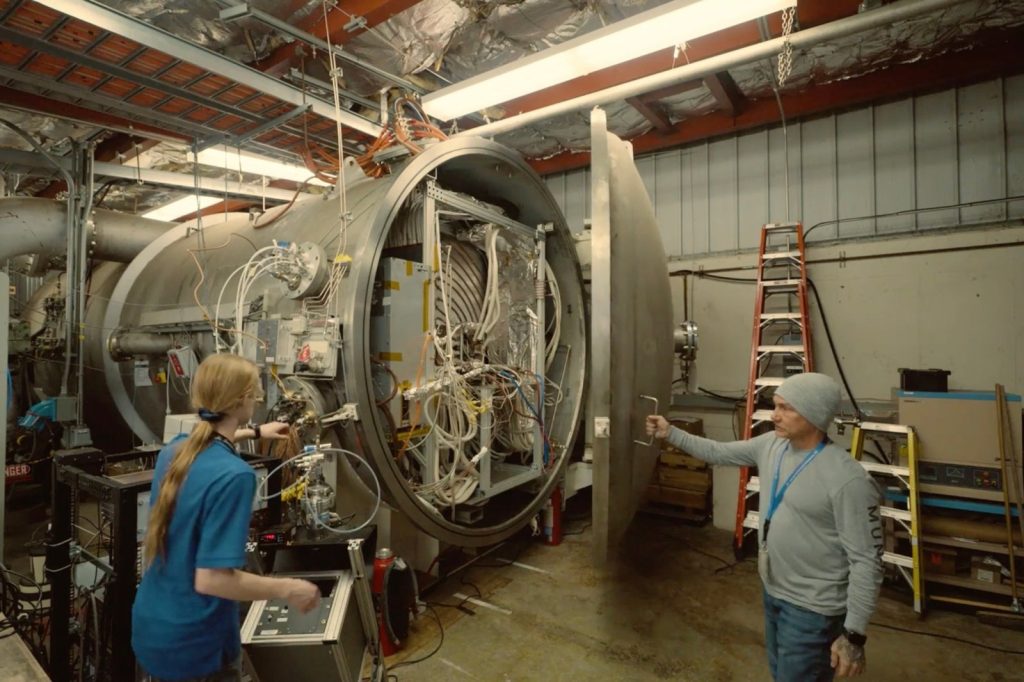
Inside a water-cooled vacuum chamber in Pasadena, something flared red in late February, and American electric propulsion crossed a line it has been eyeing since the 1960s. On February 24, a team at NASA’s Jet Propulsion Laboratory fired a lithium-fed magnetoplasmadynamic thruster at up to 120 kilowatts, the first time any US electric propulsion system has run at that power. The results were published in late April.
The numbers first. Five ignitions. A tungsten electrode glowing white at over 5,000 degrees Fahrenheit, some 2,800 degrees Celsius. And 120 kilowatts, which the agency says is more than 25 times the power Psyche’s electric thrusters can muster; the asteroid probe currently flies the highest-power electric engines of any NASA spacecraft, though their gentle push only builds to 124,000 mph over time. The new design is meant to keep that thrift while adding real muscle.
How it works: the thruster vaporises lithium metal, and high electric currents interacting with a magnetic field electromagnetically accelerate the resulting plasma. Researchers have studied MPD thrusters since the 1960s without ever flying one operationally. Lithium, NASA notes, ionises efficiently, has a low atomic mass and delivers high specific impulse, the measure of how well a drive uses its fuel.
The science behind the push is brutally simple arithmetic. By NASA’s reckoning, every kilogram of payload bound for Mars demands roughly 261 kilograms of chemical fuel, and a full round trip lands somewhere between 1,000 and 4,000 tons. Chemical transits run eight to nine months. Yet flight-proven ion engines such as NEXT-C manage just 236 millinewtons, about the weight of a falling postcard; fine for probes, hopeless for crews. Electric propulsion generally burns up to 90% less propellant than chemical rockets, and the MPD concept is the attempt to keep that economy while adding shove.
What researchers found, and what is left to do: the hardware ran in JPL’s CoMeT chamber, an 8-meter rig the agency describes as a unique national asset built for testing metal-vapour thrusters at megawatt-class power. The team now aims for 500 kilowatts to 1 megawatt per thruster. A crewed Mars mission would need 2 to 4 megawatts, several thrusters firing together, and more than 23,000 hours of operation, with heat tolerance the central open question. Sunlight alone cannot feed that appetite; solar arrays near Mars produce only 40 to 50 percent as much power as near Earth. So the concept pairs the thrusters with a compact onboard nuclear reactor under NASA’s Space Nuclear Propulsion project, run since 2020 out of Marshall Space Flight Center in Huntsville, with JPL working alongside Princeton and NASA’s Glenn Research Center. Intriguingly, the rival nuclear-thermal path, the NASA-DARPA DRACO effort, lost its funding in the 2026 budget.
James Polk, the JPL senior research scientist behind the work, who cut his teeth on Dawn and Deep Space 1, put it plainly: “Designing and building these thrusters over the last couple of years has been a long lead-up to this first test,” and “It’s a huge moment for us because we not only showed the thruster works, but we also hit the power levels we were targeting.” NASA Administrator Jared Isaacman went further: “This marks the first time in the United States that an electric propulsion system has operated at power levels this high, reaching up to 120 kilowatts”, adding that the test “demonstrates real progress toward sending an American astronaut to set foot on the Red Planet”.
A single hot test is not a Mars engine, and the agency leaves the timeline open. But the road from kilowatts to megawatts now has fired hardware on it, which is more than the field has managed since the 1960s.
Sources
- NASA tests lithium thruster: Milestone for manned Mars missions? | heise online
- NASA Fires Up Powerful Lithium-Fed Thruster for Trips to Mars | NASA Jet Propulsion Laboratory (JPL)




