
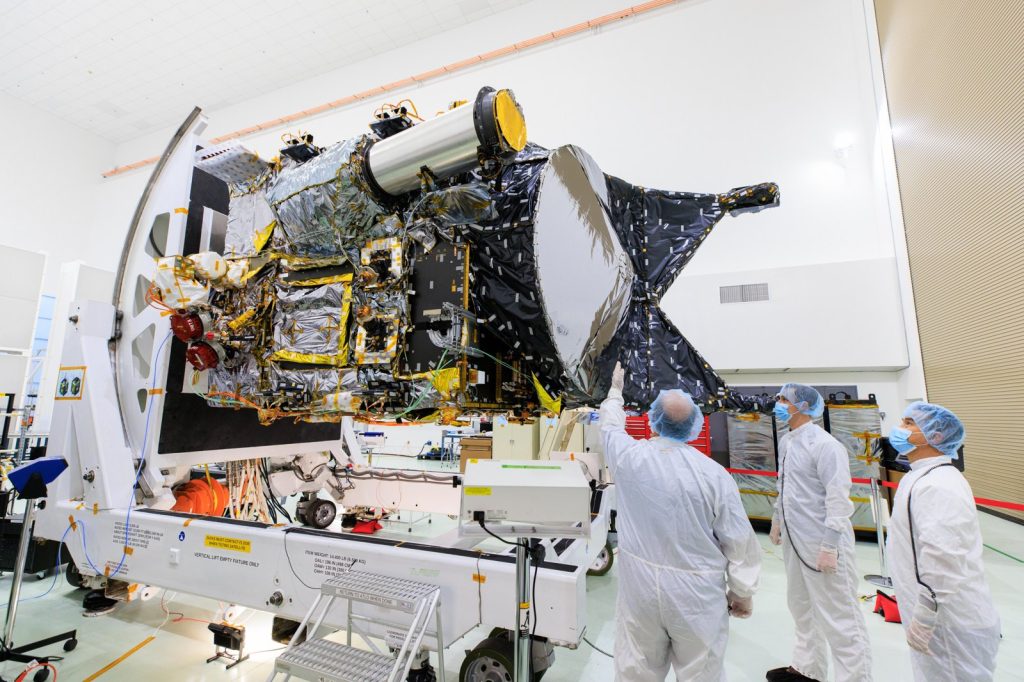
LOS ANGELES — On May 15, the NASA‑led Psyche probe performed a close pass of Mars that did more than trim its fuel budget. The maneuver served as a comprehensive check‑out of every scientific instrument aboard, confirming that the hardware functions as intended. This validation is crucial because the spacecraft will not reach its ultimate destination, the metallic asteroid 16 Psyche, until 2029—roughly six years and several hundred million kilometres away.
Launched in October 2023, the mission’s first real operational test came with the Mars encounter. Engineers monitored the activation of cameras, the collection of data by spectrometers and other sensors, and the transmission of telemetry back to Earth. No anomalies were recorded; none of the instruments suffered a jam or glitch that would have required extensive troubleshooting during the long cruise phase.
The flyby also offered scientists a brief, high‑altitude glimpse of Mars. Passing 4,609 metres above the surface, Psyche captured images of sunlight scattering through the planet’s upper‑level dust, producing a crescent view rarely seen from orbit. While these pictures primarily serve as calibration frames for the onboard cameras, they also add a modest scientific contribution by documenting a slice of the Martian atmosphere that is often missed by other missions.
Beyond the immediate data return, the maneuver provided a significant boost to the spacecraft’s trajectory. By using Mars’ gravity as a slingshot, Psyche gained approximately 1,600 kilometres per hour, steering it toward the main asteroid belt without expending additional propellant. The saved fuel will be essential for future orbital insertion and science operations around 16 Psyche, where every kilogram counts.
What makes the Psyche mission unique is its target. Researchers believe the asteroid may be the exposed metallic core of a protoplanet that never fully formed. If this hypothesis proves correct, studying 16 Psyche could offer an unprecedented window into the composition of planetary cores, including that of Earth. Measurements of the asteroid’s density, composition, and magnetic field will help determine whether it truly represents a planetary core or an alternative type of metal‑rich body.
Despite the successful Mars flyby, the journey ahead remains long and uncertain. The spacecraft must still traverse vast stretches of empty space before reaching the asteroid. The mission team now has a wealth of data to analyze, allowing them to fine‑tune instrument settings based on the performance observed during the encounter. The cameras that imaged Mars will later be directed toward 16 Psyche, and the engineering confidence gained will support the spacecraft throughout the remaining cruise phase.
It is important to note that the flyby did not alter existing uncertainties about the asteroid itself. Although 16 Psyche has been observed from Earth for decades, no probe has visited it, leaving many assumptions about its structure and history provisional. The May 15 event simply confirmed that the suite of tools designed to test those assumptions is ready for the task.
In summary, the Psyche spacecraft’s Mars flyby delivered a successful rehearsal of its scientific payload, provided a modest scientific snapshot of the Red Planet, and added velocity to its trajectory without using fuel. These outcomes collectively enhance confidence as the mission proceeds toward its 2029 arrival at one of the solar system’s most intriguing metallic bodies.




