
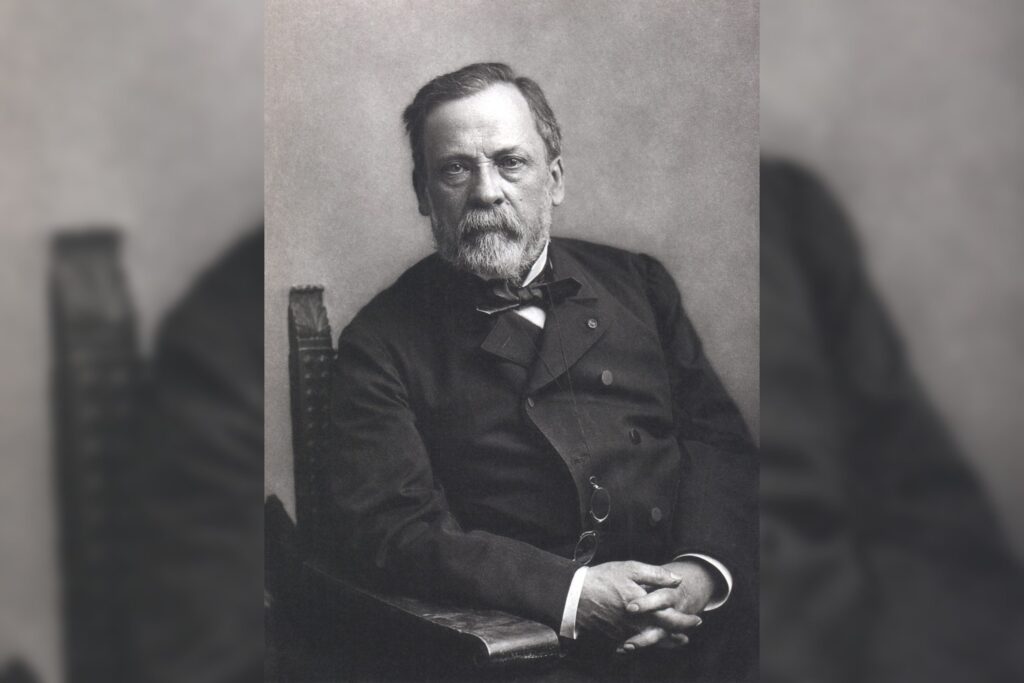
The date worth remembering is July 6, 1885: in a Paris laboratory, a vaccine against rabies was administered to a human being for the first time. The man behind the needle was not a physician at all. Louis Pasteur, born December 27, 1822, was a French chemist whose doctorate, won in 1847, was in physical sciences, and whose route to medicine ran through brewery vats. Asked by French brewers why beer, wine and milk soured, he traced the spoilage to microbes in the air, a finding that would quietly overturn two thousand years of medical guessing.
Against the backdrop of the age, the reigning ideas were miasma, that disease rode on bad air rising from filth, and spontaneous generation, the belief that germs were produced by rotting matter rather than being its cause. Pasteur dismantled the second with a swan-necked flask: broth boiled to kill any microbes, left standing in vessels whose long curved necks trapped dust from the air, stayed fresh; tilt the flask so the liquid touched that trapped dust, and it went off. The French Academy of Sciences had set the spontaneous-generation question as a formal challenge in 1860; Pasteur took its prize on December 1, 1862, and was elected to membership a week later. In 1861 he had published the germ theory itself: microbes cause decay, and can cause disease.
His first vaccine arrived by accident, which is the detail schoolchildren should keep. Studying fowl cholera in 1879, Pasteur had an assistant forget to inject the chickens with fresh bacteria before a holiday; a month later the delayed dose produced only mild signs, and the birds survived. Fresh bacteria then failed to sicken them at all. Pasteur reasoned that exposure to oxygen had weakened the culture, and attenuation, the deliberate taming of a pathogen, became a method. On June 5, 1881, his anthrax vaccine was put to a landmark public test; by May 19, 1884, he could announce that an attenuated rabies virus protected dogs.
The human doses followed, and the numbers were published with them: on March 1, 1886, Pasteur presented results from 350 people treated with the new vaccine, recording a single fatality, which he attributed to treatment begun too late in the disease’s progression. The Institut Pasteur was inaugurated on November 14, 1888, to carry the work forward, and Pasteur, who had buried a daughter in 1859, suffered another family tragedy in 1866 and a stroke in 1868, lived to see it. He died at Marnes-la-Coquette, outside Paris, on September 28, 1895, at 72.
The wider picture is a triangle, not a lone genius. In Germany, Robert Koch, a doctor where Pasteur was a chemist, identified the specific microbe behind each disease, isolating the anthrax bacterium in 1876, the tuberculosis organism in 1882 and cholera’s in 1883, and pioneering the agar plates, dye-staining and microphotography that let germs be seen, grown and checked. The two men were rivals in an era of Franco-German hostility, and their governments funded the race. The third corner came in 1909, when Paul Ehrlich, who had trained alongside Koch’s circle, found that the 606th arsenic compound his team tested killed the syphilis microbe without killing the patient: Salvarsan 606, the first “magic bullet” and the beginning of chemotherapy.
What is at stake in the story is slower than the eureka. British doctors were sceptical for decades; Joseph Lister applied germ theory to surgery with carbolic acid in 1867, John Tyndall defended the flask experiments publicly, and the clean water and sewers of public-health reform followed logically once germs, not smells, were indicted. The theory produced few immediate cures; Prontosil arrived only in the 1930s and penicillin later still. Its power was understanding. The chemist who started with sour wine gave medicine its cause of disease, its first laboratory vaccines, and the Institute that still carries his name.
Sources
- Louis Pasteur, ForMemRS | History of Vaccines
- Germ Theory: Pasteur, Koch and Ehrlich: AQA GCSE History | Aicademy




