
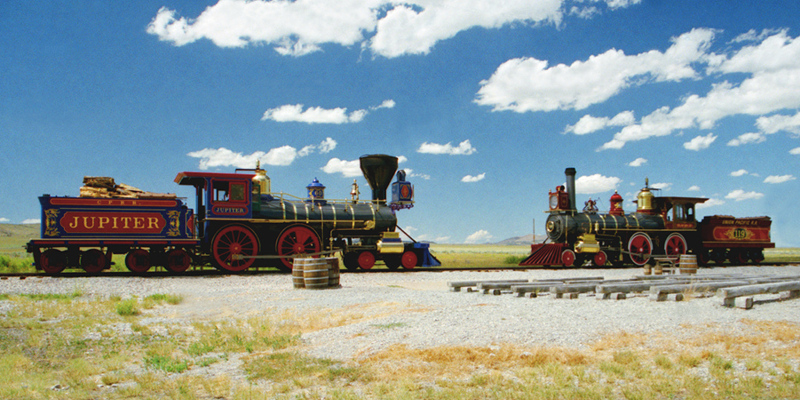
At 12:47 pm on May 10, 1869, a telegraph operator at Promontory Summit sent one word across the country: D-O-N-E. The Central Pacific and Union Pacific lines had met in the Utah high desert, and the nation was joined by rail from coast to coast. Crossing the continent, which once took months, now took days.
A spike nobody had ordered
The famous golden spike almost did not exist. David Hewes, a San Francisco contractor and friend of Central Pacific president Leland Stanford, noticed that nobody had planned a keepsake for the completion, which was then scheduled for May 8. He could not talk anyone into paying for a solid gold or silver length of rail, so he settled for something smaller. He put up $400 of his own gold, and the William T. Garratt Foundry in San Francisco cast a spike from it.
The result measured 5 5/8 inches and weighed 14.03 ounces. It was 17.6 carat gold, and only about $350 worth went into the spike itself; the leftover metal stayed attached in a large sprue. Engravers then covered all four sides and the top. Two faces listed railroad officers and directors. A third recorded that the Pacific Railroad was begun on Jan 8th 1863 and completed May 8th 1869. The fourth carried a prayer: “May God continue the unity of our Country as this Railroad unites the two great Oceans of the world.” The top said simply “The Last Spike.”
It was not the only one. Nevada sent a forged silver spike, ordered on May 5, 1869 and rushed twenty miles to Reno, where it reached Stanford’s special train barely in time. Arizona Territory offered an iron spike with a gold plated head and silver plated shaft. Frederick Marriott, who ran the San Francisco News Letter, ordered a second golden spike of 9 1/2 ounces, made from about $200 worth of gold.
A tent town and a crowd
Behind the crowd that gathered that day stood a row of wall tents, all put up during the previous week. Crews and the telegraph agent got the first ones, along with a Wells Fargo office. Saloons and restaurants opened north of the tracks. Workers’ tents sat across from what the Park Service calls the row of “rum-holes.” Nearest the ceremony, telegraphers pitched their own tent so they could send word of the last spike to the rest of the country. By May 10 there were fourteen tents in two rows, and the largest held J. S. Conner’s grocery, which did steady business with the thirsty.
The project drew people from everywhere. WJLA reported that thousands of Chinese laborers worked on the Central Pacific while many Irish immigrants worked on the Union Pacific, and that Native Americans played important roles in the line’s construction and felt its consequences.
What survives
The railroad itself was built with iron spikes; the gold one was a symbol of the joining of the two companies. The original now sits at the Cantor Arts Center at Stanford University, a gift of David Hewes. At Golden Spike National Historical Park, visitors can see full-scale replicas of the Jupiter and No. 119, the two locomotives that met on that day.
Sources
- Golden Spike National Historical Park (U.S. National Park Service): park overview, "Four Special Spikes" and "The Tent City at Promontory" pages
- America 250: How "DONE" marked the beginning of America's railroad dominance




