
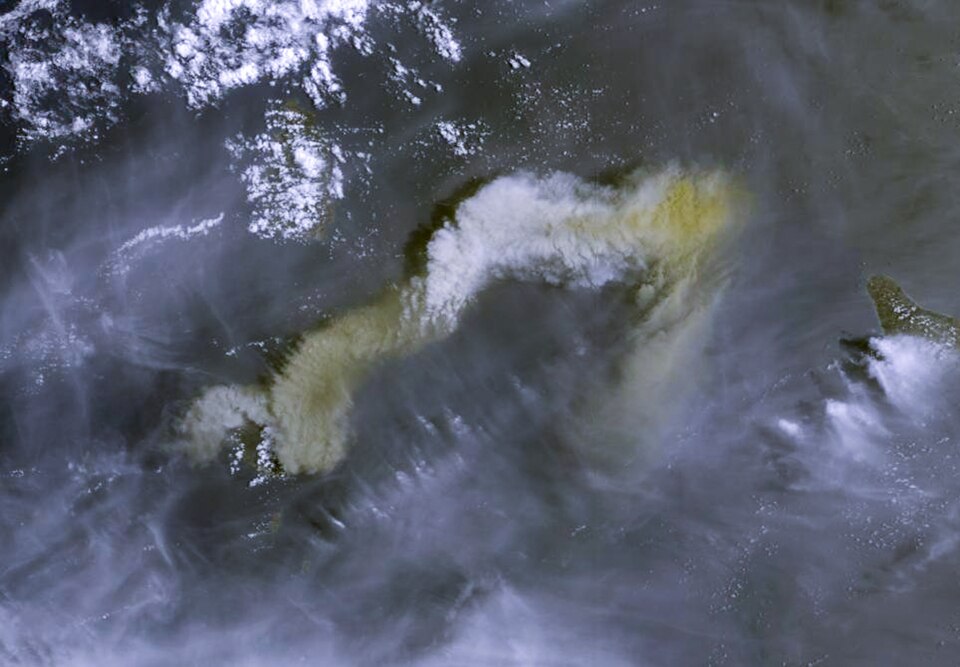
Semeru throws up an explosion roughly every 20 to 30 minutes. It has done so, on and off, since 1967. At 12,060 feet, it is the tallest volcano on Java, an island that holds more than half of Indonesia’s nearly 280 million people.
It is not the country’s busiest volcano. That title usually goes to Mount Merapi, also on Java. Semeru is not far behind.
A long-running eruption
Persistent dome growth in the Jonggring Seloko crater feeds near-continuous explosions, ash plumes, glowing avalanches and frequent pyroclastic flows down the southeast valleys. Volcano Live describes the current phase as one of the longest documented for an open-vent system. The Global Volcanism Program counts an eruption as continuous unless it pauses for three months or more, and by that rule the present one has run since April 2014.
At last report the volcano sat at alert level 3, known as Siaga, with ash plumes usually 100 to 1,000 meters above the crater. The exclusion zone covered a 1 km radius from the crater and 8 km to the southeast.
December 2021
The worst recent day came on December 4, 2021. A dome collapse sent an ash column 15 km into the sky and pyroclastic flows as far as 19 km, burying villages and destroying bridges. Scientific American put the toll at 51 dead, mostly from lahars, the rivers of ash, mud and rock that bury nearby villages. More than 11,000 people were evacuated.
Another large eruption followed on December 4, 2022. Ash reached 15 km, flows ran up to 13 km south and southeast, and hundreds evacuated. Nobody died. On November 19, 2025, ash rose to between 16.5 and 18 km and flows travelled 13 to 14 km. Authorities briefly raised the alert to level 4. Three people suffered severe burns, with no deaths.
Why rain matters
Indonesia’s disaster agency said heavy seasonal rain had eroded unstable lava near the summit before the 2022 collapse. Sally Sennert, a U.S. Geological Survey volcanologist with the Smithsonian’s Global Volcanism Program, compared it to uncorking a soda bottle. Rain can wash away earlier eruption deposits, relieving the pressure that traps hot gas. “It’s really hard to know what happened,” she said. “Sometimes [explosions and erosion] trigger each other.”
Lahars follow wherever loose volcanic material piles up high and the climate is wet. They hit Semeru every wet season, and 80 percent are triggered by rainstorms. After a pyroclastic flow eruption, a 2010 paper found, lahars stay more frequent for five to seven years. The ASEAN Coordinating Centre for Humanitarian Assistance estimates that more than 61,000 people live within 6.2 miles of the mountain.




