
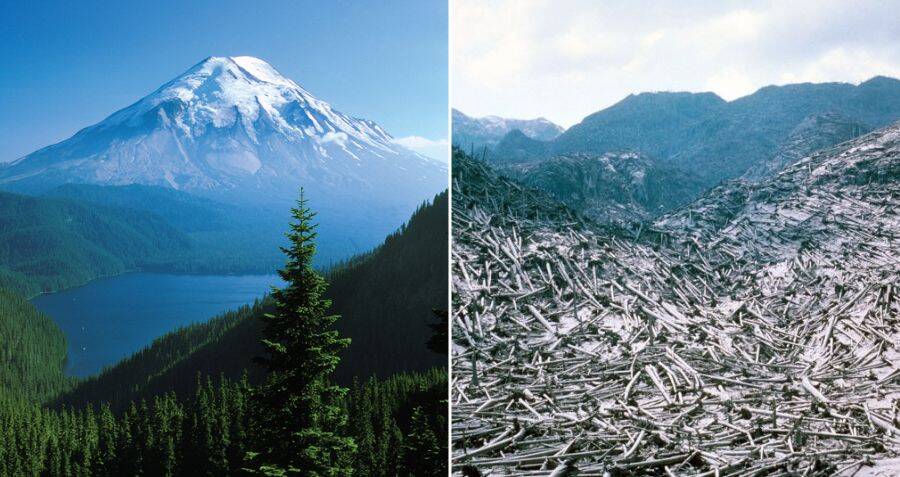
The eruption of Mount St. Helens on May 18, 1980, caused more than $1 billion in property damage and killed 57 people. It also handed scientists an unplanned experiment. Then came a harder question: whether to let nature rebuild the blast zone on its own or hurry the forest back for the timber industry.
What the blast did
The volcano had rumbled since March. When it went, temperatures reached 660 degrees Fahrenheit and melted the mountain’s snow and glaciers. Gases and shattered rock moved at 300 miles per hour. The summit lost 1,314 feet. Trees closest to the blast vaporized, and an estimated 4.7 billion board feet of timber disappeared or died across more than 86,000 acres. Ash rose 15 miles and fell over more than a dozen states.
The earthquake that triggered the eruption also set off the largest recorded landslide in history. It buried more than a dozen miles of the North Fork Toutle River under an average of 150 feet of debris, with some spots under 600 feet. Mudflows washed out more than 20 bridges, and sediment reached the Columbia River, 75 miles away. Spirit Lake emptied about 50 billion gallons, then filled with thousands of logs and a lakebed raised nearly 200 feet.
Life that survived
About 10 days after the eruption, Forest Service ecologist Jerry Franklin landed near Ryan Lake and spotted a sliver of green, about 2 inches high. Fireweed was pushing through the ash. Colleagues found plants, insects and algae, and pocket gophers that had lived out the blast underground. “All of us smart ecologists realized we didn’t have the correct working hypothesis,” Franklin said. Scientists call what remained, living or dead, biological legacies.
Wildlife followed. More than 200 elk were counted in 1981, frogs and toads had colonized the new lakes and ponds that year, and within about a dozen years every native amphibian was back.
Leave it alone, or replant?
By autumn 1981 the Forest Service chose to preserve 85,000 acres for education, recreation and research. Congress created the Mount St. Helens National Volcanic Monument in August 1982, covering 110,000 acres. The law aimed to let geologic forces and ecological succession proceed “substantially unimpeded.” Timber harvesting inside was barred, apart from salvage already agreed. Burlington Northern and Weyerhaeuser still owned about 32,000 acres around the mountain, and the government offered land swaps to avoid a checkerboard. Mineral rights took until 1998 to settle, when President Bill Clinton signed the Completion Act on October 23.
Outside the monument, the economics pushed the other way. Worried about fire and insects, officials allowed salvage logging on national forest land, about 200 million board feet in all, after the planned harvest had been cut 44 percent. On Weyerhaeuser’s land more than 1,000 people hauled out up to 600 truckloads a day, a reported 850 million board feet.
Weyerhaeuser began planting less than a month after the eruption, putting about 18 million seedlings into roughly 45,000 of its 68,000 blast-zone acres. Ash suppressed weeds, and seedlings grew one to three feet a year. By 2009 the trees stood 70 feet tall, though not everyone agreed a tree farm counted as a forest. The Forest Service replanted about 14,000 acres east of the mountain, some 9 million trees, and federal foresters found more than 150 plant species there eight years after the blast.




