
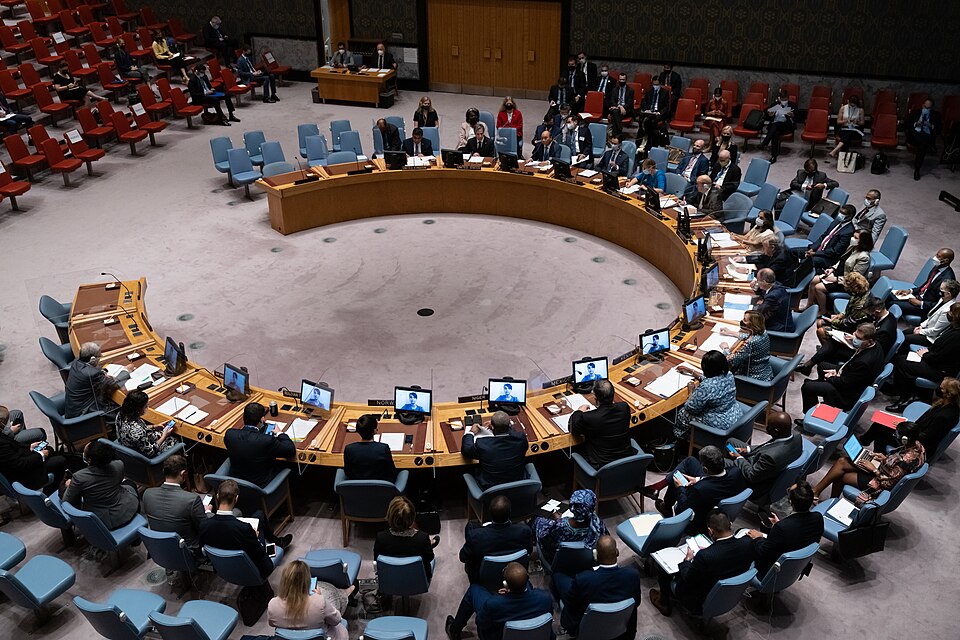
“One country is not going to arrive on the Security Council and suddenly transform it.” Hervé Verhoosel has no illusions about what a seat at the table buys. Yet the former UN official, who spent nearly two decades inside the system, thinks Morocco’s bid for a 2028-2029 term has something the Council needs: a country that can keep talking to everyone.
Verhoosel told Morocco World News, in an interview published in late September, that his answers were personal views shaped by Geneva, New York and field postings. He was visiting Rabat until October 5. His career began in global health, at the RBM Partnership to End Malaria, Unitaid and the World Health Organization. He later served as Director of Communications for MINUSCA, the UN peacekeeping mission in the Central African Republic, where he worked daily with Moroccan Blue Helmets.
The bid
Foreign Minister Nasser Bourita announced Morocco’s candidacy on September 22, during the General Assembly’s high-level debate. The election takes place in June 2027. Bourita told the Assembly the bid rests on a realistic vision of international cooperation and on respect for international law, and tied it to King Mohammed VI’s picture of the kingdom as a reliable actor for stability and sustainable development.
The debate also carried an African theme. In his final address to the Assembly, Secretary-General António Guterres called a Security Council without permanent African representation “unjust and indefensible.” Presidents William Ruto of Kenya, Duma Boko of Botswana and Netumbo Nandi-Ndaitwah of Namibia were among the African leaders who echoed the call, Morocco World News reported.
What a middle-sized member can do
Verhoosel put political will ahead of institutions or trust when asked what ails the UN. “We often talk about the UN as if it were something separate from its Member States,” he said. The organization, in his words, “can do extraordinary things when countries want it to act,” yet “can also become almost powerless when the main powers fundamentally disagree.”
His fix is to rebuild, not walk away. “The question is whether a world with less multilateralism would work better. I see very little evidence that it would,” he said. That means listening beyond the usual capitals. “Not every good idea has to come from Washington, Paris, London, Brussels or Beijing,” he said, adding that reform ideas from Africa, Asia, Latin America and the Arab world deserve serious discussion.
Elected members can still raise issues, build coalitions and keep dialogue alive when positions harden, he argued. The work is rarely dramatic: “being present, knowing the files, following them over time, and talking to people who don’t necessarily agree with you.”
Morocco, he said, “doesn’t fit neatly into one box.” He described an African, Arab and Muslim country that is close to Europe in geography, economics, politics and human ties, with deep links across Africa. “The Council needs countries that can continue talking to different sides,” he said. “Morocco has the potential to do that.”
Moroccan peacekeepers up close
Verhoosel knows the peacekeeping record firsthand. He shared meals and tea with Moroccan contingents in the Central African Republic. He did not paint it as flawless. Relations with local communities “were not always simple,” he said, and other nationalities drew criticism too.
He recalled Bangassou, where civilians and peacekeepers alike were under attack. More than once he had “the painful responsibility” of announcing the deaths of Moroccan peacekeepers. “Those announcements are not simply numbers in a press release,” he told Morocco World News.




