
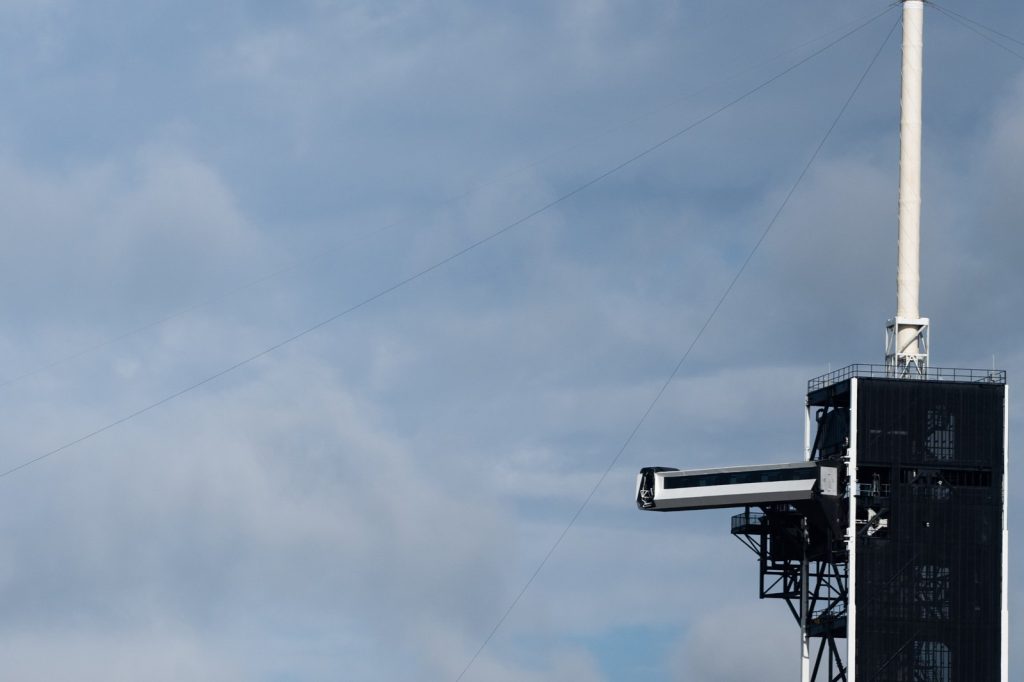
NASA Administrator Jared Isaacman was midway through a news conference on Sunday, August 30, telling reporters he expected the Roman Space Telescope to become a household name, when his cellphone rang. It was President Donald Trump. “Boy, it looked beautiful on television,” Trump said, and then: “You’re the hottest in space.”
The call came a couple of hours after SpaceX lifted the $4.3 billion observatory off Launch Complex 39A at Kennedy Space Center on a Falcon Heavy, just after daybreak. Minutes later the two reusable side boosters came down tail-first back at Cape Canaveral, with sonic booms to match. The telescope then separated cleanly from the upper stage and ground controllers applauded. Nicky Fox, NASA’s science mission director, was in tears. “It’s such a good day!” she said.
NASA Goddard controllers confirmed that the solar panels and the lower instrument sunshade had deployed and that every system was working normally.
Heading for L2
Roman is on a three-month trip to a point about 1.6 million kilometres from Earth, the same neighbourhood the Webb telescope already occupies. NASA plans roughly 90 days of preparation before full science operations, and the first images are expected before the end of the year.
The bus-sized observatory is named for Nancy Grace Roman, NASA’s first chief astronomer, who died in 2018 at 93. It is the first NASA space telescope named after a woman. Ed Weiler, the retired NASA scientist who coined the phrase “Mother of Hubble” for her, called the honour overdue. “I think Nancy would be very proud,” he said. Roman launched nearly a year ahead of schedule and within its budget.
Built for speed
The headline feature is the field of view, at least 100 times wider than Hubble’s. Julie McEnery, the senior project scientist, put it in terms of time: a month of Milky Way observations by Roman would take Hubble a century. The wide-field infrared camera matches Hubble’s sensitivity but runs 1,000 times faster. Its primary mirror is the same size as Hubble’s, nearly 2.4 meters across, though it began life as surplus hardware from a spy satellite. The National Reconnaissance Office donated two such mirrors to NASA more than a decade ago, and the second is still in storage.
Fox listed what the telescope should find: “thousands of supernovae, tens of thousands of planets, billions of galaxies and tens of billions of stars.” Another estimate, reported by i24NEWS, puts the haul at more than 100,000 new exoplanets. Roman will also map galaxies across wide stretches of sky to help scientists work out how fast the universe is expanding under the pull of dark matter and dark energy. And it will scan the galactic bulge at the center of the Milky Way faster than any earlier instrument.
A coronagraph, an experimental instrument, blocks the glare of a star so that planets circling it can be imaged directly. Roman was not built to look for signs of life, Fox said, but it lays groundwork for future telescopes aimed at NASA’s biggest question: “Are we alone?” The design also allows refuelling in orbit, which could extend its working life if a robotic tanker becomes available in the next decade.
Once a candidate planet turns up, Webb will follow up in finer detail. McEnery summed up the pitch on the eve of launch: “Roman’s vast reach will allow us to find the weird, the rare and the unusual.”
Sources
- NASA Launches Nancy Grace Roman Space Telescope To Survey Billions Of Galaxies And Hunt For New Worlds – i24NEWS
- SpaceX sends $4.3 billion Roman Space Telescope to look for 'weird, rare, unusual’ stars and planets; leaves NASA's director Nicky Fox in tears – The Times of India




