
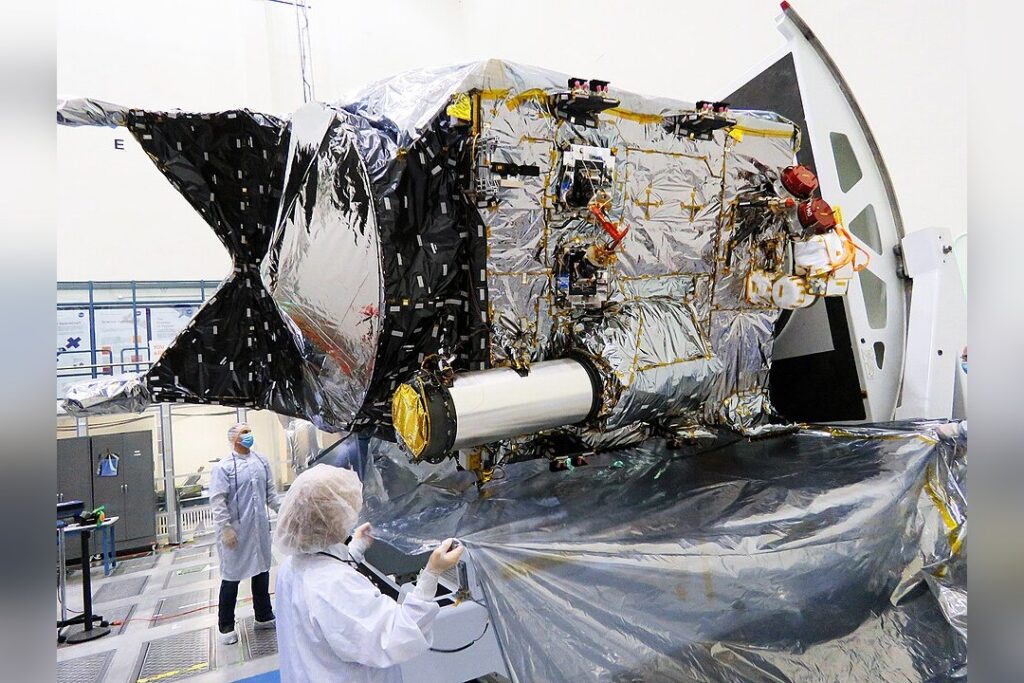
NASA’s Psyche spacecraft has cashed in a gravitational favor from Mars. During its close approach on May 15, the probe passed about 2,864 miles (4,609 kilometers) above the Martian surface, letting the planet’s gravity add roughly 1,000 mph of speed and tilt its orbital plane by about 1 degree relative to the Sun without spending a drop of propellant. Afterward the flight team pored over radio signals between the spacecraft and NASA’s Deep Space Network to confirm the trajectory. “Although we were confident in our calculations and flight plan, monitoring the DSN’s Doppler signal in real time during the flyby was still exciting,” said Don Han, Psyche’s navigation lead at the Jet Propulsion Laboratory. “We are now on course for arrival at the asteroid Psyche in summer 2029.”
The encounter doubled as a full dress rehearsal. Every instrument was switched on for calibration, from the imagers and magnetometers to the gamma-ray and neutron spectrometer, a dry run for the science campaign at the target asteroid. The pictures were a bonus. Approaching at a high phase angle, Psyche saw Mars as a slim crescent that glowed brighter and stretched farther around the planet’s disk than predicted, thanks to sunlight scattering through the dusty atmosphere. Later frames captured the water-ice south polar cap, more than 430 miles (700 kilometers) across, wind streaks near Syrtis Major and the double-ring crater Huygens. “This dataset provides unique and important opportunities for us to calibrate and characterize the performance of the cameras, as well as test the early versions of our image processing tools being developed for use at the asteroid Psyche,” said Jim Bell, the imager lead at Arizona State University. Perseverance, Curiosity, Mars Reconnaissance Orbiter, 2001 Mars Odyssey and two European orbiters pitched in with complementary observations, and early magnetometer readings may have caught Mars’ bow shock.
The spacecraft, launched in 2023 and clocking 12,333 mph at the flyby, will now fall back on its solar-electric thrusters for the run to the asteroid belt between Mars and Jupiter. Arrival and orbit insertion are set for August 2029 at asteroid 16 Psyche, an object about 173 miles (280 kilometers) wide that may be the exposed metallic core of a planetesimal, one of the building blocks of early planets. A 2021 University of Arizona study cautions it could instead be closer to a rubble pile, and pop estimates of its metal value run to a fanciful $10,000 quadrillion. Settling that argument is the mission’s whole point. “We can thank the Red Planet for giving our spacecraft a critical gravitational slingshot farther into the solar system,” said Lindy Elkins-Tanton, the mission’s principal investigator. “Onward to the asteroid Psyche!”
Sources
- NASA’s Psyche Mission Aces Mars Flyby, Targets Metal-Rich Asteroid | NASA Jet Propulsion Laboratory (JPL)
- Another new Psyche mission flyby image of Mars




