
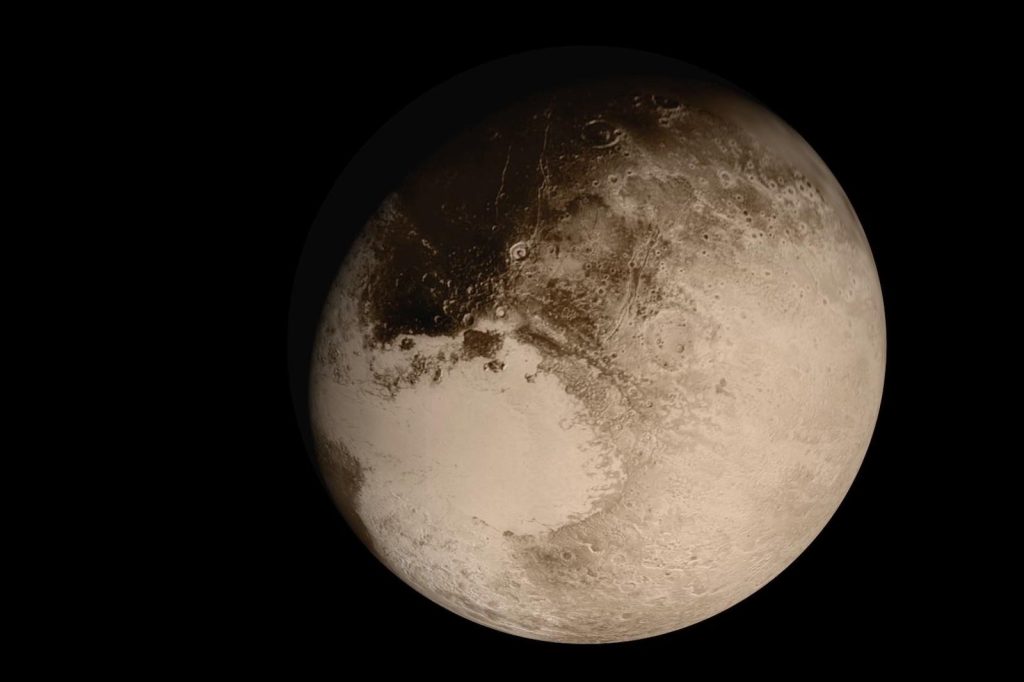
Behind the breakthrough are the people who refused to let it end. NASA’s New Horizons spacecraft launched on January 19, 2006, tore past Jupiter a year later, then cruised seven more years to reach Pluto. Today, after almost twenty years operating in deep space and more than eight billion kilometers from home, it is still on the job in the Kuiper Belt, the cold outer zone no other spacecraft has visited, gathering data and hunting one more target.
The 2015 flyby of Pluto is the memory most people carry: a surprisingly varied world of craters and crevasses, craggy mountains of ice, seas and glaciers of frozen nitrogen, a frozen heart of solid nitrogen ice, and the red-tinted moon Charon alongside. With that encounter, humanity finished its initial reconnaissance of the classical solar system. Then, in 2019, came the bonus: Arrokoth, the farthest world any spacecraft had ever visited, essentially a bi-lobed baby comet, reachable only because it was found while the probe still had propellant to spare. The two flybys produced “spectacular results,” in the words of Jane Luu, the University of Oslo astronomer who co-discovered the Kuiper Belt back in 1992.
The human side since has been a budget fight. A 2022 NASA review judged the spacecraft’s distant studies of Kuiper Belt objects “unlikely to markedly improve knowledge,” and the agency moved to end the planetary science and repurpose the probe for heliophysics. Mission leader Alan Stern would not write the required proposal: “We refused to write a proposal that terminated the Kuiper Belt science,” he says, calling it outrageous to end “the only mission purpose-built and sent to the Kuiper Belt while it’s still collecting unique data.” Colleagues signed a letter of alarm that summer.
For the scientists, the reprieve mattered. On September 29, 2023, Nicola Fox of NASA’s Science Mission Directorate announced the reversal: “The agency decided that it was best to extend operations for New Horizons until the spacecraft exits the Kuiper Belt, which is expected in 2028 through 2029,” with a possible future close flyby left open. “The community and I are thrilled that this logjam is finally broken,” said Pontus Brandt of the Applied Physics Laboratory. Stern called it, verbatim: “It is good news for Kuiper Belt exploration and very much welcomed by our team and also by the planetary science community,”
The ledger behind the sentiment: a nearly $1-billion spacecraft that costs about $10 million a year to run, against work no Earth telescope can copy, reading the shapes of distant objects from their changing brightness and hunting for co-orbiting pairs. The mission might operate until 2050. And the youngest hands involved were there from the start: a dust counter built by University of Colorado students at Boulder, the first student-designed science instrument on a NASA planetary mission, still counting as the probe sails on.
Sources
- New Horizons, exploring Pluto and the Kuiper… | The Planetary Society
- Beyond Pluto, New Horizons Gets a Reprieve from NASA | Scientific American




