
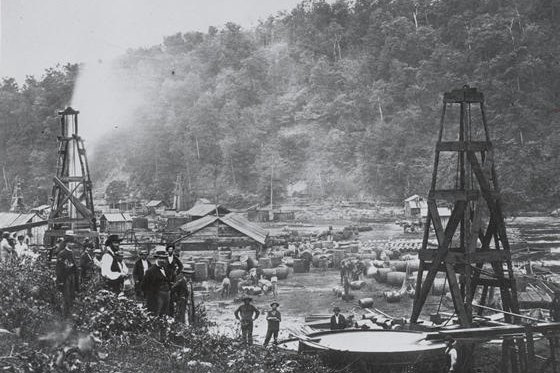
The well was 69½ feet deep. On August 27, 1859, drillers in Titusville, Pennsylvania, hit oil at that depth, and the Drake Well, as the Drake Well Museum puts it, gave “birth to an industry that has forever shaped our modern world.”
Edwin L. Drake had arrived in Titusville two years earlier as an agent for the Seneca Oil Company of Connecticut. His brief was narrow: find crude in quantities big enough to refine into kerosene at a profit. He hired a salt well driller and blacksmith, William “Uncle Billy” Smith, and adapted salt well methods to drilling for oil. The site later earned national historic landmark status, in 1935.
One company, then thirty-four
Money followed oil quickly. In 1870, John D. Rockefeller founded Standard Oil in Cleveland, Ohio. According to the Supreme Court Historical Society, the company squeezed out rivals by buying up the means of production and by striking private deals with railroads that gave it low shipping rates and rebates no one else got. Smaller refineries drifting toward bankruptcy were bought and folded into trusts. Rockefeller was worth $1.5 billion when he died in 1937, making him the world’s first billionaire.
Congress passed the Sherman Antitrust Act in 1890, but it was rarely enforced against industrial monopolies. Pressure built after journalist Ida Tarbell’s 1904 book, The History of the Standard Oil Company, and President Theodore Roosevelt ordered an investigation in 1905. The Justice Department sued in 1906 with a report of about 12,000 pages covering 40 years of business dealings. A federal circuit court ordered Standard Oil dissolved in 1909, and in 1911 the Supreme Court unanimously agreed. The trust was split into 34 independent companies. The ruling also set the “rule of reason” test that still guides antitrust cases. Some of the pieces later recombined. ExxonMobil and Chevron, two of the three largest oil companies in the world, are direct descendants.
When the supply became a weapon
The next shock came from producers, not refiners. In the 1973 Arab-Israeli War, Arab members of OPEC imposed an embargo on the United States, angered by its decision to resupply the Israeli military. They extended it to the Netherlands, Portugal and South Africa. The embargo banned shipments to those countries and cut output.
The US State Department’s historians describe an economy that had grown increasingly dependent on foreign oil. The price of a barrel first doubled, then quadrupled. With the dollar devalued at the same time, a global recession looked imminent. The embargo was lifted in March 1974, once the prospect of a negotiated end to fighting between Israel and Syria had convinced the parties to stop.
Washington’s answers to the shock included the Strategic Petroleum Reserve, a national 55-mile-per-hour speed limit, later fuel economy standards under President Gerald Ford, and the creation of the International Energy Agency.
Sources
- Site History (Drake Well Museum, Pennsylvania Historical and Museum Commission)
- Standard Oil Company v. United States (1911) (Supreme Court Historical Society)
- Oil Embargo, 1973-1974 (Office of the Historian, U.S. Department of State, Milestones in the History of U.S. Foreign Relations)




