
The Energetic Calculus of Flight and Its Trade-Offs
Flight provides clear advantages–escaping predators and reaching distant food sources–but maintaining those capabilities demands specific physical traits. Developing and sustaining the powerful flight muscles, lightweight bones, and high metabolic rate required for aerial movement consumes substantial energy. In the ostrich’s native African landscape, where open terrain offered few hiding places and predators roamed, the benefits of flight became less critical than other adaptations. Over generations, natural selection tilted the balance: individuals with larger body sizes and more powerful legs had a survival edge, while those that retained full flight capacity faced a greater energetic burden without corresponding gains.
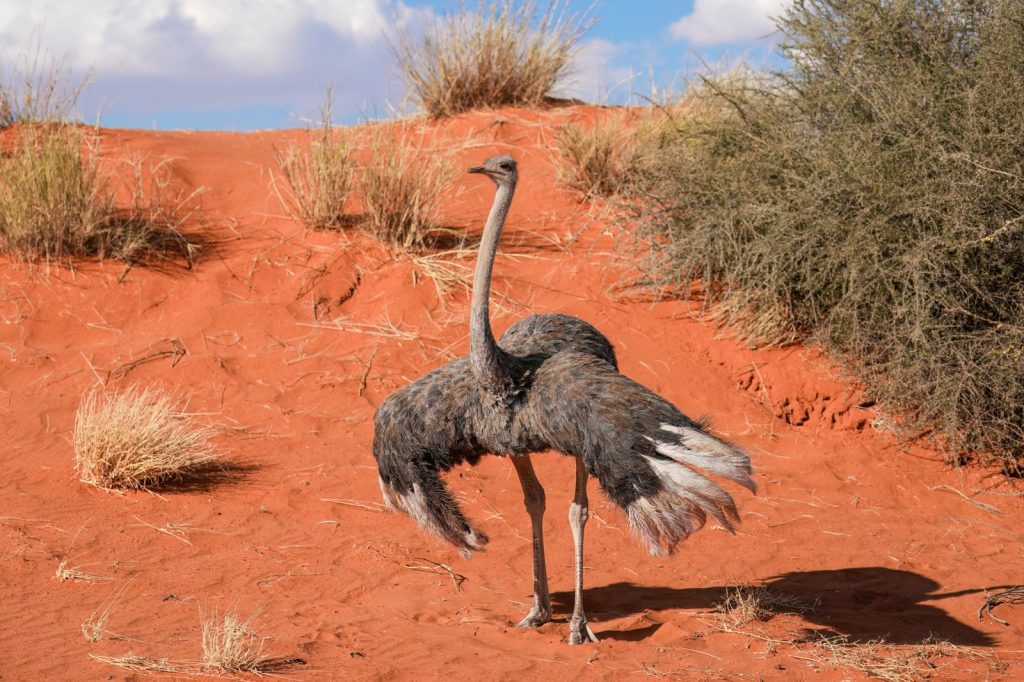
The energy saved by reducing flight muscle mass and bone density could then be redirected toward features that enhanced survival and reproduction on the ground. This evolutionary trade-off, documented in the fossil and anatomical record, unfolded gradually. Vestigial wings remain today as a physical remnant of the ostrich’s airborne ancestry, a quiet testament to the journey from flier to runner. Sources familiar with the ongoing research describe the transition as a steady shift away from flight capabilities toward terrestrial adaptation, with the selective pressures of the African savanna acting as the primary driver. The ostrich thus stands as a powerful example of how the competing demands of flight and ground survival can reshape a species over geological time.
A Global Evolutionary Journey from Asia to Africa and Beyond
The ostrich belongs to a group of birds known as ratites, which includes other flightless or weakly flying species such as emus, rheas, and kiwis. These birds first appeared during the Early Eocene, and early fossil forms have been found across North America, Europe, and Asia. Evidence suggests the group likely originated in Asia, then spread westward. Later fossils discovered in Namibia indicate that the genus moved into Africa, and from there the birds dispersed across Eurasia, once ranging as far east as China and Mongolia. This wide distribution shows that the ratites were once a successful and broadly adapted lineage before environmental changes and competition gradually confined them to isolated southern continents.
The ostrich’s evolutionary history, from its early appearance in the Eocene to its modern form in Africa, illustrates how geographic movements and shifting ecological pressures can drive major anatomical changes. The timeline of its evolution shows a steady departure from flight capabilities, with each generation reinforcing the traits that made it a master of the ground rather than the sky.
Economic Significance and Human Use Across Millennia
Beyond its biological interest, the ostrich holds enduring economic importance. Humans have used ostrich meat and eggs for thousands of years, and that relationship continues to shape global agriculture today. A large share of global ostrich products comes from South Africa, where the industry is most developed. Other nations, including Namibia and the Philippines, maintain farming operations that produce ostrich oil, leather, and feathers. The feathers, in particular, are used for ceremonial headgear, continuing a tradition that stretches back centuries.
The bird’s transition from a once-flying ancestor to a flightless giant is not merely an academic puzzle–it is a story written in the fossil record, in the vestigial wings that still hang at its sides, and in the economics of a species that humans have relied on for millennia. The selective pressures that drove the ostrich to the ground remain a subject of study, but the outcome is clear: in the trade-off between flight and survival, the ground won.




