
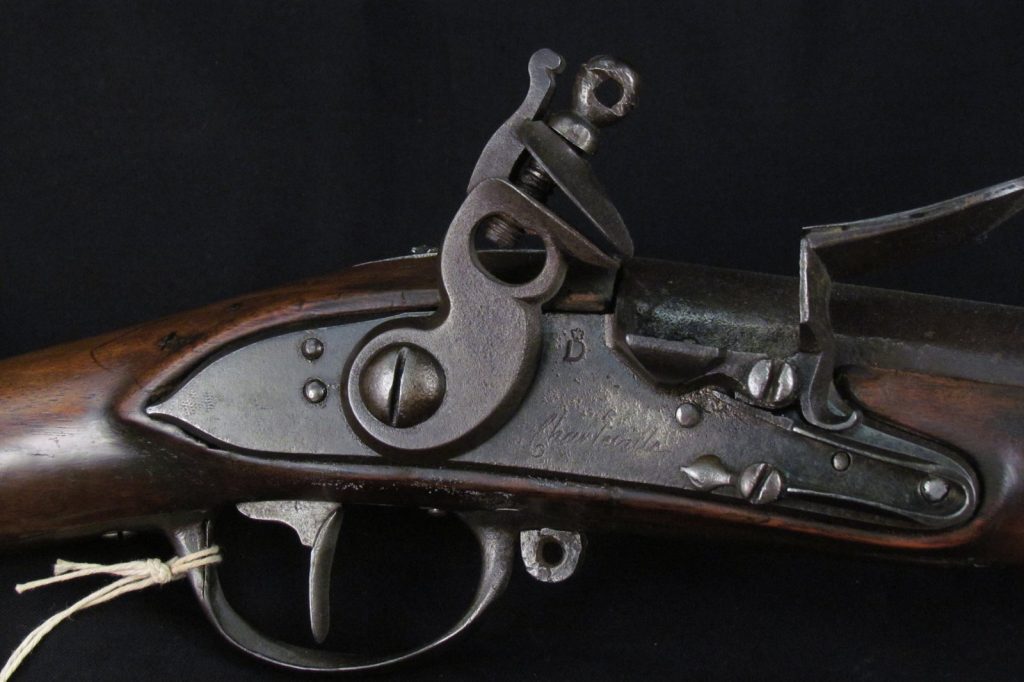
The shift is not where the folklore puts it. Popular memory hands the Revolution’s gun glory to the Kentucky long rifle. The record hands it to a French import. From the war’s first shots, the Continental Army was short of muskets, powder and cannon, and American gunsmiths could not come close to meeting demand. France, Great Britain’s longtime rival, filled the gap, and the weapon that crossed the Atlantic became the primary infantry firearm of Washington’s army.
The timeline is brisk. In 1776 the Continental Congress began buying arms from France; the first shipment reached Portsmouth, New Hampshire in early 1777. The Marquis de Lafayette arrived that same year, reportedly carrying several hundred muskets as a gift, and deliveries scaled up in 1778 once France formally entered the war. All told, France handed over as many as 48,000 Charleville muskets, with some reports running as high as 100,000.
What arrived was one of the finest military muskets of its century. The pattern dated to 1717, the French Army’s first standardized musket, named for the armory at Charleville-Mézières though also produced at Tulle, Saint-Étienne and Mauberge. It threw a .69 caliber lead ball, slightly smaller than the .75 round of the British “Brown Bess”, and a trained soldier managed three, sometimes four, shots a minute. Tactics followed the physics: lines pointed at formations rather than individual men, with bodies of troops hittable at 200 yards and a lone soldier at perhaps eighty. Wavering lines were settled with bayonets, the era’s “cold steel”.
Two versions reached American hands, the Model 1763 and the Model 1766. The 1763, first redesigned after the Seven Years’ War, was built heavier and sturdier, just over ten pounds. The 1766 slimmed the barrel, shortened the lock and lightened the stock, and proved rugged in hard service. Contemporaries rated the design above its British rival, lighter with slightly better accuracy, and French armories had manufactured more than 600,000 by the war’s start. One myth worth retiring: the Model 1777 served only with French troops under Rochambeau on American soil, never with Washington’s regiments.
The trend underneath runs well past 1783. The Model 1766 shaped the Springfield Model 1795, the first regulation musket made in the United States, and copies or derivatives spread to Prussia, Austria, Belgium, Russia and the Netherlands. French armories kept producing Charlevilles until 1840, between seven and eight million in all, and reenactors still carry reproductions. The National Museum of the US Army displays a Model 1763 in its temporary Call to Arms exhibition. Watch this space of memory: wars run on supply chains, and this one ran substantially on French steel and walnut.




