
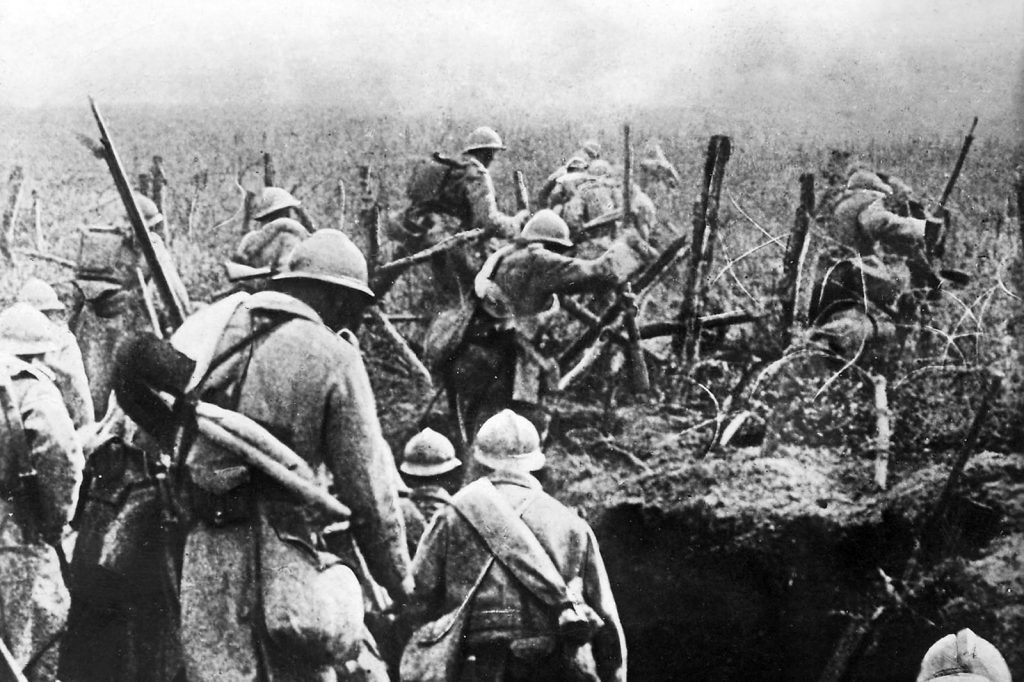
The First World War was the industrial age turned on itself. Europe’s powers had spent decades converting coal, steel and science into wealth and empire, and in the summer of 1914 the same machinery converted an assassination in Sarajevo – Archduke Franz Ferdinand, heir to Austria-Hungary – into a general war within weeks. Britain, France and Russia faced Germany, Austria-Hungary and the Ottoman Empire, as militarism, alliances, imperialism and nationalism all paid out at once.
The killing was industrial because the weapons were. Poison gas, machine guns, tanks, long-range artillery and airplanes all operated at genuine scale for the first time, while generals still worked from older playbooks, sending huge numbers of men against heavily defended trenches. The result, along the Western Front’s dug lines across Belgium and northeastern France, was a four-year stalemate of mud, disease and shellfire.
The end came in a railway carriage. Germany signed the armistice just after dawn on the war’s last day, November 11, 1918: Matthias Erzberger, a civilian politician, inked the terms in a Compiegne forest carriage roughly 50 miles from Paris, Marshal Ferdinand Foch and Admiral Rosslyn Wemyss signing opposite him, and the guns fell silent at 11:00 a.m.
The balance sheet was staggering on both sides of the line. Soldiers died crossing open ground against dug-in machine guns or from disease in flooded trenches; gas left slow deaths and long-term lung damage. Civilians were killed by famine and blockade as food supplies were cut, occupied Belgium and northern France endured military rule and forced labor, and entire communities in the Ottoman Empire were wiped out. The Spanish Flu of 1918 moved along the war’s supply routes and killed tens of millions worldwide.
Then came the restructuring. Four empires collapsed – the German, Austro-Hungarian, Russian and Ottoman – and the map of Europe and the Middle East was redrawn. Poland, Czechoslovakia and Yugoslavia emerged where empires had ruled; Ottoman territory was parceled out to British and French control. Many of the new borders grouped different peoples together or split communities apart, seeding disputes that outlasted the century.
The June 28, 1919 Treaty of Versailles put the blame and the bill on Germany: roughly 13 percent of its territory gone, including Alsace-Lorraine to France and the Polish Corridor to the east, all overseas colonies forfeited, the military strictly limited, and reparations owed. Germans read it as humiliation, resentment later exploited to catastrophic effect. The League of Nations, founded in 1920 to prevent repetition, was weakened when the United States Senate refused approval and the country never joined.
The war also strained Russia into revolution and the eventual Soviet Union, and its unfinished business set the stage for a second, larger war. Grey’s August 1914 line became the epitaph: “The lamps are going out all over Europe; we shall not see them lit again in our lifetime.”
Sources
- Significance of World War I: A Detailed Summary – History Crunch
- World War 1 Free Essay Examples And Topic Ideas | PapersOwl.com




