
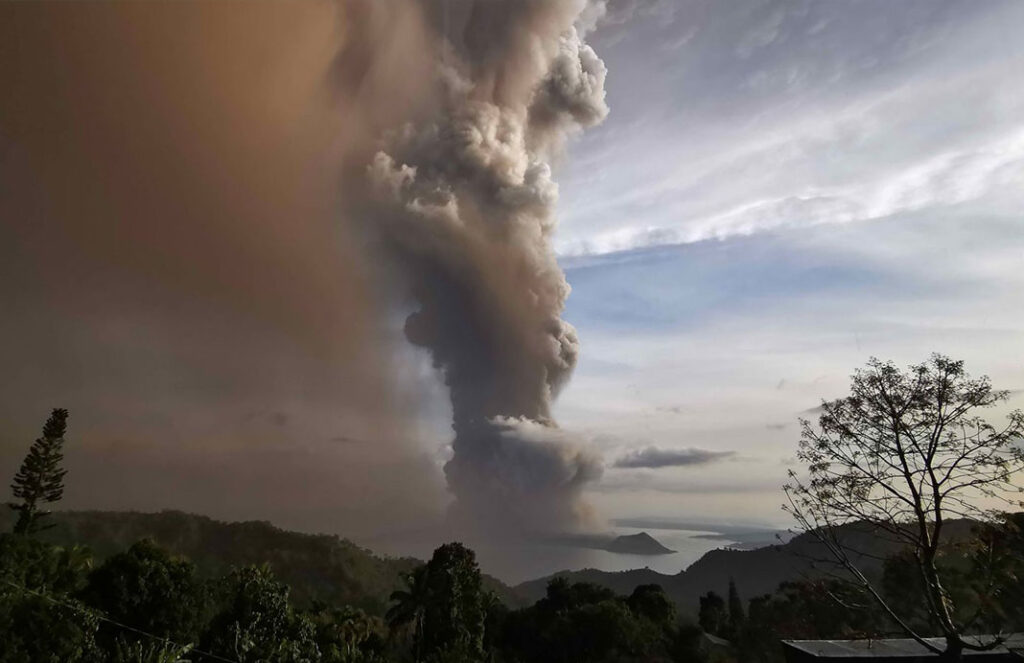
The Philippine Institute of Volcanology and Seismology (Phivolcs) said Monday morning that the Taal volcano could bring a “volcanic tsunami” if activities escalate.
On its website, the bureau said: “a volcanic tsunami may occur in caldera lakes when water is displaced by deformation of the lake floor caused by rising magma.”
A volcanic tsunami would accompany an eruption column of as much as 15 kilometers high and could bring floods, as explained.
Phivolcs, on Monday morning, have put Taal Volcano under Alert Level 4 following the magmatic eruption and lava fountaining.
They added that an Alert Level 5 might be raised within the next few days if the volcano remains unrested.
Extreme hazards can be expected at Alert Level 5.
As of 5:00 AM on Monday, more than 23, 000 Filipino residents of Batangas province have been evacuated by the Philippine Army’s 2nd Infantry Division as Taal continues to spew ash.
The Government sent military trucks beginning Sunday night to help residents flee from danger zones around Taal Lake, including the most affected towns of Balete, Laurel, San Nicolas, Talisay, and part of
Lipa and Tanauan City.
As of writing, no casualties have been officially reported yet.
Taal, which lies around 60 km (37 miles) south of Philippines’ capital city Manila, started exploding steam on Sunday afternoon.
The Philippines is located in the Pacific Ring of Fire, a region prone to volcanic and seismic activity due to the movement of several major tectonic plates.
This unique geology has resulted in the country being home to numerous active volcanoes, with Taal Volcano being one of the most prominent. Volcanic eruptions in the Philippines have the potential to impact large populations and cause significant damage to infrastructure and the environment. Volcanic tsunamis, like the one warned about by Phivolcs, are a relatively rare but potentially devastating phenomenon.
They can occur when volcanic activity displaces large amounts of water, such as in a caldera lake, generating tsunami waves that can travel at high speeds and cause widespread flooding and damage. The potential for a volcanic tsunami at Taal Volcano is particularly concerning due to its location in a densely populated region and the presence of a large lake, which could amplify the effects of such an event.
The evacuation of residents from areas surrounding Taal Volcano is a precautionary measure aimed at minimizing the risk of injury or loss of life. The Philippine government has a well-established protocol for responding to volcanic eruptions, which includes evacuation procedures, emergency shelter provision, and the distribution of essential supplies. The involvement of the Philippine Army’s 2nd Infantry Division in the evacuation efforts highlights the scale of the response and the commitment to ensuring public safety.
The economic and social impacts of a major volcanic eruption at Taal Volcano could be significant, affecting not only the local communities but also the broader regional economy. The Philippines is an agricultural country, and volcanic ash fall can damage crops and impact livestock, leading to food shortages and economic losses. Additionally, the disruption to transportation and commerce caused by a large-scale eruption could have far-reaching consequences, underscoring the need for effective emergency planning and response measures to mitigate these effects.




