
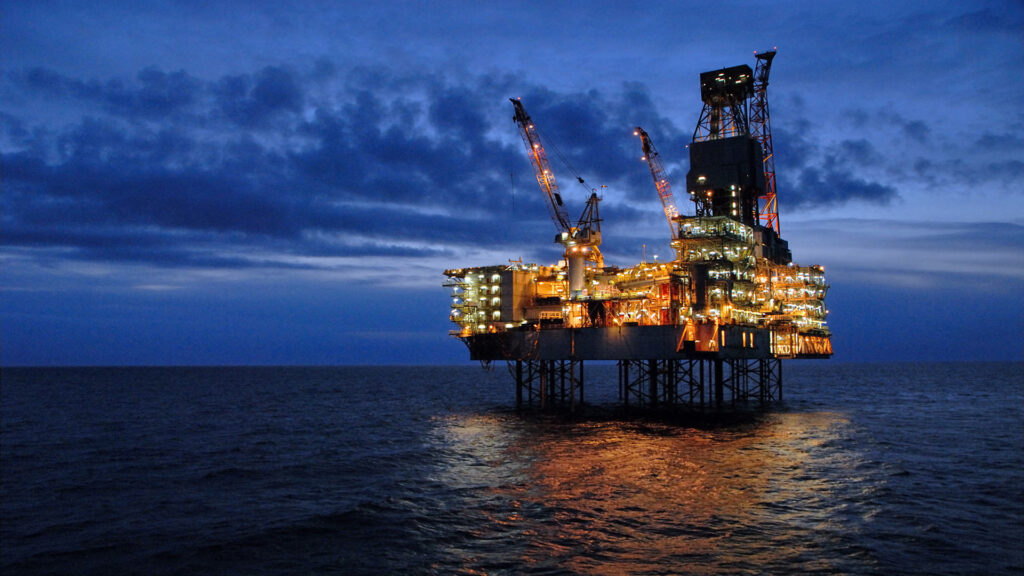
Thirty thousand litres of crude oil, seeping from the seafloor in the Gulf of St. Lawrence, went undetected for 50 days last summer. No alarm sounded. No cleanup crew mobilized.
That is because no one was looking for it. The leak was discovered by accident.
Julien Vadnais, a PhD student at the University of Bergen in Norway, and his colleagues were testing satellite algorithms in August 2025. They wanted to see how well their radar data covered the Gulf. What they found instead was a major natural oil spill 35 kilometres northwest of the Old Harry geological structure.
The finding, published in the scientific journal Geology, marks the first confirmed natural oil leak in the St. Lawrence. Vadnais told Le Devoir the discovery was entirely unexpected.
The flow was quantified using a nearby oceanographic buoy. Here is the immediate question: what else is down there? Old Harry was once a target for fossil-fuel companies.
The geological formation held commercial promise. That interest has since faded, but the new data suggests the region’s subsurface is active. The researchers’ most likely hypothesis is that oil escaped from a shallow accumulation, having migrated from a deeper deposit over several kilometres.
Seismic data and the regional geology support this. Vadnais was categorical on one point: this is not an exploitable oil deposit.
The leak is natural. But the discovery forces a reexamination of what lies beneath the Gulf floor. If oil can migrate that far and escape, what other accumulations exist?
Are there more seeps, active or dormant? The scientists say there is no indication the leak posed an environmental risk.
That is a cautious statement. Thirty thousand litres is not a trivial volume. It flowed over roughly seven weeks.
In a contained laboratory setting, that amount of oil would be a hazard. At sea, diluted and dispersed, it may have been harmless. But the word “may” carries weight.
The researchers did not conduct an environmental assessment. They quantified the leak.
They did not measure its impact on marine life, water quality, or shoreline exposure. That gap matters. The Gulf of St. Lawrence is a working body of water.
It supports fisheries, shipping lanes, and coastal communities. A natural seep does not trigger the same response as a pipeline rupture or tanker accident.
But it is still oil entering the marine environment. The long-term effects of chronic, low-level seeps are poorly understood. This one was a single event.
Others could be ongoing. The technology that found this leak is still in development. Vadnais and his team are building algorithms to detect natural hydrocarbon seeps from satellite radar.
Their test worked. It found something real.
That means the method can be used elsewhere. It also means the Gulf of St. Lawrence is no longer a blank space on the map of natural seeps. What is at stake is not an oil rush.
The scientists ruled that out. What is at stake is knowledge.
The region’s geology is more complex than previously understood. Oil can move. It can surface.
It can do so without human intervention or oversight. The next leak might be larger. It might happen closer to shore.
It might not be detected by a curious PhD student testing software. For now, the data is clear.
Thirty thousand litres. Fifty days. One buoy.
One accidental discovery. The Gulf gave up a secret.
It is up to researchers to decide whether to look for more.




