
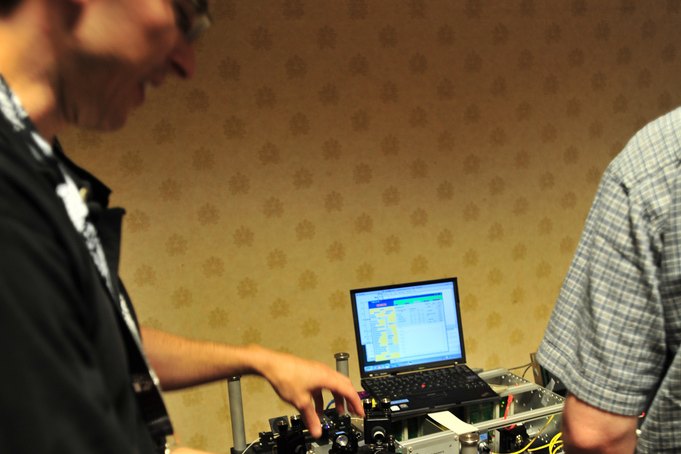
HEFEI, Aug 4 — A team of physicists has pushed quantum entanglement across 420 kilometers of optical fiber, more than four times the distance of earlier demonstrations and a step that could determine whether a future quantum internet is built on the ground rather than in the sky. The experiment, described in a peer-reviewed journal, clears a threshold that has long blocked terrestrial quantum networks: the point where photon loss in glass normally destroys the fragile link between entangled particles.
Direct transmission of entanglement over fiber had previously stalled at roughly 100–150 kilometers, because every kilometer of cable absorbs and scatters photons, and noise eventually overwhelms the quantum signal. The new work breaks past that wall using advanced quantum repeaters and error-correction techniques.
Quantum memory nodes store the entangled state at intermediate points, and a process called entanglement swapping extends the range without letting the quantum state degrade. The result is a working demonstration that long-distance entanglement can survive inside the very infrastructure telecom operators already use.
A terrestrial route to the quantum internet
The achievement matters because of what it makes practical. Quantum entanglement — where particles remain correlated regardless of distance — is the backbone of quantum key distribution, or QKD, a method of secure communication that detects any attempt at eavesdropping. A quantum internet built on QKD would allow banks, governments and data centers to exchange keys that cannot be intercepted without being noticed.
But for that to work over real distances, entanglement has to travel through optical fiber, not just open air or space. The most famous precedent, China’s Micius satellite experiment in 2017, distributed entanglement over 1,200 kilometers.
That was a landmark, but it relied on free-space transmission between the satellite and ground stations. Free-space links work well over long lines of sight, yet they are less practical for dense terrestrial networks, where cities, buildings and weather get in the way. Fiber is already everywhere — in the ground, under the sea, inside data centers.
The new 420-kilometer result suggests the quantum internet may arrive not via a constellation of satellites but through the same cables that carry today’s internet. The collaboration spans three groups: researchers at the University of Science and Technology of China, the University of Vienna, and industry partners specializing in fiber-optic infrastructure.
That mix of academic and commercial players is itself notable. For Asia, where several governments have treated quantum communication as a strategic priority, the involvement of industry partners in the experiment points to a faster road from laboratory to deployed network.
From a 1935 paradox to 2026
Quantum entanglement has a long and contentious pedigree. Albert Einstein, Boris Podolsky and Nathan Rosen laid out what became known as the EPR paradox in a 1935 paper, arguing that entanglement’s implications violated local realism and therefore that quantum mechanics was incomplete. Erwin Schrödinger, who coined the term entanglement, published several papers on the subject that same year.
Einstein and Niels Bohr argued about the interpretation for decades, with Bohr defending the quantum view. Later experiments settled the scientific question.
Measurements of polarization or spin on entangled particles at separate locations statistically violated Bell’s inequality, proving that the correlations cannot be explained by local hidden variables. Since then, entanglement has been demonstrated experimentally with photons, electrons, top quarks, molecules and even small diamonds. The phenomenon remains strange — measuring one particle appears to collapse the shared state of the whole system — but it is now an engineering fact, not just a philosophical puzzle.
One limitation is worth stating plainly: entanglement cannot transmit information faster than light. The correlations are statistical, not causal.
But for secure communication, that is not a drawback. QKD does not rely on superluminal signaling; it relies on the fact that any measurement disturbs the entangled system in ways both parties can detect.
What to watch next
The 420-kilometer mark is not the end of the road. The experiment demonstrates feasibility, not yet a deployed network. The next challenge is scaling: linking multiple repeater segments into longer chains, improving the fidelity of quantum memory nodes, and proving the system works outside laboratory conditions on live fiber infrastructure.
Analysts will also watch whether the industry partners involved commercialize the technology, or whether the approach stays in the research domain for a few more cycles. For India and the wider Asia-Pacific region, the direction of travel is clear.
Terrestrial fiber networks are already extensive, and quantum repeaters that work inside those networks remove the single biggest technical obstacle to country-scale QKD. The race to a quantum internet is no longer just about satellites in orbit; it is increasingly about the glass already buried under our streets.
Sources
{“@context”: “https://schema.org”, “@type”: “NewsArticle”, “headline”: “Physicists Break Quantum Entanglement Record Over 420 km Fiber”, “description”: “HEFEI, Aug 4 — A team of physicists has pushed quantum entanglement across 420 kilometers of optical fiber, more than four times the distance of…”, “datePublished”: “2026-08-04T09:30:00+00:00”, “author”: {“@type”: “Person”, “name”: “Arjun Mehta”}, “publisher”: {“@type”: “Organization”, “name”: “InfoPulse Today”, “url”: “https://newsfeed.infopulsetoday.com/”}, “citation”: [{“@type”: “CreativeWork”, “url”: “https://en.wikipedia.org/wiki/Quantum_entanglement”}]}




