
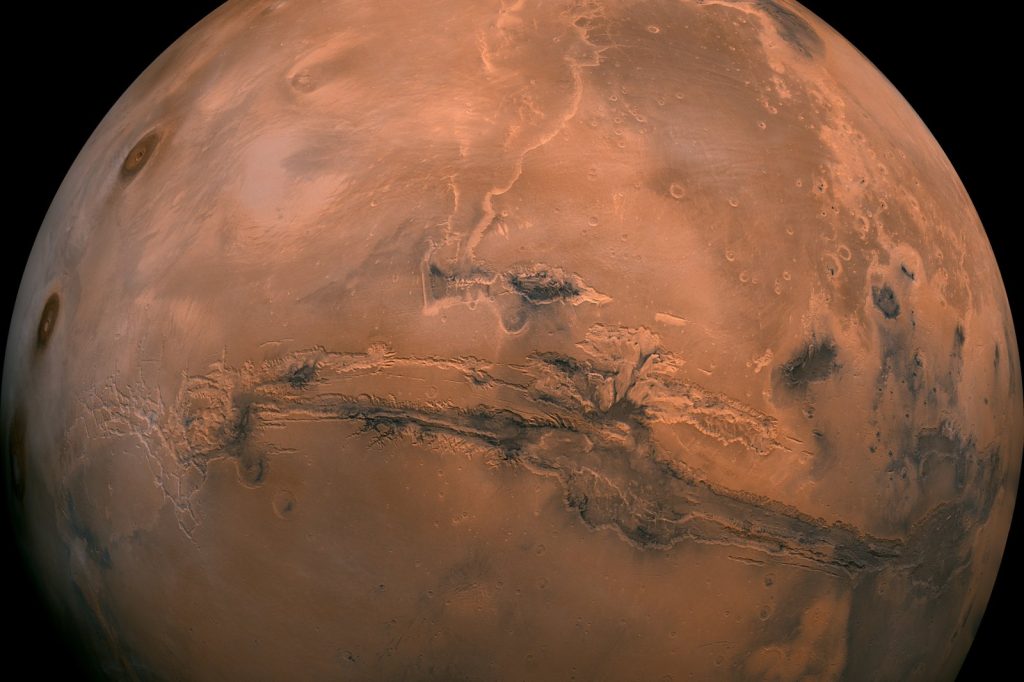
Mars loses gas to space at about 100 grams a second. That is roughly a quarter of a pound, every second, and it is the number NASA’s MAVEN orbiter put on the table when the mission announced its results at a media briefing on Nov. 5, 2015.
The finding explains a lot. Ancient Mars was a warmer world with standing bodies of water that could have supported life. Today it is cold, dry and desert-like. MAVEN’s team says the solar wind did the stripping.
When the magnetic field switched off
Bruce Jakosky, MAVEN’s principal investigator at the University of Colorado Boulder’s Laboratory for Atmospheric and Space Physics, laid out the sequence. Mars once had a global magnetic field that shielded it from the solar wind. “So it would have been the turn off of the magnetic field, that would have allowed the turn on of stripping of the atmosphere by the solar wind,” he told Universe Today.
The evidence suggests the field disappeared about 4.2 billion years ago, as the planet’s internal dynamo cooled. Water kept carving the Martian surface until about 3.7 billion years ago, and the atmosphere was stripped away over roughly the same span.
How the stripping works
The solar wind is a stream of particles, mainly protons and electrons, flowing from the sun at about a million miles per hour. According to a NASA description, the magnetic field it carries past Mars can generate an electric field, much as a turbine on Earth generates electricity. That field accelerates charged atoms in the upper atmosphere, called ions, and shoots them into space.
MAVEN watched it happen. NASA’s visualization compares simulations with the orbiter’s measurements of escaping oxygen ions. The most energetic ions are accelerated in a plume above the planet, while most of the escaping ions are lost along the tail in the wake of the solar wind. Solar storms sharply raise the loss, compared with normal solar wind conditions.
David Brain, a MAVEN co-investigator at the lab, said measurements from the spacecraft’s nine instruments show the solar wind removing carbon dioxide and oxygen at that 100-gram rate today.
A lot more gas, a long time ago
Today’s loss is small. “Most of the stripping by the solar wind at Mars was thought to have taken place very early in the history of the solar system when the sun was much more active,” Jakosky said at the briefing.
The current atmosphere is about 6 millibars thick, just under 1 percent of Earth’s. Jakosky said getting there would have meant removing about as much gas as is in Earth’s atmosphere today, which implies an early loss rate 100 to 1,000 times higher than now. That fits what models had predicted.
The results appeared in nearly four dozen papers in the Nov. 5 issues of Science and Geophysical Research Letters. With them, the team met the mission’s primary goal: working out how and why Mars lost its early, thick atmosphere and water over the past four billion years. MAVEN, a $671 million spacecraft, reached Mars orbit on Sept. 21, 2014, and its extended mission was due to begin on Nov. 16.
Michael Meyer, lead scientist for NASA’s Mars Exploration Program, put the stakes plainly. “Water is the prime ingredient needed for life,” he said. NASA’s stated goal is to send humans to Mars in the 2030s.
Sources
- NASA's MAVEN Orbiter Discovers Solar Wind Stripped Away Mars Atmosphere Causing Radical Transformation
- NASA Scientific Visualization Studio | Solar Wind Strips the Martian Atmosphere




