
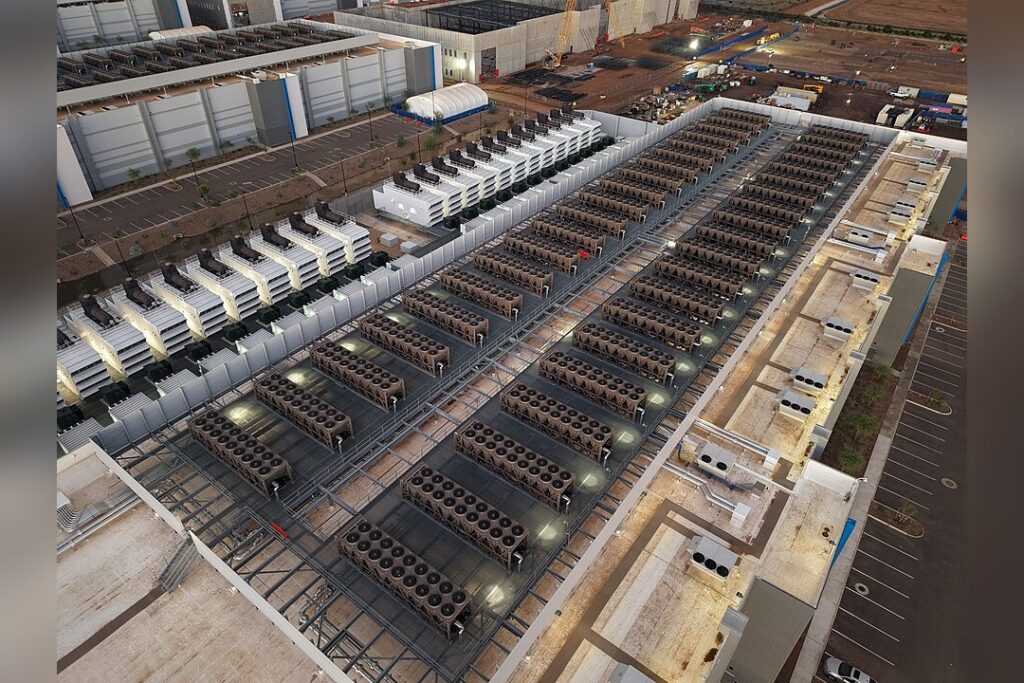
A $400 million data center campus in Ashburn, Virginia is built, wired and waiting for servers. The utility says it can deliver power in 2030. The investors’ model assumed 2026.
An April energy-market analysis describes that mismatch between construction schedules and grid schedules as the central tension in the sector right now. Its author argues that the ability to deliver firm power to a specific place on a specific date has become the scarce asset.
A 49-gigawatt gap
The numbers are lopsided. Morgan Stanley projects 74 gigawatts of US data center power demand by 2028. Grid capacity already committed over the same period comes to roughly 25 gigawatts, leaving 49 gigawatts to be filled some other way.
The analysis says gas-fired plants are filling it. Combined-cycle units and peakers can be sited, permitted and commissioned faster than renewables stuck in congested interconnection queues. Each gigawatt of data center load that comes online, it argues, is firm demand that gas generation will serve for 10 to 15 years, locked in by power purchase agreements that utilities are signing now. That cuts against the older forecast of gas demand peaking between 2025 and 2027 and then declining.
Where it is tight
Loudoun County, Virginia has run out of substation capacity in several locations. ERCOT in Texas is taking on data centers at the same time as manufacturing and Bitcoin mining, with thin reserve margins to begin with. Singapore has frozen new data center approvals. Ireland is running what the analysis calls a de facto rationing system.
Nuclear and private money
Microsoft, Amazon and Google have all made nuclear commitments, from power purchase agreements to direct reactor investments and small modular reactor programs. None of the new projects will deliver commercial-scale power before 2035, according to the analysis. A hyperscaler holding a nuclear PPA that starts in 2035 can live with a gas-fired stopgap, it says.
Money is following. Infrastructure funds that shifted hard toward renewables between 2020 and 2022 are rebuilding gas positions in PJM and ERCOT, in pipelines serving constrained corridors, and in batteries designed to sit alongside gas peakers. Some institutional portfolios now hold uranium.
Power rates in northern Virginia’s data center corridors have risen substantially over the past two years, the analysis says, and that cost passes into cloud pricing.




