
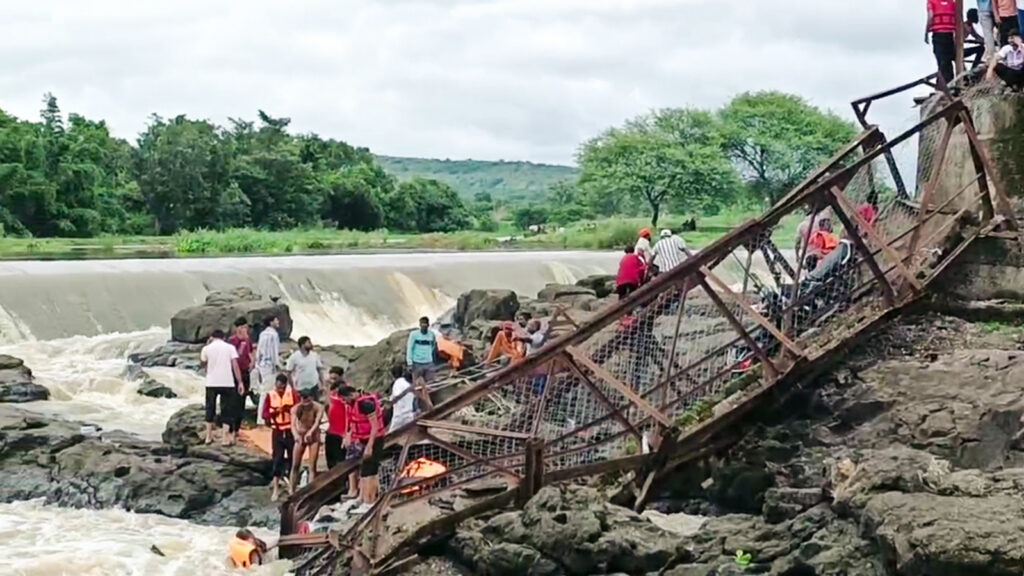
Pune, June 15, 2025 — cybernewschronicle.com — Twenty-five people are missing in the river below. Six are dead. Thirty-two more are injured, six of them critically.
Those are the numbers from a bridge collapse in Kundamala, Pune, that gave way on June 15, 2025. The structure, a bridge over a river in a popular tourist area, simply failed.
Tourists were on it when it happened. Pune is not a small town. It is the largest city in Maharashtra by area at 516.18 square kilometers.
Its metropolitan region held 7.2 million people as of the 2011 Census. That is a lot of lives depending on bridges, roads, and public infrastructure every single day.
When a bridge falls in a place like that, the stakes are not abstract. They are measured in bodies pulled from water. The injured are in nearby medical facilities.
That is where the six critical cases are. Search teams are still looking for the 25 swept away. Rescue efforts are ongoing.
But the event has already shifted from a simple accident to a systemic question. How does a bridge over a river in a tourist zone collapse with people on it?
This is not a remote rural crossing. Kundamala is part of Pune, the administrative headquarters of the Pune district and Pune division. It is a hub.
It draws tourists for its history and culture. The bridge was not some forgotten back-road structure.
It was in a place people go intentionally. That makes the failure harder to explain away as an act of nature or bad luck. Local calls for a thorough investigation have started.
They want to know why the bridge gave way. They want to know who was responsible for inspecting it, maintaining it, and certifying it safe. Those are reasonable demands.
When a structure fails in a city of 7.2 million, the margin for error is zero. The consequences are not theoretical.
They are six dead and 25 missing. The broader issue is infrastructure maintenance across tourist hotspots. Pune is a major economic and cultural engine for Maharashtra.
Its bridges, roads, and public spaces carry heavy use. They carry locals commuting to work.
They carry tourists visiting for leisure. They carry everyone. When maintenance slips, the result is not a delay.
It is a collapse. Six people are dead because of that slip. Twenty-five more may be dead.
The six in critical condition may join them. Those are the real stakes.
Not a political talking point. Not a budget line item. People are gone or may soon be gone because a bridge failed to hold.
The rescue teams are working. The hospitals are treating.
The community is in shock. But the fundamental question remains unanswered. Who let that bridge get to the point where it could not bear its own load?
That is what the investigation must find. That is what the public needs to know. Because if it can happen in Pune, it can happen anywhere.
And the next time, the numbers could be worse.




