
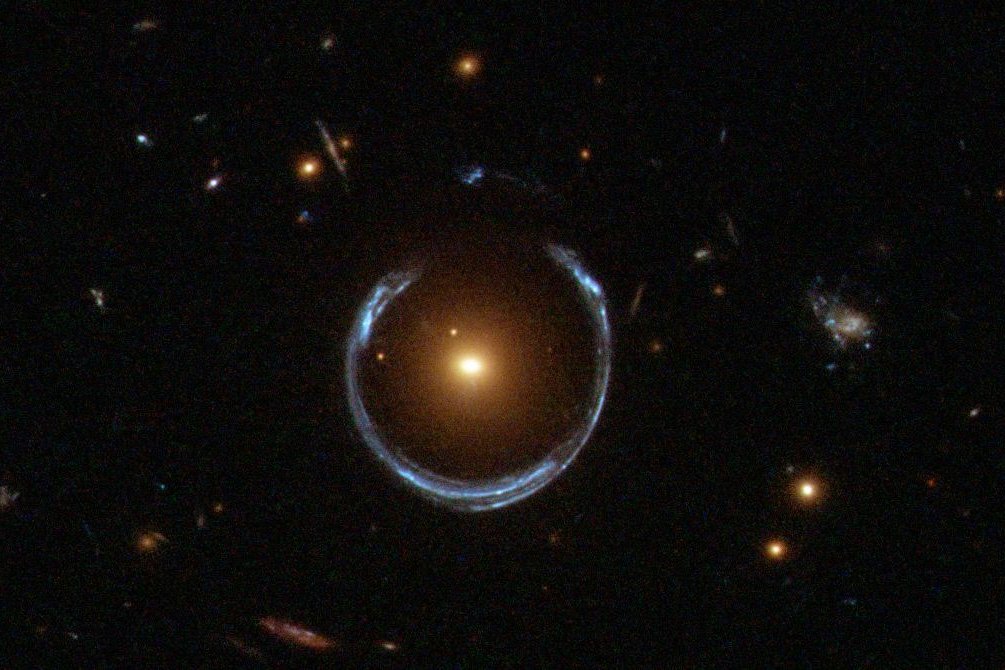
“We spent six years searching for such an event by compiling a list of promising gravitational lenses, and in August 2025, SN Winny matched exactly with one of them.” That is how Sherry Suyu, associate professor of observational cosmology at the Technical University of Munich (TUM), describes the find. She is also a Fellow at the Max Planck Institute for Astrophysics.
The object is a superluminous supernova, officially SN 2025wny, about 10 billion light-years away and far brighter than a typical stellar explosion. Suyu’s team nicknamed it SN Winny. It shows up in the sky five times. Two galaxies in the foreground bend its light onto paths of slightly different lengths, so each copy arrives at a different moment.
Suyu put the odds of finding a superluminous supernova lined up with a suitable lens at lower than one in a million.
A clean lens
To pin down the lens masses, researchers from the Max Planck Institute for Extraterrestrial Physics (MPE) and Ludwig Maximilians University (LMU) turned to the Large Binocular Telescope in Arizona. It has two 8.4-meter mirrors and adaptive optics that reduce atmospheric distortion. The result was the first high-resolution colour image of the system: two lensing galaxies at the centre, ringed by five bluish points of light.
That count is a surprise. Galaxy-scale lenses usually give two or four images.
Allan Schweinfurth of TUM and Leon Ecker of LMU, both junior members of the team, used the five positions to build the first detailed model of how mass is spread through the two galaxies. Schweinfurth explained why it matters. Earlier lensed supernovae were magnified by massive galaxy clusters, “whose mass distributions are complex and hard to model.” These two galaxies are different. “We find overall smooth and regular light and mass distributions for these galaxies, suggesting that they have not yet collided in the past despite their close apparent proximity.”
Why the delays count
The Hubble constant, the universe’s present expansion rate, is measured two ways that do not agree. This is the Hubble tension.
One method climbs a “ladder” of distances through nearby galaxies, using objects of known brightness and comparing the results with how fast galaxies recede. With many calibration steps, small errors can accumulate. The other studies the cosmic microwave background, the faint radiation left over from the Big Bang, and uses models of the early universe to work out today’s rate. It is very precise but leans on assumptions about cosmic history that are still debated.
A lensed supernova offers a third route. Stefan Taubenberger, lead author of the identification study, says that timing the gaps between the images, combined with the lens masses, gives the Hubble constant directly. “Unlike the cosmic distance ladder, this is a one-step method, with fewer and completely different sources of systematic uncertainties.”
Only a small number of lensed-supernova measurements have been attempted so far, and each depends on how well the lens masses are known. Telescopes on the ground and in space are still watching SN Winny.
Sources
- A one-in-a-million supernova seen five times could reveal the Universeâs true speed
- Measuring the expansion of the universe with cosmic fireworks
Sources
- A one-in-a-million supernova seen five times could… | ScienceDaily
- Measuring the expansion of the universe with cosmic fireworks




