
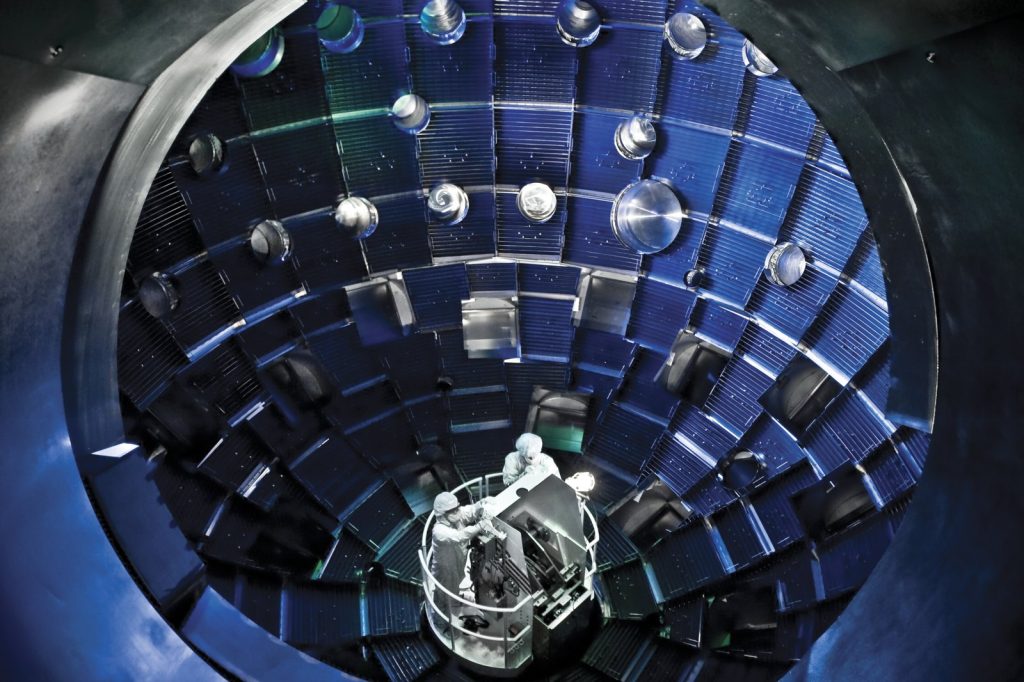
Focused Energy, a German fusion startup, has raised $240M to turn the laser experiment at the National Ignition Facility (NIF) into a commercial power plant. The utility RWE led the round. SPRIND, the German Federal Agency for Breakthrough Innovation, Prime Movers Lab and the European Innovation Council Fund also took part.
The first machine will be a demonstration system called Lighthouse. Focused Energy plans to put it on the site of a decommissioned nuclear fission plant in Germany that RWE operated. The choice is practical, since the site already has grid connections, cooling infrastructure and regulatory frameworks built for nuclear facilities.
From NIF to a power plant
The company works on inertial confinement fusion. Lasers squeeze a fuel target until conditions get extreme enough for atoms to fuse and give off energy. NIF, at Lawrence Livermore National Laboratory in California, proved the idea in December 2022. It remains the only controlled fusion reaction to release more energy than was needed to ignite it.
One person ties the startup directly to that result. Debbie Callahan, who helped design the fuel target for the NIF shot, joined Focused Energy in December as chief strategy officer. Her job is to make the target simple enough to mass-produce. NIF fires about 400 shots per year. A commercial reactor would need 10 shots per second, or roughly 864,000 per day.
One planned simplification is to drop the hohlraum, the precision-made gold cylinder NIF uses to turn laser energy into X-rays that then compress the fuel pellet. Focused Energy’s “direct drive” design has the lasers hit the pellet directly. That should raise efficiency and make the target easier to manufacture.
Crowded field, big gap
Rivals are well funded. Inertia Enterprises raised a $450 million Series A in February for its own inertial confinement reactor. Thea Energy raised $100 million last week. Type One Energy, backed by Bill Gates, raised nearly $90 million toward a $250 million Series B in January, and Commonwealth Fusion Systems raised $863 million for its magnetic confinement approach.
The distance from NIF to a plant is large. NIF’s net gain was measured against the energy delivered to the fuel, not the far greater energy its lasers drew. A commercial reactor has to show gain against total system input, which takes more efficient lasers and higher-yield targets. Direct drive removes the hohlraum’s energy losses, but the company still has to show its lasers can deliver the precision, repetition rate and efficiency for continuous operation.
The pressure is real, with AI infrastructure alone expected to consume 9% of US electricity by 2030. That does not change the physics. RWE’s role as lead investor, along with the offer of a plant site, suggests a company with long experience running power stations sees a credible path to grid power. Whether Lighthouse can close the gap between lab physics and commercial generation is the $500 million question.
Sources
Sources
- A German startup raised $240 million to commercialise the only…
- Focused Energy raises $240M to commercialise NIF laser fusion tech




