
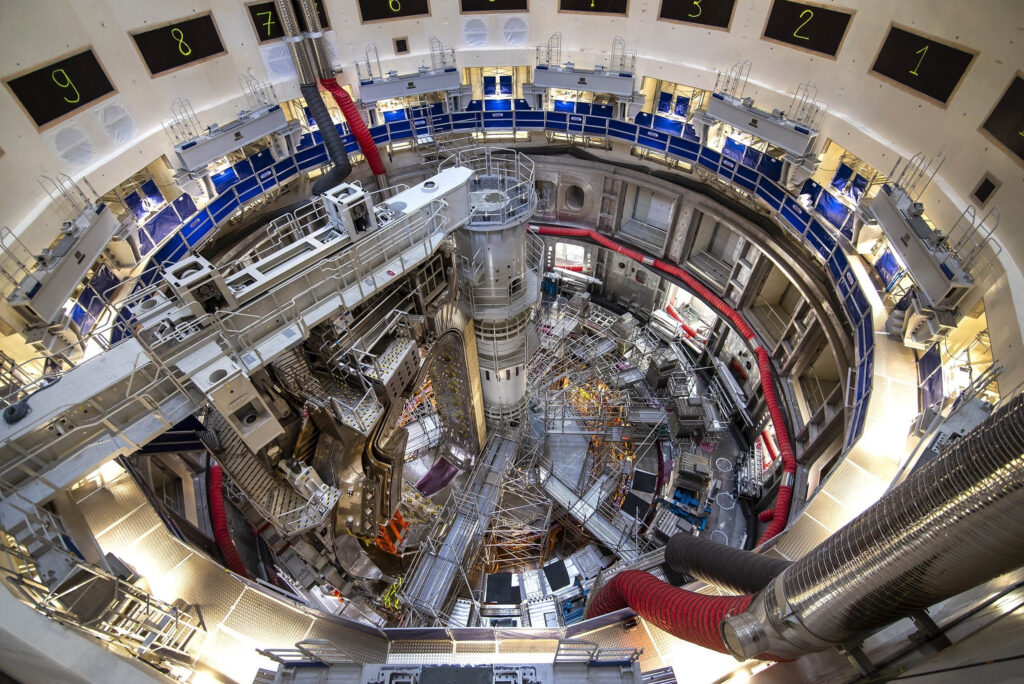
The strategic anomaly sits on a levelled 42-hectare platform at Cadarache, in the south of France. ITER, the world’s largest nuclear fusion experiment, launched in 2007 as a collaboration of 33 nations, is designed to prove fusion can work as a low-carbon energy source. Europe hosts it and, per the project’s own website, bears “the largest portion of construction costs,” some 45.6 percent. The Russian Federation, under sweeping European Union sanctions and frozen out of European science almost everywhere else, remains a 9.1% contributor.
The broader stakes explain why that combination is durable. The EU and Russia are geopolitical adversaries; since the invasion of Ukraine, Brussels suspended Russia from Horizon Europe, Horizon 2020, Euratom and Erasmus Plus, and CERN suspended Russian observer status in 2022 while refusing new collaborations. ITER, though, was built on different rules: its founding arrangements stipulate that no member can be removed. When three MEPs asked in 2025 whether the EU planned to phase out dependence on Russian participation, the reply from Commissioner Dan Jørgensen was plain: members cannot be expelled, only withdraw voluntarily.
What Moscow actually supplies is the reason the question will not go away. Russia delivers the PF1 poloidal field coil that shapes and controls the burning plasma, gyrotrons that heat it, and, in the project spokesperson’s words, “equipment supporting the power supply protection of the superconducting magnets” plus “vacuum vessel upper ports”. “The Russian Federation is an ITER member and participates through its Domestic Agency, Project Center ITER,” the spokesperson said, adding that all activities follow applicable legal and regulatory requirements.
The machine these feed is of a scale that forgives no missing part. Fuel heated to 150 million degrees Celsius inside a doughnut-shaped chamber, magnets cooled to -269 degrees to hold the plasma in a magnetic cage, a target of 500 megawatts of heat for about seven minutes, ten times more heat than the reaction takes to start. The site counts 39 buildings and power supplies, more than three thousand people on civil engineering, and European-built PF coils of 17 to 25 metres weighing 200 to 400 tonnes.
Strategically, the project’s defenders argue the interdependence is the point: a decades-long endeavour needing specialised knowledge and industrial supply chains, designed on the assumption that scientific cooperation survives political change. The assumption is under visible strain. ITER signed a fresh cooperation agreement with Russia’s Kurchatov Institute in June, covering exchanges of scientific information, research programs and training, even as European institutions cut other ties. The chessboard has moved; the fusion machine, half of the world’s population among its sponsors, is still welded across every divide.
Sources
- ITER : International Thermonuclear Experimental Reactor – Fusion for Energy
- The Russian exception: Why Moscow still has a role in Europe’s ITER fusion project despite EU sanctions | Euronews




