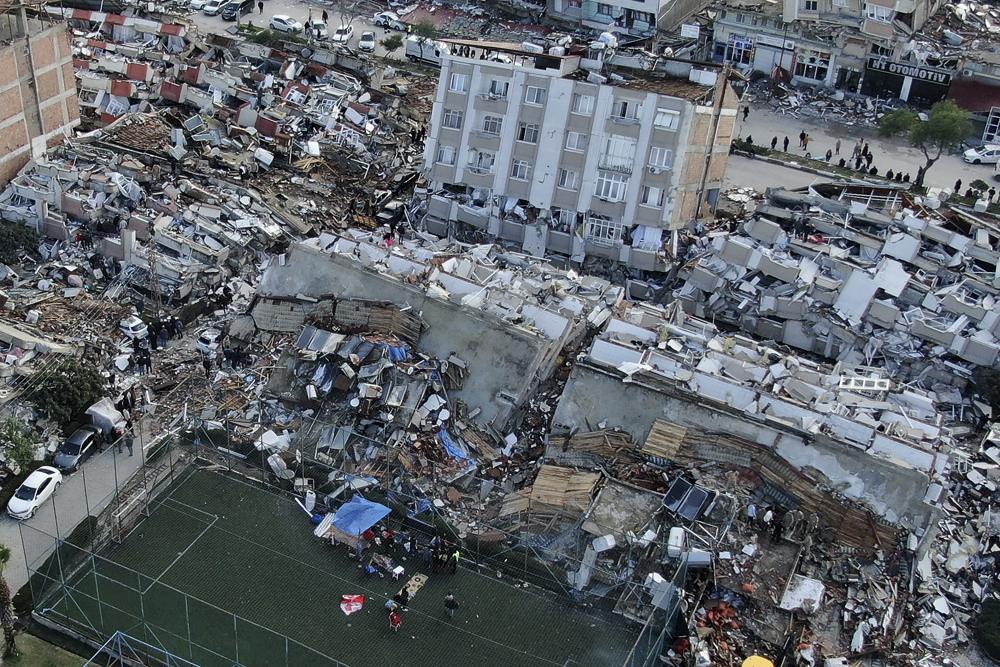
Rescue operations continued through the night of February 9, 2023, in Turkey and Syria after the death toll from the 7.8 magnitude earthquake exceeded 15,000. The disaster is now the deadliest earthquake worldwide in more than ten years. As freezing temperatures and extensive damage gripped the region—already scarred by Syria’s civil war—the likelihood of finding additional survivors diminished rapidly.
Emergency teams from over two dozen countries joined tens of thousands of local responders in the search. However, time was running out.
In the Turkish city of Malatya, journalist Ozel Pikal, who also participated in rescue work, painted a bleak picture. “There is no hope left in Malatya as of today, thus today is not a good day,” Pikal said. “No one is emerging from the wreckage alive.” He reported witnessing eight bodies removed from a collapsed building, laid side by side on the ground and wrapped in blankets while awaiting funeral vehicles.
Pikal also noted that a hotel in the city had collapsed, potentially trapping more than one hundred people. With temperatures falling to minus 6 degrees Celsius (21 Fahrenheit), he believes some victims may have frozen to death.
“The cold prevents our hands from picking up anything,” he added. “Working tools are required.” Turkish President Recep Tayyip Erdogan visited a tent city in Kahramanmaras, near the earthquake’s epicenter, where displaced residents had gathered. He acknowledged early shortcomings in the government’s response but pledged that no one would “be abandoned in the streets.” Many survivors spent nights in cars, outdoors, or in public shelters. Aysan Kurt, 27, told the Associated Press: “We lack everything, a tent, a heating source, and other essentials.
Our kids are in terrible shape. We are all getting drenched in the rain, and our kids are outside in the cold.
We won’t die from the cold; we didn’t die from hunger or the earthquake.” Turkey’s disaster management agency reported 8,500 deaths in the country. In Syria, the Health Ministry confirmed over 1,200 fatalities in government-held areas, while the White Helmets volunteer group estimated at least 1,400 deaths in the rebel-controlled northwest. The earthquake struck a region already devastated by more than a decade of civil war.
Millions had fled their homes in Syria, seeking safety in Turkey, and many of those refugees were among the dead. Syrian officials reported that the Bab al-Hawa border crossing was used to return the bodies of more than 100 Syrians who died in Turkey for burial.
Mazen Alloush, an officer on the Syrian side of the border, said twenty more bodies were on the way. All were Syrian refugees who had fled the civil war. Aid efforts in Syria faced severe obstacles due to the ongoing conflict and the isolation of the rebel-held border region, surrounded by government forces backed by Russia.
Western sanctions related to the war have made Syria a global pariah, further complicating relief operations. Despite the overwhelming tragedy, a few rescues offered moments of hope.
Polish rescuers in Turkey pulled nine people alive from the rubble, including parents with two children and a 13-year-old girl from the ruins in Besni. Two firefighters told Polish TVN24 that the cold weather was working against them, but some survivors may have benefited from being trapped in bed with warm covers during the early-morning quake. In Kahramanmaras, three-year-old Arif Kaan was rescued nearly two days after the earthquake.
Emergency workers carefully hacked rubble away from the boy, whose lower body was pinned under concrete slabs and twisted rebar. They covered his torso with a blanket to keep him warm.
His father, Ertugrul Kisi, who had himself been rescued earlier, sobbed as his son was freed and loaded into an ambulance. A Turkish television reporter exclaimed: “For now, the name of hope in Kahramanmaras is Arif Kaan.” In northwest Syria, residents of the village of Jinderis found a wailing infant on Monday, still attached by umbilical cord to her dead mother. The newborn was the only member of her family to survive a building collapse.
But such stories were rare. More than two days after the pre-dawn earthquake, thousands of buildings lay in ruins, and the cold continued to tighten its grip.
The death toll was expected to rise significantly. The 2011 earthquake near Japan, which triggered a tsunami, killed nearly 20,000 people. Turkey and Syria have not given figures for the number of people still missing.