
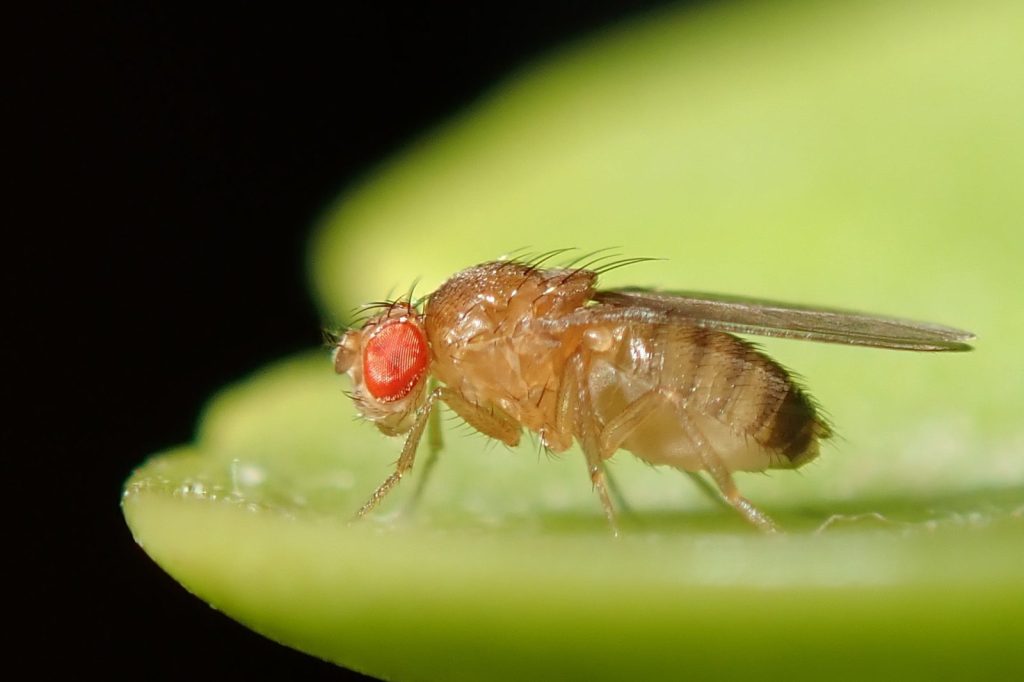
In the video, an animated fruit fly shuffles its legs, rubs them together and dips its proboscis into a small dish to drink. The insect is not real. Eon Systems built it from the wiring of a real fly’s brain, 125,000 neurons and 50 million synaptic connections, and placed it in a virtual sandbox that looks like something out of “The Matrix.”
Alex Wissner-Gross, a co-founder of the company, published the clip. “For decades, whole brain emulation has been a tantalizing analogue of artificial intelligence. To copy it neuron by neuron, synapse by synapse, and run it,” he wrote. He called the experiment “the world’s first embodiment of a full brain emulation capable of producing multiple types of behavior.”
How the loop closes
The work builds on research by Eon’s senior research scientist Philip Shiu and colleagues. The team relied on the FlyWire connectome, an existing project from Princeton University that charts the neural circuitry of the adult fly.
A computational model of the fruit fly’s brain had already appeared in 2024. Built to study the circuits behind feeding and grooming, it predicted the simulated fly’s motor behavior with about 95% accuracy. Activating neurons sensitive to sugar or water, the paper states, “accurately predicts the nerve cells responding to taste.”
What Eon added was a place for that brain to live. Wissner-Gross described a “disembodied brain” given an environment. “Sensory signals come in, neural activity spreads throughout the connectome, motor commands go out, and the physically simulated body executes them,” he said. “For the first time in history, whole brain emulation closes the loop from perception to action.”
He also pointed to earlier work, including a 2025 effort by DeepMind’s team that modeled the fly’s neural pathways with reinforcement learning.
The mouse is next
Eon says it will build a digital mouse brain first and a human brain after that. The scale is the obstacle: a mouse brain holds over 500 times more neurons than a fruit fly’s.
Wissner-Gross does not treat that as a barrier of principle. “If the sensory-motor loop could be closed in the fly simulation, for a mouse, it’s a matter of scale, not principle,” he wrote.
Other labs are working on related problems. In July 2024, Chinese scientists developed a robot with a lab-grown artificial brain that can be taught to perform various tasks.




