
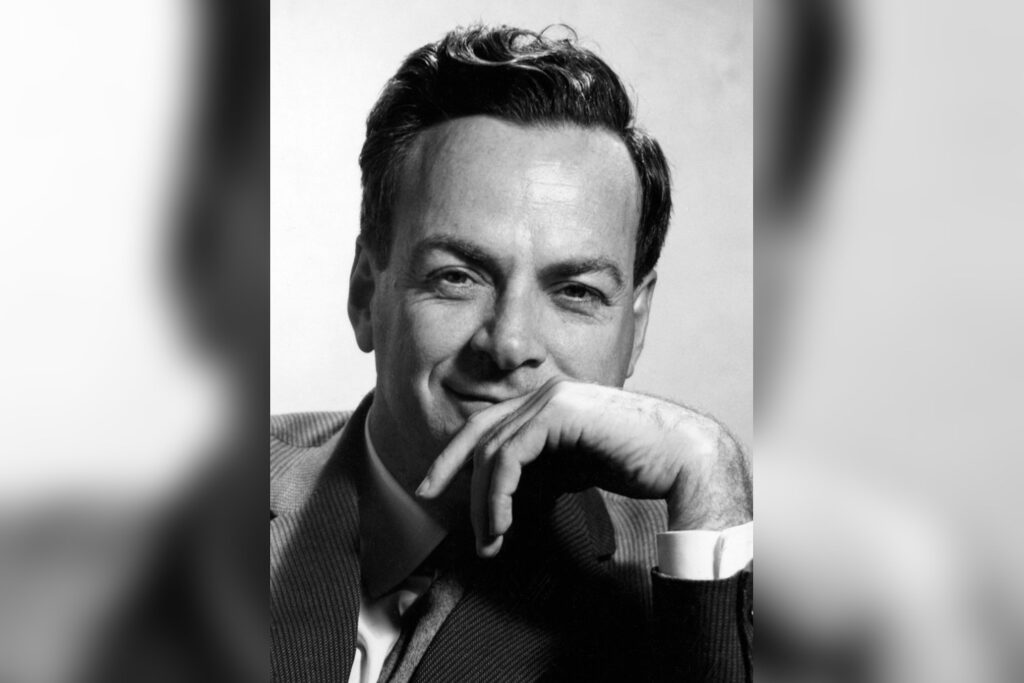
PASADENA, July 8 — The intellectual architecture of the modern world rests on foundations laid decades ago, often in a single lecture hall. For the field of quantum computing, that foundation was poured in 1982 at MIT, by a man who was already a titan of theoretical physics. Richard Feynman, the Nobel laureate known for his work in quantum electrodynamics, stood before the First Conference on the Physics of Computation and made a case that was a direct challenge to the computing establishment.
He argued that classical computers were fundamentally incapable of efficiently simulating quantum systems. The calculus was simple: if you want to understand the quantum world, you need a machine that speaks the same language.
Feynman’s proposal was radical in its elegance. He suggested using quantum systems themselves as the computing substrate. This was not a minor technical tweak; it was a shift in the broader stakes of computation.
Instead of trying to force a classical machine to approximate quantum behavior, Feynman envisioned a computer that operated on the same probabilistic, superposition-based rules as the physical universe it sought to model. His 1982 paper, “Simulating Physics with Computers,” is now considered the foundational text of quantum computing, a document that laid out the roadmap for an entire industry before the first qubit was ever built.
The timing of Feynman’s talk is worth noting. It came nearly four decades after his work on the Manhattan Project, where he had witnessed firsthand the computational demands of nuclear physics. Between 1942 and 1945, the project relied on human “computers” and rudimentary electromechanical machines to solve the equations of fission.
That experience, combined with his later work at Cornell University and the California Institute of Technology, gave Feynman a unique vantage point on the limits of classical calculation. He had already revolutionized theoretical physics with the development of Feynman diagrams—a graphical method for tracking particle interactions that became a standard tool in the field. Born in 1918, Feynman was a polymath whose influence extended far beyond the equations of quantum electrodynamics, for which he shared the 1965 Nobel Prize with Julian Schwinger and Sin-Itiro Tomonaga.
He was also a bestselling author, with works like “Surely You’re Joking, Mr. Feynman!” reaching audiences far beyond the physics community. But it is the 1982 talk at MIT that continues to resonate most loudly in the current technological landscape.
What Feynman signaled that day was not just a new type of computer, but a new way of thinking about the relationship between physics and information. The broader stakes of Feynman’s insight are only now becoming fully apparent. For decades, quantum computing remained a theoretical curiosity, a concept that seemed perpetually decades away from practical realization.
The engineering challenges were immense: maintaining quantum coherence, correcting errors, and scaling up the number of qubits required a level of precision that seemed almost impossible. Yet the strategic logic of Feynman’s argument never faded.
If a classical computer cannot simulate a quantum system efficiently, then the discovery of new materials, new drugs, and new chemical processes will remain gated by computational limits. Today, as nations and corporations race to build fault-tolerant quantum systems, Feynman’s 1982 lecture is frequently cited as the moment the race began. The physics of computation is no longer an abstract subfield; it is a geopolitical chessboard.
Governments in Washington, Beijing, and Brussels are pouring billions into quantum research, recognizing that the nation that achieves quantum supremacy first will hold a decisive advantage in cryptography, materials science, and artificial intelligence. The calculus has shifted from “if” to “when.” What this signals is a profound intellectual debt. Every quantum startup, every government research lab, and every tech giant pursuing a quantum roadmap is, in a real sense, following the path Feynman sketched out in a single conference talk.
The man who helped build the atomic bomb and then spent the rest of his career demystifying the quantum world had, in his later years, handed the next generation its most ambitious challenge. He died in 1988, six years after that foundational talk, but his intellectual legacy continues to shape the strategic priorities of the 21st century.
The coming years will test whether the engineering can catch up to the vision. The first fault-tolerant quantum computers are expected to emerge within the next decade, and when they do, they will be running on the architecture Feynman proposed. The question is no longer whether quantum systems can compute—Feynman settled that question in 1982.
The question now is how fast the world can build them, and who will get there first.
{“@context”: “https://schema.org”, “@type”: “NewsArticle”, “headline”: “Richard Feynman: The Nobel-Winning Physicist Who First Proposed”, “description”: “PASADENA, July 8 — The intellectual architecture of the modern world rests on foundations laid decades ago, often in a single lecture hall. For the…”, “datePublished”: “2026-07-08T09:30:00+00:00”, “author”: {“@type”: “Person”, “name”: “Noah King”}, “publisher”: {“@type”: “Organization”, “name”: “InfoPulse Today”, “url”: “https://newsfeed.2bme.xyz/”}}




