
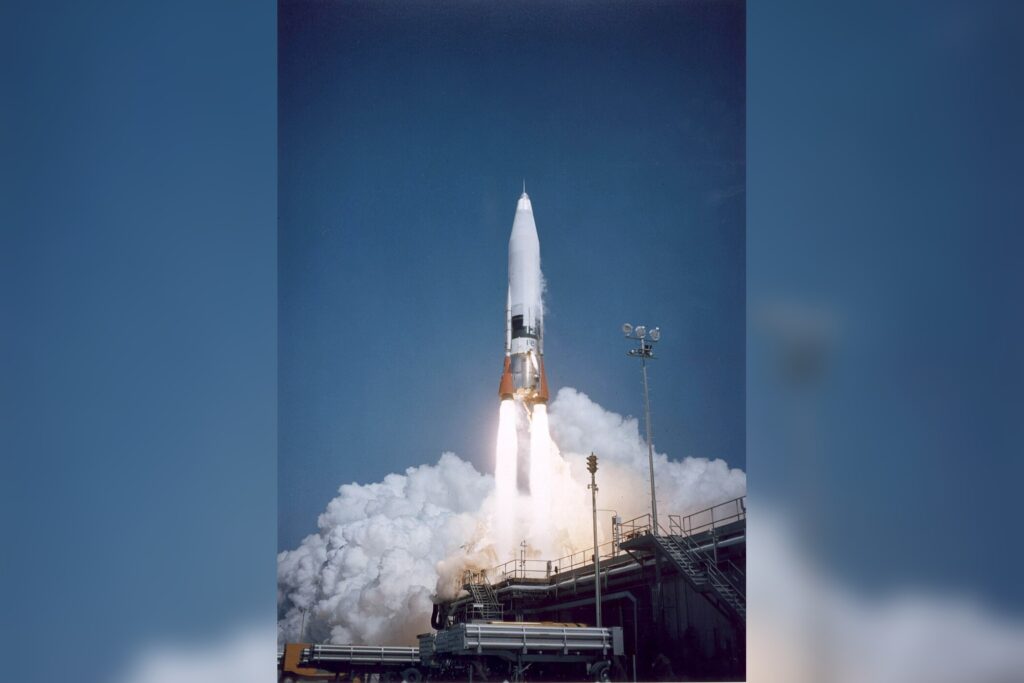
The Cold War competition to build the first intercontinental ballistic missile was decided by a margin of just under four months. On August 21, 1957, the Soviet R-7 Semyorka lifted off from a launch pad and became the world’s first operational ICBM.
The United States answered with the Atlas missile, which logged its first successful flight test on December 17 of the same year. That narrow gap in 1957 established a lasting pattern: the same rocket technology that could deliver a nuclear warhead across continents could also, with modifications, place a satellite in orbit. The R-7’s lineage is direct. The same booster, adapted from its ICBM configuration, launched Sputnik 1 in October 1957, shocking the world and triggering the Space Race.
Later, the R-7 family carried Yuri Gagarin’s Vostok spacecraft. On the American side, the Atlas rocket had a second life as the launch vehicle for Project Mercury, carrying the first U.S. astronauts on orbital flights.
The Titan and Minuteman missile families also contributed their propulsion and structural designs to civilian launch vehicles. These were not separate programs; they represented the same engineering, repurposed from strategic deterrence to space exploration.
The Treaty and the Reconnaissance Imperative
By 1967, the dual-use tension between weapons and spaceflight was clear enough to draw a legal line. The Outer Space Treaty, signed that year by the United States, the Soviet Union, and other nations, banned the placement of weapons of mass destruction in orbit. What it did not ban—and what became vital—was military satellites for reconnaissance and communication.
The United States moved quickly to exploit this gap. On August 18, 1960, the Air Force launched Discoverer 14, the first successful Corona reconnaissance satellite mission.
That flight returned the first film ever recovered from orbit, a feat that gave American intelligence a direct look at Soviet missile sites and military installations. The reconnaissance imperative shaped the entire trajectory of space policy. Early ICBMs, including the R-7 and Atlas, were liquid-fueled designs that required fueling before launch, slowing response times.
Later models shifted to solid propellant, enabling faster deployment and the transition from fixed silos to mobile truck launchers. The same propulsion advancements that made missiles more responsive also fed into launch vehicle reliability.
The early missiles lacked precision and could only hit large area targets like cities, making crewed bombers necessary for attacking specific military sites. Newer generations improved accuracy to the point that modern designs can hit small point targets, and some can carry several warheads to strike different locations with a single launch.
What Investors Should Watch
The ICBM-to-space pipeline remains the foundational architecture for every major launch provider today. The same engineering logic that sent the R-7 and Atlas aloft underpins modern boosters.
The difference is payload: nuclear warheads have been replaced, in most cases, by communications satellites, Earth-observing platforms, and crew capsules. The current generation of ICBMs—the U.S. Air Force’s Sentinel program, Russia’s Sarmat, China’s DF-41—continues the pattern. They are designed for deterrence, but their production lines and propulsion technologies feed into the commercial and military space sectors.
The 1967 treaty did not end the linkage; it simply shifted the boundary. The technology that began with the V-2 rocket program in Nazi Germany—those liquid-fueled missiles bombed cities in Britain and Belgium during the final years of World War II—was inherited by both superpowers after the war.
Today, only a few nations possess operational ICBMs. Because they provide a way to maintain a nuclear deterrent from home soil, they influence how world powers interact. The ability to strike distant targets quickly changes the nature of international diplomacy and defense.
The engineering bridge between missiles and spacecraft, forged in the 1950s, remains intact decades later, driving both security strategy and commercial access to orbit.




