
The last evening was orderly, which is part of the mystery. Aboard the steamship Dresden on the night of 29 September 1913, the engineer Rudolf Diesel dined and asked for a 6:15 am call. When the steward came, the cabin spoke: bed untouched, nightshirt laid out, watch on the vanity, hat and overcoat folded beneath the afterdeck railing. Diesel, crossing from Antwerp to Harwich, vanished into the North Sea night.
Against this backdrop stands a thoroughly European life. Raised in Paris, Diesel was twelve in 1870 when the Franco-Prussian War drove the family to London, then on to relatives in Augsburg, where an uncle taught him German and mathematics. A scholarship took him to Munich’s Royal Bavarian Polytechnic, he graduated in January 1880 with his class’s highest honours. Back in Paris he built refrigeration plants with Carl von Linde, later ran its Berlin research office, and amassed patents his contract barred him from exploiting. So he sought his own field.
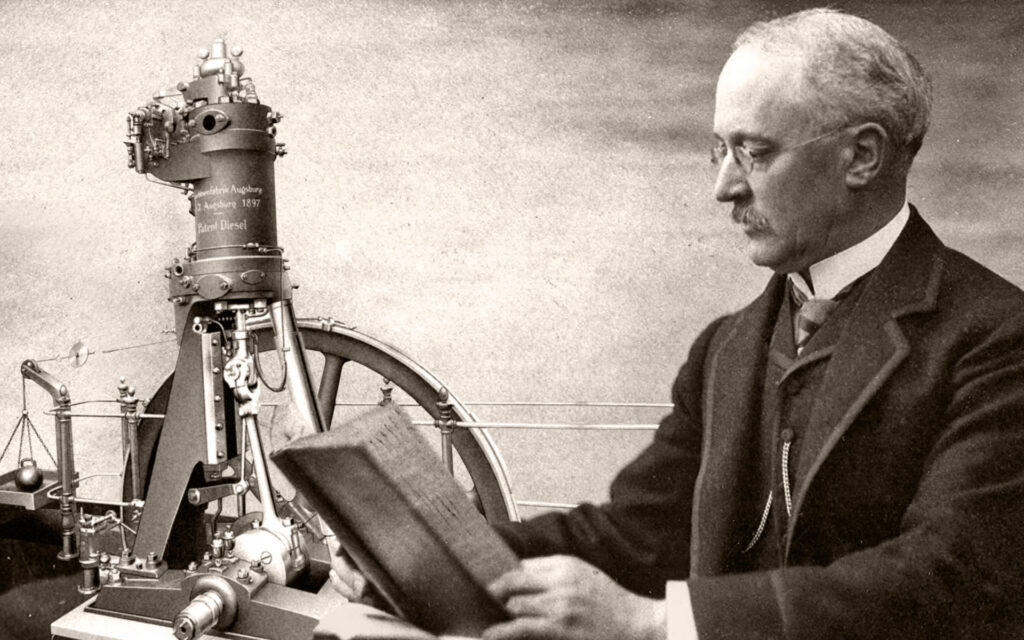
An early ammonia-vapour engine blew up in testing, costing a long hospital stay and lifelong eyesight damage. He patented the engine on February 28, 1892, and set out the idea a year later in a paper titled “Theory and Construction of a Rational Heat Engine to Replace the Steam Engine and Contemporary Combustion Engine”: compression ignition, fuel meeting air squeezed until hot enough to catch, no ignition system, burning almost any fuel, prototypes included peanut and vegetable oil. Steam engines of the day threw away more than 90 percent of the energy in their fuel; he promised 75 percent, and the best engine he built achieved 26 percent. Its first successful run came in 1897, and that machine is preserved in Munich’s Deutsches Technikmuseum.
Within a decade the world had its first diesel ships, trucks and submarines; by 1912 more than 70,000 engines ran worldwide, mostly in factories and generators, trains joining that year. After World War II trucks and buses hauled heavy loads on it economically.
The mystery closes in. On October 10 a Belgian sailor spotted a decomposed body; it stayed in the water, but the identification card and pocket knife taken from it were Diesel’s. He had left his wife Martha a bag for the following week: 200,000 marks in cash, about 1.2 million dollars today, beside statements showing the accounts at zero. His diary, found aboard, carried a cross on September 29. The official judgement was suicide; he was nearly broke, en route to a plant groundbreaking and British navy submarine talks. Yet one headline cried “Inventor Thrown Into the Sea to Stop Sale of Patents to British Government” and another “Murdered by Agents from Big Oil Trusts”, theories fed by his refusal to give the German military exclusive rights. In the corridors of engineering history the file stays open; the evidence was lacking, and the engine outlived the question.
Sources
- Inventor Rudolf Diesel mysteriously vanishes | September 29, 1913 | HISTORY
- September 29, 1913 – Inventor of the Diesel engine mysteriously disappears from ship – This Day In Automotive History




