
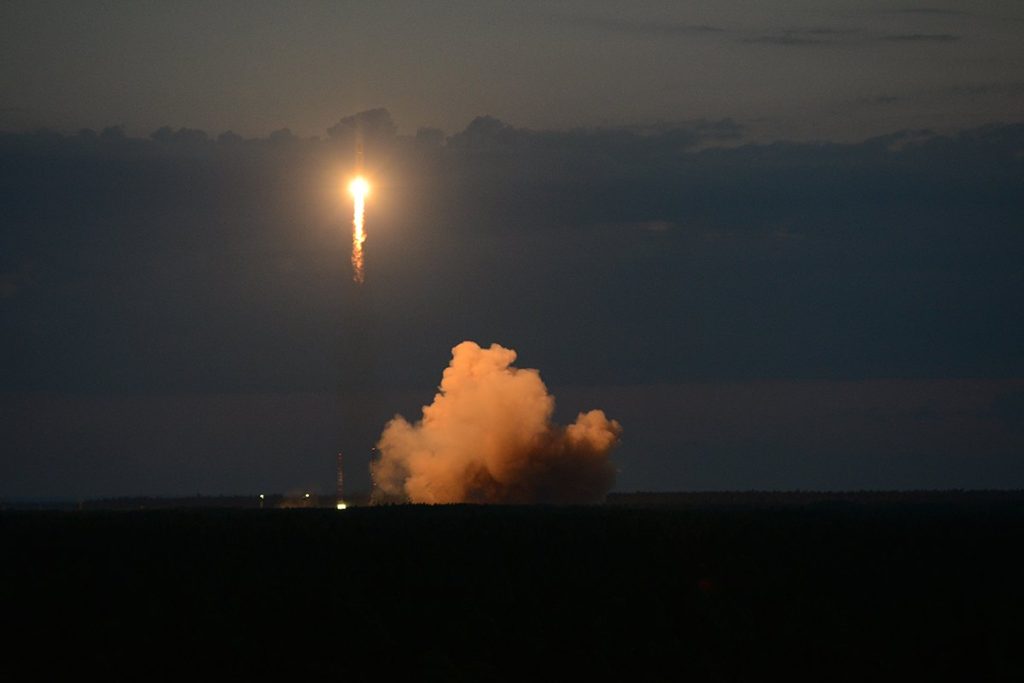
In 2002, only seven of Russia’s 24 GLONASS satellites were still in operation.
A global navigation satellite system, or GNSS, usually needs at least 24 satellites in medium Earth orbit about 12,550 miles high. The applications span five areas: location, navigation, tracking, mapping and timing. That first Russian constellation had been fully populated in 1996, but it collapsed in the years after the Soviet breakup.
The Soviet Union began developing GLONASS in 1976, three years after the United States started GPS. Russia restored full operational capability on December 8, 2011, once again with 24 satellites. The Russian Aerospace Defense Forces operate the system. A 2022 analysis in Eurasia Review called it an “unabashedly military system,” driven by the same precision-guided munitions requirement that shaped GPS.
The United States flew its first Navigation System with Timing and Ranging satellite in 1978, and the full 24-satellite GPS constellation reached operational capability in 1993. As of June 2021, 31 operational GPS satellites were in orbit. The newest block, GPS III/IIIF, launched in 2018.
For years the U.S. degraded public accuracy with Selective Availability, adding 50 meters of error horizontally and 100 meters vertically. President Bill Clinton ended that policy in May 2000. In 2007 the Department of Defense said future satellites would not include the feature.
Europe and China build their own
The European Commission and European Space Agency built Galileo to provide an independent civilian-run alternative. Galileo went live in 2016 with 26 satellites, aiming for a 30-satellite constellation. It offers a free open service and a restricted Public Regulated Service for military and emergency users. The EU has 28 partner nations, and security modules for the regulated service must be manufactured in the EU.
China decided to build BeiDou after the 1995-1996 Taiwan Strait Crisis, when a disruption in GPS left the People’s Liberation Army unable to track ballistic missiles fired over the strait. BeiDou-1 began serving China in 2000. BeiDou-2 reached the Asia-Pacific region in 2012. BeiDou-3, the third generation, started offering global services in 2018 and completed its preliminary system with the final satellite launch in June 2020.
Russia also pursued international adopters: Brazil signed military technology agreements in 2008, India received a high-precision signal agreement in 2010, Ukraine joined GLONASS development in 2010, and Belarus signed a sweeping agreement in 2013.
Receivers use several constellations at once
Garmin and many cellphone makers began supporting both GPS and GLONASS in 2011. That multi-GNSS chipset design became the standard for phones and car navigation systems, now also pulling in Galileo and BeiDou. Receivers benefit from more signals: faster fixes, better accuracy in difficult conditions, and resilience if one system degrades. Japan and India run regional systems, and the United Kingdom has planned its own constellation since leaving the EU.
Sources
- BeiDou: China's GPS Challenger Takes Its Place On World Stage – Analysis – Eurasia Review
- GNSS Explained: What Does It Stand For?




