
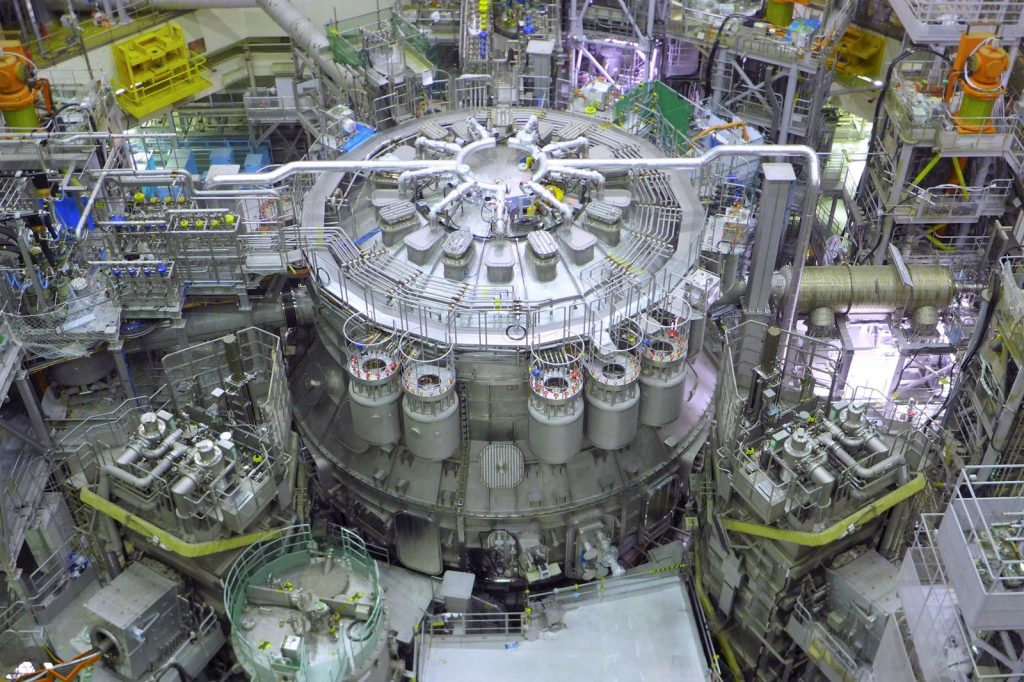
PARIS, July 25 — The sun’s engine is being reverse‑engineered in laboratories and private startups on both sides of the Atlantic, but the race to bottle a star has a complication that rarely makes the press releases: someone else is trying to steal the blueprints. Nuclear fusion — the process that powers the sun, fusing atomic nuclei to release energy without long‑lived radioactive waste or meltdown risk — is now a geopolitical prize. And the mechanics here are as much about intellectual property as they are about plasma physics.
Fusion works by forcing lightweight atomic nuclei together until they combine, releasing a burst of energy. Unlike fission reactors, which split heavy atoms and leave dangerous waste, fusion’s fuel — isotopes of hydrogen such as deuterium and tritium — is abundant, and the reaction itself produces no chain‑reaction runaway.
That clean‑energy promise has drawn billions in public and private investment. The international ITER project, under construction in Cadarache, France, is the flagship: it aims to demonstrate a sustained fusion reaction that puts out 500 MW of thermal power from 50 MW of input, with a target date of 2035. The UK’s JET facility, an older experiment, set a record in February 2022 by sustaining 69 megajoules of fusion energy using a deuterium‑tritium mix.
That was a proof‑of‑concept, not a power plant. On closer reading, the timelines are long and the engineering brutal.
The US Department of Energy’s National Ignition Facility (NIF) at Lawrence Livermore National Laboratory pulled off a different trick in December 2022: laser‑based inertial confinement fusion that achieved net energy gain — 3.15 megajoules out from 2.05 megajoules of laser energy in. That is a big laboratory milestone, but scaling it to a grid‑connected plant is a decade‑plus challenge. Meanwhile, private outfits like Commonwealth Fusion Systems (USA) and Tokamak Energy (UK) are pushing compact reactor designs, trying to shrink the timeline and the cost.
The catch: Russian hackers want the plans
The catch is that the same engineering data that makes fusion viable also makes it a target. The intellectual property sought by Russian hackers, according to the information available, covers superconductor magnets, plasma confinement geometries (both the doughnut‑shaped tokamak and the twisted stellarator), tritium breeding technologies, and high‑energy laser systems. Steal the magnet design or the confinement geometry, and a rival could leapfrog years of trial‑and‑error.
That is not just about energy; fusion has obvious military applications, particularly for powering naval vessels. A fusion‑powered warship could stay at sea indefinitely, with no need for refuelling.
The theft of fusion research, as the source material notes, could accelerate rival development or enable countermeasures. Follow the money, and the stakes become staggering. A 2022 report by the Fusion Industry Association projected the global fusion market could reach $948 billion by 2050.
That is a trillion‑dollar industry in the making, built on a technology that is still unproven at commercial scale. The strategic logic is clear: fusion offers a virtually limitless, clean baseline power source that reduces dependence on fossil fuels and the geopolitical leverage that comes with oil and gas reserves.
Nations that crack the code first hold a decisive advantage, not just in energy markets but in defence and industrial competitiveness.
What to watch next
The narrative around fusion has often been “always 30 years away.” That may be changing — the NIF net‑gain result and the JET record are genuine technical breakthroughs. But the security dimension is new. The ITER project remains the largest coordinated international effort, with a 2035 target, but its data and designs are shared among partners.
Private companies are more protective. The question now is whether the race to build a fusion reactor will be slowed by the race to protect the plans that make it possible.
For investors and policymakers, the signal is unmistakable: fusion is no longer just a physics problem; it is a security risk with a $948 billion payoff on the horizon.




