
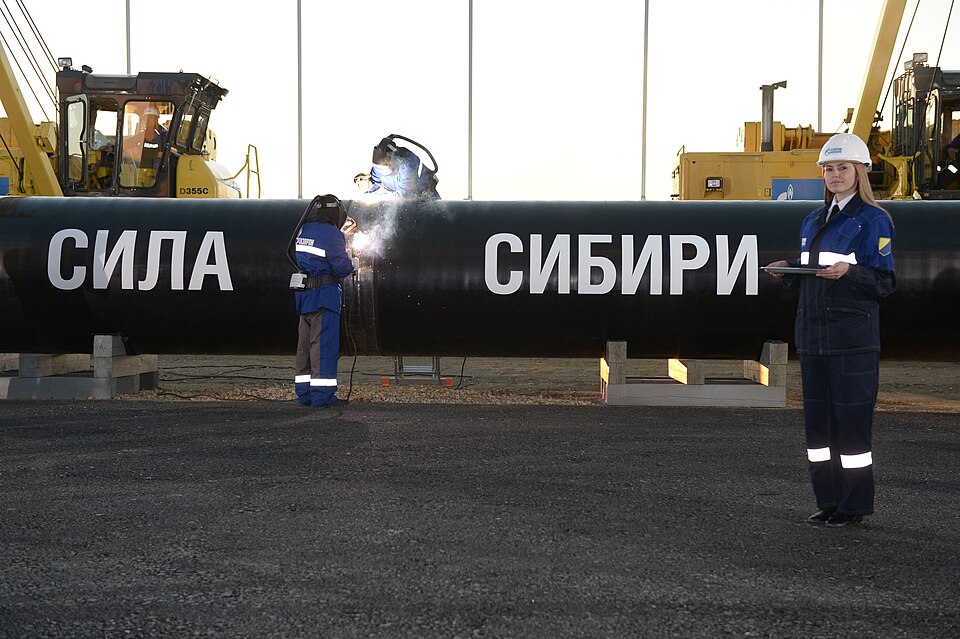
In 2021, more than 150 billion cubic metres of gas reached the European Union from Russia. In 2025 the figure was 36. That one comparison, taken from European Commission calculations published by the Council of the EU, shows how far the bloc has moved away from the supplier that once sat at the centre of its energy system.
Where the dependence began
The International Energy Agency set out the starting point in March 2022, days after Russia’s invasion of Ukraine. In 2021 the EU imported an average of over 380 million cubic metres a day by pipeline from Russia, around 140 billion cubic metres for the year. Another 15 billion cubic metres came as liquefied natural gas, or LNG. The total of 155 billion cubic metres made up around 45% of the EU’s gas imports and almost 40% of its total gas consumption.
The IEA’s 10-point plan argued that measures taken within a year could cut the call on Russian gas by more than 50 billion cubic metres, over one-third. Deeper cuts, it said, were possible, but at a cost. The faster policy makers moved, the greater the economic costs or the slower the near-term fall in emissions. The agency pointed to expiring contracts as an opening: Gazprom contracts covering more than 15 billion cubic metres a year were due to end by the close of 2022, about 12% of the company’s EU supplies in 2021.
What replaced it
The Council says Russia’s share of EU pipeline gas imports fell from around 40% in 2021 to around 6% in 2025. Counting pipeline gas and LNG together, Russia supplied around 12% of the EU’s gas that year. Its 36 billion cubic metres put it fourth in the 2025 supplier table, with a 12.5% share.
Norway led at 30.9%, or 89.3 billion cubic metres, which the Council describes as almost one third of all imports. The United States followed at 26.2%, or 75.6 billion cubic metres, up from 18.9 billion in 2021. North Africa supplied 12.7%. The United Kingdom, Azerbaijan and Qatar made up most of the rest.
LNG did much of the work. The EU imported over 140 billion cubic metres of it in 2025, according to Bruegel data cited by the Council, and the US supplied almost 58% of that. Imports from the US tripled between 2021 and 2025. Falling demand helped too: EU gas consumption dropped by over 19% between 2021 and 2024.
The legal end date
The shift is now being written into law. In January 2026 the Council adopted a regulation banning both LNG and pipeline gas from Russia starting 18 March 2026, with transition periods for existing contracts. By the end of 2027, all Russian gas imports will be prohibited.
The Council is blunt that this takes money and time. Diversification “requires investment in infrastructure”, it says, such as new pipelines and LNG terminals. Gas still matters at home: around 30% of EU households are heated with it.
Sources
- Where does the EU's gas come from? – Consilium
- A 10-Point Plan to Reduce the European Union’s Reliance on Russian Natural Gas – IEA




