
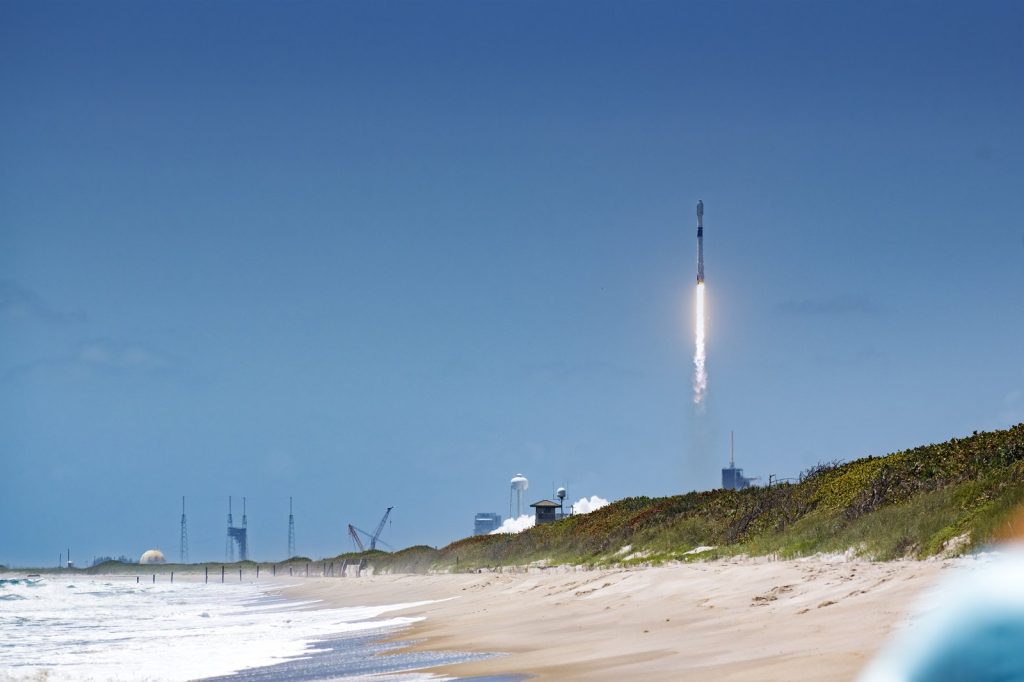
CAPE CANAVERAL, July 15 — The race to control the skies above us is no longer just about rockets. It is about internet signals, orbital parking spots, and a rivalry between two of the most valuable companies on Earth. SpaceX, founded by Elon Musk in 2002, and Amazon, founded by Jeff Bezos in 1994, are on a collision course in space.
Combined, these companies are worth roughly $4.5 trillion as of early 2025. Their conflict is playing out across multiple fronts: satellite constellations, launch vehicles, and government contracts.
Satellite showdown
The most visible battleground is broadband from space. SpaceX launched its Starlink constellation in 2019. By 2024, the company had placed over 4,000 satellites in orbit, aiming to deliver global internet coverage.
Amazon announced its own plan, Project Kuiper, also in 2019. That project calls for a constellation of 3,236 satellites, with initial launches expected in 2025.
Think of it like a limited number of parking spots in a crowded lot — except the lot is low Earth orbit, and the spots are specific radio frequencies and orbital slots. Both companies have filed complaints with the Federal Communications Commission (FCC) in 2021 and 2022 over who gets to use what. These filings are the bureaucratic equivalent of a territorial dispute, and they show how heated the competition has become.
Rockets and launch contracts
SpaceX has been developing its massive Starship rocket since 2016. Amazon, rather than building its own heavy-lift rocket, has taken a different approach. In 2022, the company signed a deal for up to 83 launches from three providers: Blue Origin (also founded by Bezos), United Launch Alliance, and Arianespace.
That is a staggering number of launches, and it signals Amazon’s intent to get its Kuiper satellites into orbit quickly. The practical upshot for ordinary readers is this: the competition is driving down launch costs and accelerating the timeline for global satellite internet.
But it also raises questions about space traffic management and who gets to set the rules.
Beyond satellites
The rivalry extends well beyond internet constellations. Amazon Web Services, the company’s cloud computing arm, competes with potential Starlink-based services that SpaceX could offer. Both companies are also chasing government contracts.
NASA awarded SpaceX contracts for its Human Landing System in both 2021 and 2023, a program aimed at returning astronauts to the Moon. This is not just a corporate feud.
It is a fundamental competition over the infrastructure of the 21st century — the networks, rockets, and orbital real estate that will underpin everything from global communications to space exploration. The FCC filings, the launch contracts, and the NASA awards are all pieces of a larger puzzle. What to watch next: the initial launches of Project Kuiper in 2025, and whether Amazon can match the pace SpaceX has set with Starlink.
The FCC will also continue to play referee on spectrum and orbital slots. For now, the sky is getting crowded, and the two richest companies in the world are jostling for position.
Sources
{“@context”: “https://schema.org”, “@type”: “NewsArticle”, “headline”: “SpaceX and Amazon, worth $4.5T, head for space collision”, “description”: “CAPE CANAVERAL, July 15 — The race to control the skies above us is no longer just about rockets. It is about internet signals, orbital…”, “datePublished”: “2026-07-15T09:30:00+00:00”, “author”: {“@type”: “Person”, “name”: “Erika Johnson”}, “publisher”: {“@type”: “Organization”, “name”: “InfoPulse Today”, “url”: “https://newsfeed.infopulsetoday.com/”}, “citation”: [{“@type”: “CreativeWork”, “url”: “https://en.wikipedia.org/wiki/SpaceX”}]}




