
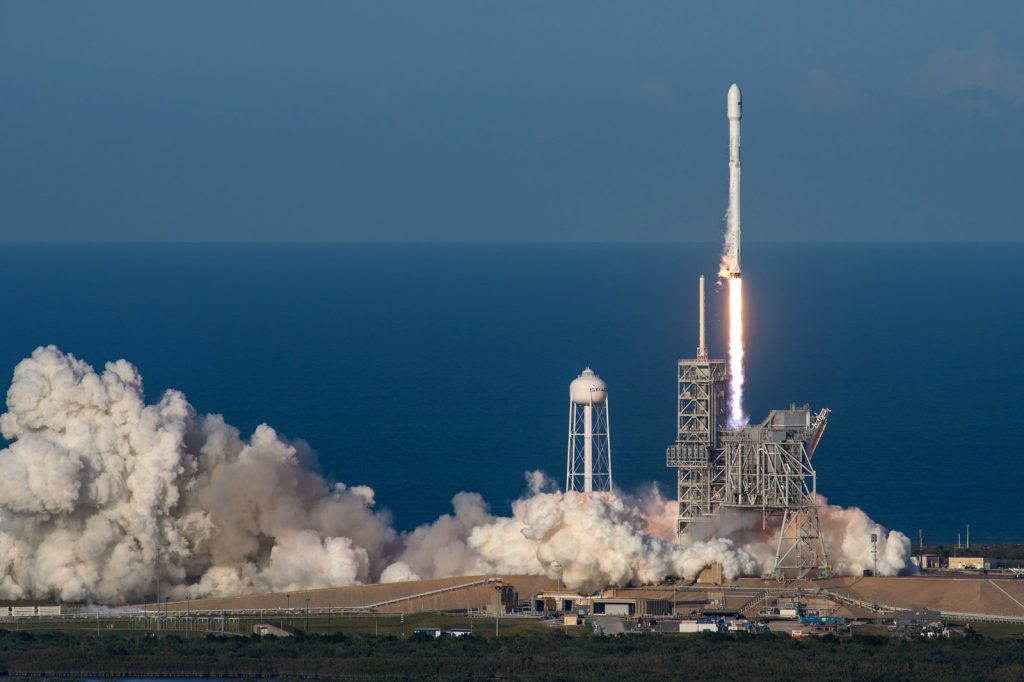
Here is the plainest way to picture the satellite internet business in mid-2026: one company owns most of the traffic. SpaceX’s Starlink runs roughly 10,400 satellites, more than 10,397 of them active, which works out to about 75 percent of every maneuverable satellite now circling the planet. For contrast, at the end of 2018 the entire world had just 1,957 active satellites in orbit.
The commercial numbers match the orbital ones. Citing Barron’s, Vision Times reported that the network serves more than 12 million paying subscribers across more than 160 countries and territories, with typical speeds landing between 100 and 200 Mbps in many regions, often beating fixed broadband in rural spots and across much of Sub-Saharan Africa.
How the Lead Was Built
The advantage was not sudden. Rewind to July 2022, when SpaceX logged its 50th Starlink launch and the constellation counted a little over 2,600 satellites, with about 2,300 working. Service then reached 32 countries. After a polar-orbit launch that month, Elon Musk told followers that “These polar launches will enable complete coverage of Earth (where approved by local government)”. Even then, speed analysts at Ookla rated Starlink the fastest satellite internet in the world, and an estimated 150,000 people a day were connecting through it free in wartime Ukraine.
The factory pace has kept up. A GeekWire tally put production at roughly 70 satellites a week at SpaceX’s Redmond facility. Next in line are the Gen3 satellites, each one rated for downlink capacity above a terabit per second, launched aboard Starship. SpaceX has talked about reaching 25 million subscribers before 2027 arrives, and a single Starship load could pour as much as 60 terabits per second into the network.
The Challengers Queuing Behind
Amazon’s constellation, since renamed Amazon Leo after beginning life as Project Kuiper, has more than 330 satellites up and thousands still to fly, backed by a landmark deal that reserved 84 launches when the plan was young. China is the bigger story: state-backed projects there could total more than 50,000 satellites. The Guowang network plans around 13,000, with roughly 190 aloft by mid-2026 and about 310 launches targeted this year, while Qianfan aims for roughly 15,000, some 200 already orbiting and a first phase of 1,296. Blue Origin has sketched a TeraWave constellation of 5,400 or more satellites for 2027 onward, and Canada’s Telesat Lightspeed plans a compact 198, with pathfinder craft due late this year and service in 2027 or 2028.
The Problem Piling Up Underneath
Every one of those launches adds to a hazard scientists named long ago. In 1978, NASA researcher Donald J. Kessler and co-author Burton J. Cour-Palais published “Collision Frequency of Artificial Satellites: The Creation of a Debris Belt” , a paper written when only about 300 active satellites were flying, warning that collisions could multiply into a self-sustaining cascade. That scenario is now called Kessler Syndrome.
The rules have tightened in response. Inter-agency guidelines long pushed operators to deorbit satellites within 25 years, a standard United States regulators have cut to 5 years for new craft. SpaceX itself is easing about 4,400 satellites down from roughly 550 kilometers to around 480, a move that shortens an uncontrolled descent from years to months and is being coordinated with other operators and U.S. Space Command, as Space News reported. Cleanup hardware is coming too: the European Space Agency’s ClearSpace-1 craft, slated for the late 2020s, is designed to grab a derelict part and haul it into the atmosphere, while Astroscale tests rendezvous and magnetic capture.
Musk, for his part, has floated constellations of up to a million satellites hosting orbital data centers for artificial intelligence. In plain terms, the race is no longer about whether space-based internet works. It is about who shares it, and whether the orbit above us can absorb the traffic.
Sources
- SpaceX Starlink pursues 'complete coverage' with polar orbit launch
- The Satellite Internet Revolution: Starlink Leads, Competitors Follow, But Space Junk Looms Larger – Vision Times




