
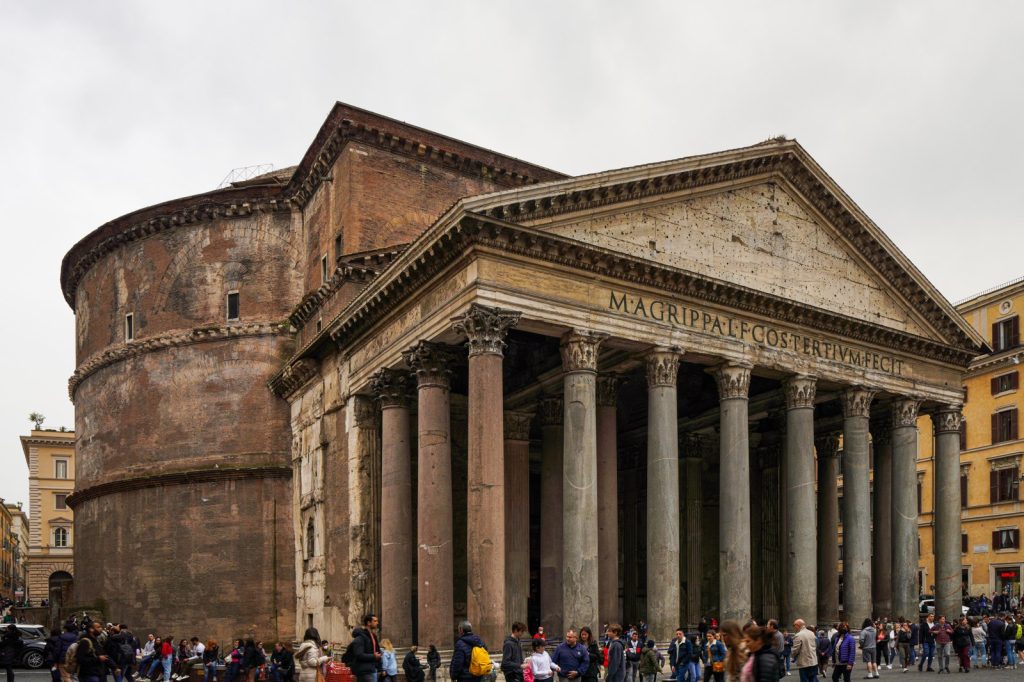
Roman harbour walls have spent 2,000 years getting hammered by waves, and many are still standing. Modern concrete often erodes within decades. A team led by geologist Marie Jackson of the University of Utah has now mapped why.
The finding is odd. Roman marine concrete is not only more durable than what engineers pour today. It gets stronger over time.
What the Romans mixed
Modern concrete is built on portland cement, made by heating silica sand, limestone, clay, chalk and other ingredients to very high temperatures. The resulting paste binds aggregate, which means chunks of rock and sand. That aggregate has to be inert. Any unwanted chemical reaction can crack the concrete, and the cracks lead to erosion and crumbling. It is why concrete does not last like natural rock.
The Romans used volcanic ash, lime and seawater. They may have copied a reaction they saw in tuff, a naturally cemented volcanic ash deposit. Volcanic rock went in as aggregate too, and it kept reacting with the mortar over time.
Inside the samples
In earlier work, Jackson’s team collected samples of Roman marine concrete from several ports along the Italian coast. This time they scanned them under an electron microscope, then went finer with X-ray microdiffraction and Raman spectroscopy. That let them identify the mineral grains that had formed in the concrete over centuries.
“We can go into the tiny natural laboratories in the concrete, map the minerals that are present, the succession of the crystals that occur, and their crystallographic properties,” Jackson said. “It’s been astounding what we’ve been able to find.”
One mineral stood out: aluminous tobermorite, a hardy silica-based mineral that is rare and hard to make in a lab but plentiful in the ancient concrete. Another, phillipsite, grew alongside it. Both form because seawater moving through the concrete slowly dissolves the volcanic ash and leaves room for interlocking crystals to build a reinforced structure. “The Romans created a rock-like concrete that thrives in open chemical exchange with seawater,” Jackson said.
Modern concrete does the opposite. Saltwater rusts its steel reinforcements and washes out the compounds that hold it together.
Why we can’t just copy it
Piers and tidal lagoons built for wave energy would benefit most. But the recipes are lost, so the only route is to reverse-engineer them from the chemistry. And the right ingredients are not everywhere. “Romans were fortunate in the type of rock they had to work with,” Jackson said. “We don’t have those rocks in a lot of the world, so there would have to be substitutions made.”
If the recipe can be cracked, marine engineers could get a material that needs no steel reinforcement, can last for centuries and produces fewer carbon emissions. The study was published in American Mineralogist.




