
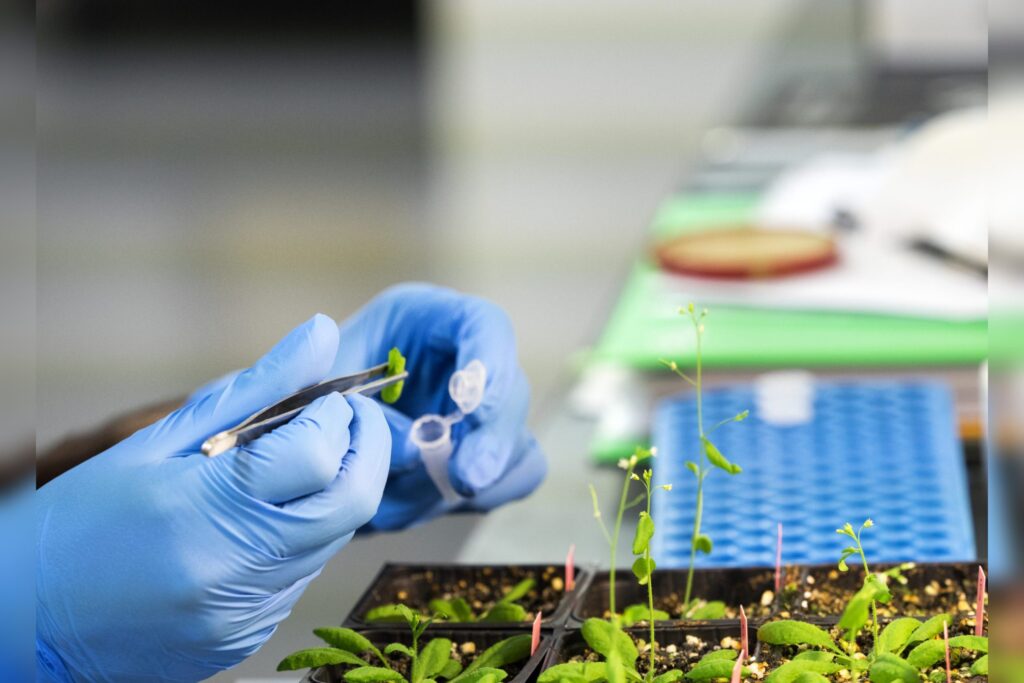
A lettuce plant can now make a protein normally found in pig muscle. Don’t expect meaty salad any time soon, though.
Researchers engineered lettuce and tobacco chloroplasts to produce myoglobin, the iron-binding protein that helps give meat its red colour, flavour and nutritional iron. The two plants were chosen because they have some of the most thoroughly studied genomes. The team came from Imperial College London, the Bezos Centre for Sustainable Protein, Kyomei and collaborating institutions.
Why chloroplasts
The method is called plant molecular farming. Genetic instructions go into a plant so its cells manufacture a useful protein, and the approach has been used for roughly four decades for medicines, vaccines and industrial products.
The team aimed at chloroplasts, the structures best known for photosynthesis. Chloroplasts carry their own genomes because they evolved from free-living bacteria, and one plant cell holds many of them, each with multiple copies of that DNA. That gives researchers plenty of templates to build a protein from.
It worked. Tobacco produced the most, lettuce somewhat less, and both far outperformed engineered algae. In tobacco, placing the gene in the chloroplast gave at least three times more myoglobin than placing it in the nucleus.
Small amounts, unfinished protein
More does not yet mean a lot. A kilogram of fresh engineered lettuce held only about 48 milligrams of myoglobin, and tobacco about twice that. Once water content was accounted for, the two performed about the same. Beef muscle holds roughly 10 times more myoglobin by dry weight.
Much of what the plants made also lacked heme, the iron-containing molecule that gives myoglobin its useful properties. The plants can build the protein. The final assembly still needs work.
The study did not work out whether growing and extracting the protein from plants would end up cheaper or more sustainable than making it in microbes or getting it from animals. The researchers say that needs its own economic analysis.
What the study did show is that a plant can be programmed to make an animal muscle protein, pass the ability to its offspring and still grow well enough to flower and set seed. The quantities are small, but plants can be grown over large areas on sunlight, while livestock need feed, land and other inputs before they produce muscle. Some meat alternatives already use leghemoglobin, a related protein from legume root nodules, made in engineered yeast.
Co-author Kyoko Morimoto, chief scientific officer at Kyomei, said: “We hope that edible lettuce, modified to express myoglobin, could also one day serve as a heme-iron-enriched biofortified food, depending on legislative approval.” Rodrigo Ledesma-Amaro, director of the Bezos Centre, said stable production in chloroplasts, including in an edible crop, “raises the possibility of using plants as scalable, low-input production platforms alongside microbial fermentation.”




