
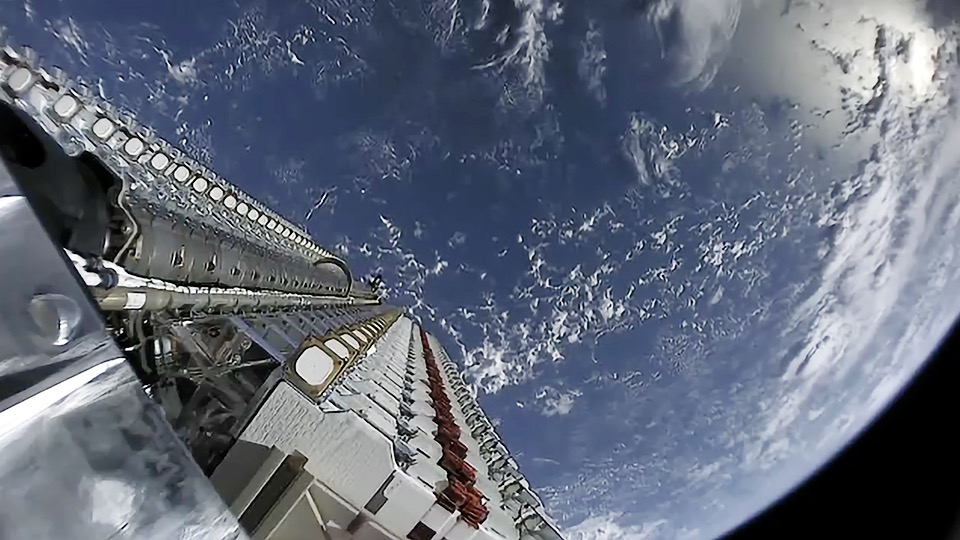
Satellites and orbital debris could make a major sky survey 7.5% less efficient and add US$21.8 million to its cost. That is the estimate from a team of researchers who published their calculations in Nature Astronomy in 2023.
The survey in question is the large-scale mapping of the night sky planned at the Vera Rubin Observatory, due to start in 2024. The team calculated what reflected sunlight from objects in low-Earth orbit would do to it. By 2030, they found, that light will likely raise the diffuse background brightness by at least 7.5% compared with an unpolluted sky. Over the survey’s ten-year life, the lost efficiency would add roughly US$21.8 million to the total project cost.
The researchers say theirs are the first published calculations of the combined effect of satellites and debris in low-Earth orbit on major ground-based observatories.
Streaks, and a haze you cannot see
Satellites interfere with astronomy in two ways. The familiar one is the moving point of light that shows up as a streak across an image. The second is subtler. Satellites too dim or small to see one by one, along with small bits of debris, still reflect sunlight. Together they make the sky less dark.
The numbers are climbing fast. Since 2019, the count of working satellites has more than doubled to about 7,600, driven mostly by SpaceX and other companies launching big groups of satellites to provide high-speed internet. The team estimates there may be 100,000 in orbit by the end of the decade. More satellites also raise the odds of collisions, which create more debris. Deliberate destruction of satellites in space warfare tests adds to it.
What a brighter sky costs
A brighter background forces telescopes to expose for longer to catch distant objects. On a project with a fixed amount of observing time, that means less science gets done, and astronomers compete harder for telescope access. Detection limits also get worse, so dimmer objects may go unseen.
Timing matters too. Some events are rare, and a survey may not get a second look if it misses one. Near-Earth objects, the comets and asteroids on orbits close to Earth, are among the faint targets at risk. A brighter sky makes it more likely that potentially hazardous ones go undetected.
Ordinary stargazers are affected as well. The human eye cannot pick out small objects the way a telescope can, so the haze looks brighter to the unaided eye than the instruments would suggest. Fainter stars and the Milky Way will be harder to see. Ground-based light pollution is worst near cities, but this change will be visible from essentially everywhere on Earth.
The authors call their models a conservative lower limit. If satellite and debris numbers keep growing as expected, the effect will be larger. In the paper they wrote that “we are witnessing a dramatic, fundamental, and perhaps semi-permanent transformation of the night sky without historical precedent and with limited oversight.”




