
DENVER, July 7 — The high frontier is leaving a chemical fingerprint in the sky. A layer of the atmosphere that most people never think about, the mesosphere, is becoming a dumping ground for the remains of thousands of satellites. This region, stretching between 50 and 85 kilometers above the Earth, is where spacecraft go to die.
When satellites reenter the atmosphere, they burn up. And according to a 2024 study in the journal Geophysical Research Letters, that incineration is releasing a specific pollutant: aluminum oxide nanoparticles.
Each satellite reentry, researchers from the University of Southern California and the University of Colorado Boulder calculated, releases roughly 30 kilograms — about 66 pounds — of these particles. The numbers are stark. The study projects that by 2030, assuming full deployment of the Starlink constellation — a network of 42,000 satellites — aluminum oxide concentrations in the mesosphere could spike 640 percent above natural levels.
How satellite ash threatens the ozone layer
These aluminum oxide particles are not inert. They act as nucleation sites for polar stratospheric clouds. That is a technical way of saying they provide a surface for chemical reactions that destroy ozone.
The mechanism involves chlorine activation — a process that eats away at the protective layer that shields life on Earth from harmful ultraviolet radiation. The ozone layer has been on a slow road to recovery since the Montreal Protocol was signed in 1987, a landmark international treaty that banned the production of ozone-depleting substances.
That recovery is now facing a new, man-made obstacle from above. The aluminum oxide from satellite reentries could slow or even reverse that progress, according to the study. This is not a theoretical future threat.
A 2023 paper in the journal Science Advances reported that metallic aerosols from satellite reentries have already been detected in the stratosphere. NASA’s WB-57 aircraft, a high-altitude research plane, collected samples that showed these particles are already present.
Monitoring the invisible fallout
The National Oceanic and Atmospheric Administration is tracking changes in atmospheric composition. The long-term effects on both climate and human health remain under active study. Scientists are still working to understand what a 640 percent increase in aluminum oxide means for the planet.
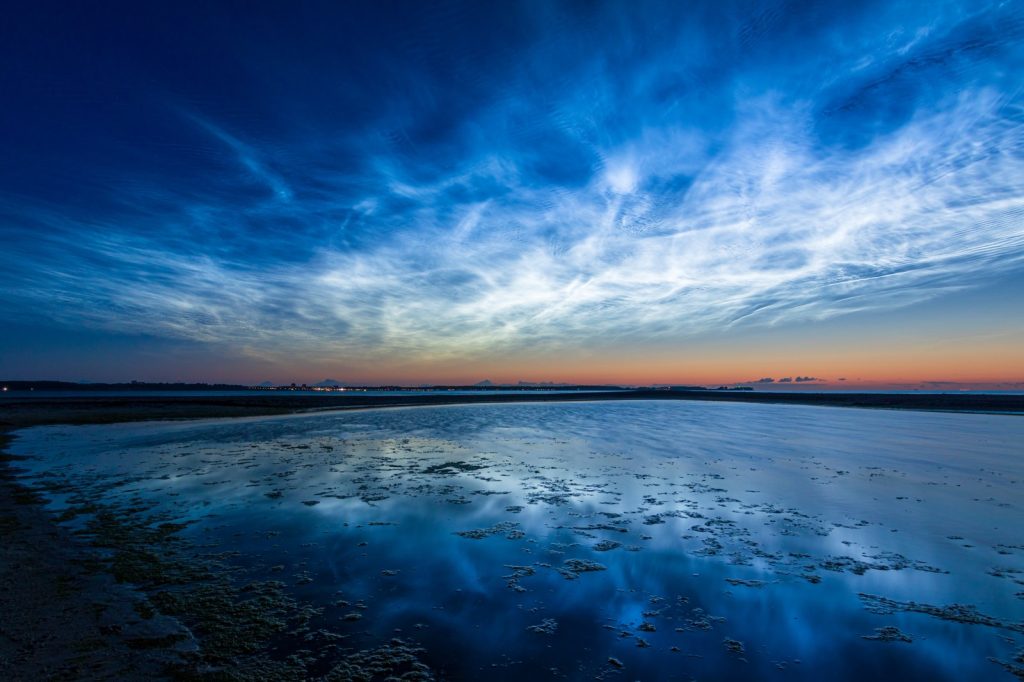
On the ground, residents of cities from Denver to Washington have no way of seeing this. The mesosphere is invisible, a silent zone of the atmosphere where noctilucent clouds sometimes glow at twilight.
By nightfall, the sky looks the same as it always has. But the chemistry is changing. The scale of the change is tied directly to the rapid expansion of satellite megaconstellations.
The Starlink network alone, operated by SpaceX, is projected to reach 42,000 satellites. Each one will eventually fall back to Earth, each one releasing its payload of aluminum nanoparticles into the upper atmosphere.
For now, the recovery of the ozone layer — one of the great environmental success stories of the 20th century — hangs in the balance. The particles are already there, confirmed by NASA’s own sampling. What happens next depends on how fast the constellations grow, and how fast the chemistry unfolds in the thin air 50 kilometers up.




