
A 100-gram cylinder of aluminum alloy 7075 sat in a glowing plasma stream in Stuttgart. After about 6.5 minutes, with the temperature up to 600 °C, it came apart in large molten drops. IEEE Spectrum watched the test, one of a series in which German researchers are trying to learn what dying satellites leave behind in the sky.
Alloy 7075 is a material often used for satellite bodies. It contains traces of zinc, chromium and magnesium. “This is the closest you can get to replicating what happens to a solid chunk of aluminum in the atmosphere,” said Fabian Hufgard, a Ph.D. researcher at the Institute of Space Systems at the University of Stuttgart.
Why the ash matters
Three or more large satellites or spent rocket stages burn up in the atmosphere every day, according to the European Space Agency’s Space Environment Report published last year. Each year, hundreds of tons of human-made objects reenter and evaporate, leaving clouds of microscopic ash and the occasional fragment that reaches the ground. The researchers say the amounts are still relatively low.
The trend worries them. The ESA counts some 18,000 operational and defunct satellites in orbit as of June. SpaceX and Blue Origin have ambitions to launch hundreds of thousands of satellites in the next decade, including giant orbiting data centers, and China is targeting up to 140 launches this year. Because most satellites are designed to be replaced every five years, tens of thousands of tonnes of old spacecraft could eventually vaporize overhead.
Space rock still outweighs space junk. An estimated 44 tonnes of it enters the atmosphere per day. But it is mostly silicon with small amounts of nickel and iron, while satellites are predominantly aluminum and titanium.
“When a satellite demises, it does not disappear,” Hufgard said. “It’s still there in the atmosphere in the form of small particles of aluminum, and we don’t know what these particles actually do in the atmosphere.”
Atmospheric researchers fear that the aluminum forms aluminum oxide, also called alumina, which is known to trigger ozone depletion and reflect sunlight. That could alter the thermal balance of the upper atmosphere. Most of the destruction happens between 60 and 80 kilometers up, too high for balloons and planes and too low for satellites to sample. “We don’t normally inject anything into that area of the atmosphere,” said Dominic Künstler, a doctoral student in the group. The upper atmosphere is “much more isolated” than the lower altitudes where air travel emissions are released.
Burning pieces in a tunnel
No plasma wind tunnel is big enough to melt a whole satellite, so the team tests single components and standard materials. Real reentries come at about 8 km/s, with friction heating that can exceed 1,600 °C. Holding that speed long enough to melt fragments is impossible in a tunnel, so the group runs flows of up to 3 km/s and adds heat from an electric arc between a tungsten cathode and a copper anode.
“We can go up to 6 megawatts of electrical power,” said Clemens Müller, another Stuttgart doctoral researcher. The plasma can reach 5,000 to 8,000 °C, so water is pumped through the tunnel walls to stop the parts from melting at once.
The test has limits. Drops of aluminum fall onto a water-cooled bed and cool. In a real descent, the molten metal would keep flying and reacting with the air until only gas and metallic dust remained. Künstler said the team is working on ways to simulate those later stages, using powdered aluminum alloys suspended in the plasma to match emission spectra seen in airborne observations, which showed atomic aluminum and aluminum monoxide.
The results so far do not settle the question. Some models show ozone-depleting aluminum oxide forming in large quantities, while others suggest the possibly less harmful aluminum hydroxide would form instead. “It would be very important to find out which types of particles arise from the aluminum,” Künstler said. “This is only the first step.”
Pieces that survive
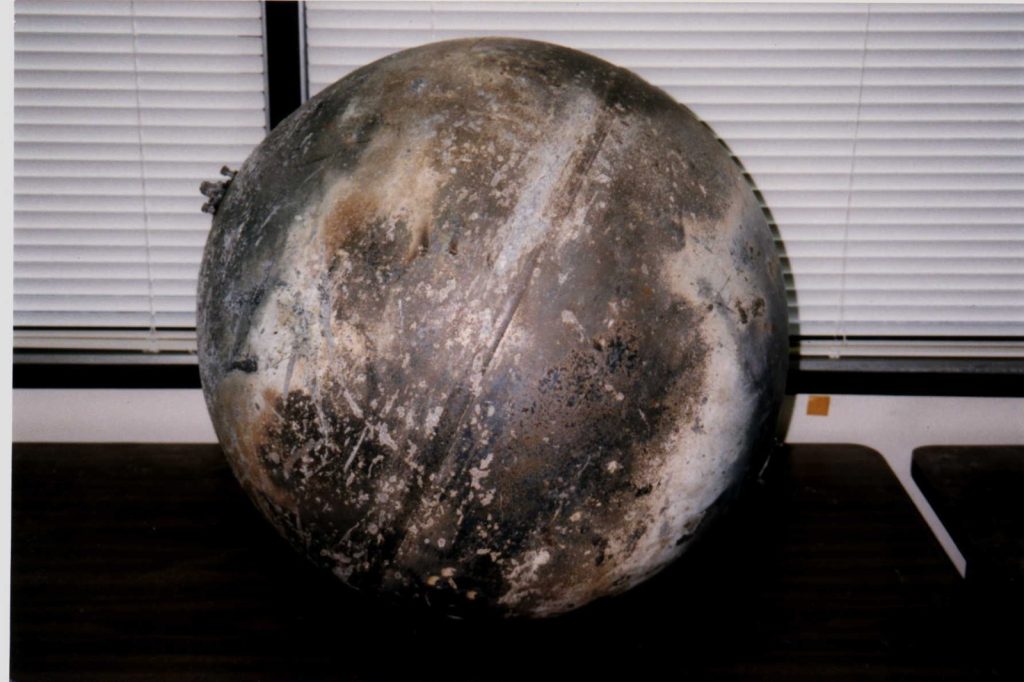
Surviving fragments are a second concern. Tanks and reaction wheels are often made of durable metals such as titanium, which unlike aluminum are unlikely to melt completely. SpaceX says its Starlink satellites burn up entirely, a claim some researchers question.
In March 2024, a piece of a battery pallet jettisoned from the International Space Station pierced the roof of a house in Florida. NASA had said the pallet, made of a nickel-based alloy called Inconel, would burn up completely. Müller said the Stuttgart team later put a similar Inconel cylinder through a reentry simulation. “We applied a very, very high heat flux on it, and it was almost impossible to melt.”
In Europe, a satellite launch requires proof that the chance of a piece surviving reentry is no more than one in 10,000, Müller said. “But obviously, if you have 10,000 satellites, then you would have a very high probability that one of them survives. So the rules need to be stricter.”




