
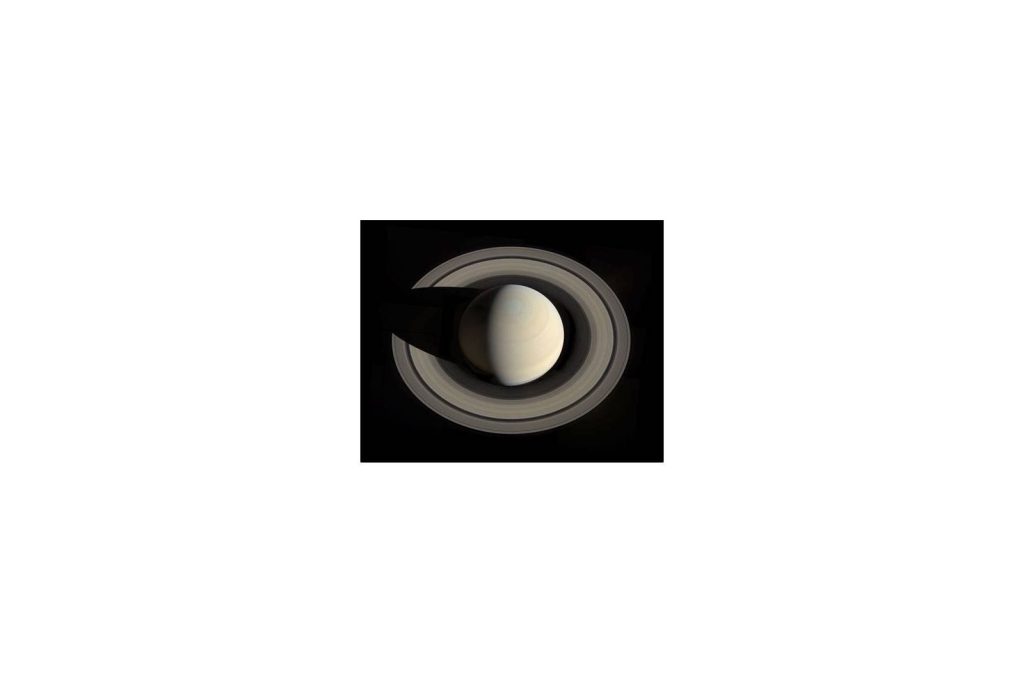
Four hundred metres per second. That is how hard the wind blows on Saturn. Always west to east. Earth’s strongest hurricanes top out at one hundred metres per second and they spin every which way. Saturn’s jet stream does not.
Liming Li, associate professor of physics at the University of Houston, calls it a long-term mystery. A three-year NASA grant worth five hundred twenty-three thousand one hundred ninety dollars will fund his team to dig into thirteen years of Cassini data. The spacecraft orbited Saturn from two thousand four to twenty seventeen. One Saturn year lasts thirty Earth years. Cassini caught barely half a season but enough to see wind speeds shift.
Three instruments. A visible camera. An infrared spectrometer. A combined visible-infrared spectrometer. The first pair offers higher resolution. The third gives simultaneous visible and infrared data. Li’s team will combine all three to measure wind speeds at different cloud levels. Temperature data will cross-check the measurements.
Saturn has three cloud layers. Infrared sees deeper. Visible sees the tops. By tracking cloud positions and movement rates Li calculates wind directions. This yields patterns: hurricanes, vortices, how speeds vary over time. Infrared data also infers temperature. Hot air rises. Temperature and motion link. Know the temperature, calculate the wind.
The Cassini mission launched in nineteen ninety-seven. Reached Saturn in two thousand four. Thirteen years in orbit. The Grand Finale dives in twenty seventeen revealed zonal winds extending down thousands of kilometres into the interior. Seven thousand to nine thousand kilometres deep. This shapes Saturn’s gravity field.
Cassini keeps giving. New analyses show Enceladus ejects fresh ice grains rich in organics. Aliphatic and aromatic compounds. Esters. Ethers. Tentative nitrogen and oxygen species. Phosphates in the plume ocean. All six CHNOPS elements confirmed. The moon meets nearly every criterion for a habitable world. Liquid water. Energy. Organic building blocks. Future missions from ESA and China’s Deep Space Exploration Laboratory are conceived.
Sources
- NASA Grant Funds Research on Saturn’s Strong Winds
- Cassini data reveals new information on Enceladus’ ice grain composition — AskAstrobio




