
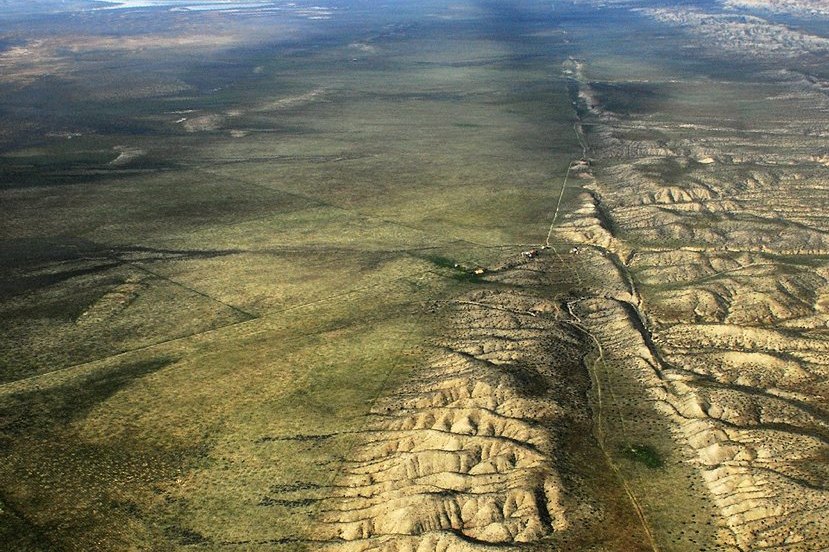
Cajon Pass carries highways, rail lines and energy infrastructure northeast of Los Angeles. It also sits where the San Andreas and San Jacinto faults come close together. A new modeling study says stress on both faults is now at or beyond the highest levels in a 1,000-year simulation, and that the junction may be primed for a rupture that crosses both.
The study stops short of forecasting an earthquake. “The study is not a prediction of when an earthquake will occur,” said lead author Liliane Burkhard of the University of Bern’s Physics Institute. “What we can say is that the system is critically stressed.”
A thousand years in a simulation
An international team built a physics-based, four-dimensional earthquake cycle model of the southern San Andreas and San Jacinto systems. It tracks three dimensions of space plus time. The team fed it a 1,000-year record of past quakes drawn from radiocarbon dating, odd patterns in tree rings, and historical accounts of ruptures that broke the surface. Scientists from the University of Hawaiʻi at Mānoa, the U.S. Geological Survey in Pasadena and Scripps Institution of Oceanography took part. The paper appears in the Journal of Geophysical Research: Solid Earth.
The model follows how each quake changes stress on neighboring segments, how stress builds in quiet intervals, and how deeper crust relaxes after big ruptures. By its numbers, stress on the San Jacinto-Bernardino section stands at 3.6 megapascals, higher than any value reached elsewhere in the simulation. The nearby Mojave South section of the San Andreas has reached 2.8.
Why the pass is called a gate
The researchers describe Cajon Pass as an “earthquake gate.” It is not a simple wall. Depending on stress across the surrounding faults, it can stop a rupture or let one run from one system into the other. History shows both. The 1857 Fort Tejon earthquake, magnitude 7.9, halted at the pass. The 1812 Wrightwood earthquake ran straight through and broke both systems in a single event.
The balance between the two faults matters as much as the raw numbers. If both are highly stressed together, a through-going rupture becomes more plausible. If their stress peaks at different times, a quake is more likely to stop at the junction. Right now both segments carry high, similar loads, a pattern the researchers say resembles the model’s state before past ruptures that crossed both systems.
The wider Los Angeles region has not seen a comparable major quake since 1857. A joint rupture could affect greater Los Angeles, San Bernardino, Riverside and the Coachella Valley, along with the pass corridor itself. Burkhard said the results give planners a clearer view of the scenarios to prepare for in hazard assessment, infrastructure planning and emergency preparedness, and that the framework could be applied to complex fault junctions elsewhere.




